
As the accounting year-end approaches, businesses enter one of the most important periods in the financial calendar.
For sole traders, limited companies, small businesses, and growing enterprises in the UK, year-end accounting is not just about closing books. It is about meeting statutory deadlines, preparing accurate financial records, reviewing business performance, and setting a stronger foundation for the next financial year.
However, the year-end process can often feel overwhelming.
Bank reconciliations, outstanding invoices, supplier bills, inventory checks, fixed asset reviews, payroll records, expense classification, adjustment entries, tax planning, and document backups all need proper attention.
The good news is that year-end accounting can be made smoother with the right checklist, accounting tools, documentation discipline, and professional support.
This article explains 10 practical steps UK businesses can follow to close their financial year-end with better accuracy, control, and confidence.
What Is Year-End Accounting?
Year-end accounting is the process of reviewing, adjusting, reconciling, and finalising a business’s financial records at the end of its accounting year.
For UK limited companies, year-end accounting is important for preparing statutory accounts for Companies House and Corporation Tax-related reporting to HMRC.
However, year-end accounting is not only a compliance requirement. It is also a valuable opportunity to assess the financial health of the business.
A proper year-end process helps businesses understand:
- Revenue performance
- Profitability
- Cash flow position
- Outstanding receivables
- Supplier liabilities
- Expense trends
- Tax exposure
- Asset position
- Business risks
- Planning opportunities for the next year
Without a structured year-end process, businesses may face errors, missed deductions, poor reporting, compliance penalties, and unnecessary stress.
Why Year-End Accounting Is Important for UK Businesses
Year-end accounting is important because it helps businesses stay compliant, organised, and financially prepared.
Key reasons include:
1. Legal Compliance
Businesses need to submit required financial records and statutory accounts on time to avoid penalties and compliance issues.
2. Tax Efficiency
Proper year-end review can help identify legitimate tax planning opportunities, allowable expenses, capital allowances, and timing adjustments.
3. Business Clarity
Year-end reporting allows business owners to understand what worked well, where costs increased, and what needs improvement.
4. HMRC Readiness
Clean records, audit trails, reconciliations, and supporting documents help businesses stay prepared for HMRC queries or reviews.
5. Next-Year Planning
A well-organised year-end close helps businesses begin the new financial year with updated records, clear goals, and better financial discipline.
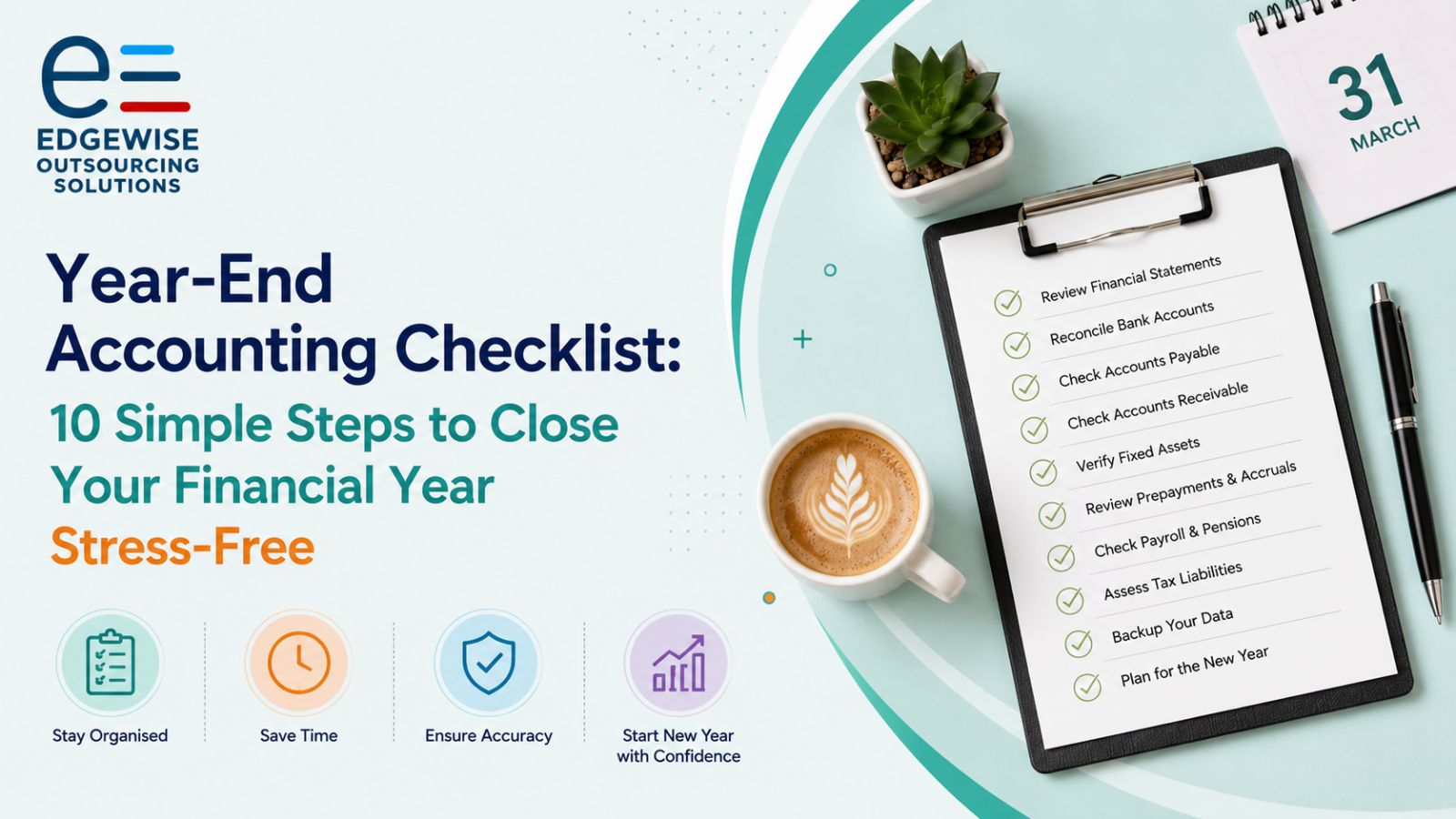
- 10 Stress-Free Steps to Close Your Financial Year-End
- Step 1: Reconcile Bank Accounts and Credit Cards
The first step in year-end accounting is to reconcile all bank accounts and credit cards.
This means comparing bank and card statements with transactions recorded in the accounting system.
Businesses should check for:
- Missing transactions
- Duplicate entries
- Incorrect postings
- Unreconciled bank items
- Bank charges
- Interest entries
- Direct debits and standing orders
- Card payments
- Transfers between accounts
Accurate bank reconciliation is essential because financial statements rely on correct cash and bank balances.
For better control, businesses should reconcile accounts monthly instead of waiting until year-end.
Step 2: Review Accounts Receivable and Accounts Payable
Unpaid customer invoices and outstanding supplier bills must be reviewed before finalising year-end accounts.
For accounts receivable, businesses should check:
- Overdue invoices
- Doubtful debts
- Customer disputes
- Unallocated receipts
- Incorrect balances
- Invoices requiring follow-up
For accounts payable, businesses should check:
- Unrecorded supplier invoices
- Bills relating to the year-end period
- Accrued expenses
- Duplicate supplier entries
- Supplier statement differences
- Pending payment obligations
Aged debtor and creditor reports are useful for understanding cash flow, working capital, and financial health.
Step 3: Conduct an Inventory Review
For businesses dealing in goods, inventory review is an important year-end task.
A physical stock count should be conducted as close as possible to the year-end date.
Businesses should compare actual stock with accounting records and identify:
- Damaged stock
- Obsolete stock
- Slow-moving inventory
- Missing stock
- Valuation differences
- Stock write-down requirements
Inventory directly affects cost of goods sold and reported profit. Therefore, proper valuation and documentation are important.
Businesses should also follow a consistent inventory valuation method such as FIFO or weighted average, depending on their accounting policy.
Step 4: Review Fixed Assets and Depreciation
Year-end is the right time to review the fixed asset register.
Businesses should check whether all assets purchased during the year have been recorded properly.
This may include:
- Office equipment
- Computers and laptops
- Machinery
- Vehicles
- Furniture
- Fixtures
- IT infrastructure
- Leasehold improvements
Businesses should also review:
- Depreciation calculations
- Asset disposals
- Capitalisation of major purchases
- Repairs wrongly classified as assets
- Assets no longer in use
- Capital allowance claims
For UK businesses, fixed asset review can also support tax planning through Annual Investment Allowance, full expensing, or other applicable capital allowance treatment.
Step 5: Finalise Payroll and Employee Records
Payroll records must be reviewed before the year-end close.
Businesses should ensure that employee records, salary payments, bonuses, deductions, pension contributions, PAYE, National Insurance, and other payroll-related entries are accurate.
Important checks include:
- Payroll journals posted correctly
- PAYE and NIC balances reconciled
- Pension contributions recorded
- Bonuses and commissions accounted for
- Holiday pay and employee benefits reviewed
- RTI submissions checked
- P60 and P11D-related information reviewed, where applicable
Payroll errors can create compliance issues, so year-end payroll review should be handled carefully.
Step 6: Categorise and Review Business Expenses
Business expenses must be reviewed and categorised correctly.
Incorrect classification can affect profitability, tax computation, and financial reporting.
Businesses should review expense categories such as:
- Travel
- Staff welfare
- Client entertainment
- Professional fees
- Software subscriptions
- Telephone and internet
- Office expenses
- Repairs and maintenance
- Training costs
- Home office expenses
- Insurance
- Rent and utilities
The objective is to ensure that expenses are recorded accurately and supported by proper documents.
Businesses should also identify allowable and non-allowable expenses for tax purposes.
Step 7: Post Year-End Adjustments
Year-end adjustments ensure that financial statements reflect the true financial position of the business.
Common adjustment entries may include:
- Accruals
- Prepayments
- Depreciation
- Bad debt provisions
- Stock adjustments
- Payroll liabilities
- Deferred income
- Corporation Tax provision
- Director loan account adjustments
- Error corrections
- Expense reclassifications
Each adjustment should be supported by proper working papers and documentation.
If accounts are prepared under applicable UK reporting frameworks, the disclosures and supporting schedules should also be reviewed carefully.
Step 8: Prepare Financial Statements
Once reconciliations and adjustments are complete, businesses should prepare financial statements.
These generally include:
- Profit and loss statement
- Balance sheet
- Cash flow statement
- Notes and schedules
- Supporting working papers
- Management reports
Businesses should compare current-year performance with previous years.
Key review points include:
- Revenue growth
- Gross margin
- Net profit margin
- Expense movement
- Cash flow position
- Debtor and creditor days
- Working capital position
- Borrowings
- Director loan accounts
- Dividend documentation
- Tax position
Financial statements are not only for filing. They help business owners understand performance and plan better.
Step 9: Conduct a Tax Planning Review
Tax planning should ideally be done before the year-end is finalised.
Businesses should review whether any legal tax-saving opportunities are available.
This may include:
- Claiming allowable expenses
- Reviewing capital purchases
- Assessing Annual Investment Allowance
- Reviewing pension contributions
- Checking bad debt write-offs
- Timing of income and expenses
- Reviewing director remuneration and dividends
- Ensuring proper documentation of deductions
Businesses should also keep important deadlines in mind, including Corporation Tax payment timelines, Companies House filing deadlines, and Self Assessment deadlines where applicable.
A tax planning review can help businesses avoid missed opportunities and unexpected liabilities.
Step 10: Back Up All Year-End Documents
After year-end accounts are completed, all supporting documents should be securely archived.
Important documents include:
- Sales invoices
- Purchase invoices
- Receipts
- Bank statements
- Credit card statements
- Payroll records
- VAT records
- Fixed asset records
- Loan documents
- Tax workings
- Year-end journals
- Financial statements
- Board minutes and dividend documentation
- Filing confirmations
Records should be stored securely and organised by accounting year.
Businesses should use secure cloud folders, restricted access, and proper backup systems. This helps in future reviews, audits, tax queries, and compliance checks.
How Outsourcing Can Help with Year-End Accounting
Year-end accounting can be demanding, especially for businesses with limited internal finance resources or accounting firms managing multiple clients.
Outsourcing year-end support can help with:
- Bank reconciliation
- Ledger review
- Accounts payable reconciliation
- Accounts receivable reconciliation
- Fixed asset schedule preparation
- Payroll data review
- Expense classification
- Adjustment entry support
- Working paper preparation
- Management report assistance
- Documentation organisation
- Cloud accounting support
Outsourcing helps reduce workload pressure and allows internal teams to focus on review, decision-making, client communication, and strategic planning.
How Edgewise Training Solutions Pvt Ltd Can Support
At Edgewise Training Solutions Pvt Ltd, we support businesses and accounting firms with structured year-end accounting and back-office accounting assistance.
Our support can include:
- Year-end bookkeeping review
- Bank reconciliation
- Ledger scrutiny
- Accounts receivable and payable support
- Payroll data assistance
- Fixed asset schedule support
- Adjustment entry support
- Working paper preparation
- Management accounts support
- Cloud accounting assistance
- Documentation and reporting support
Our objective is to help businesses and accounting firms reduce year-end stress, improve reporting quality, and close the financial year with confidence.
We work as an extended support team, helping internal teams stay organised, meet deadlines, and focus on higher-value review and planning.
Conclusion
Financial year-end is more than a compliance milestone. It is an opportunity to review performance, clean up records, identify tax planning opportunities, and prepare the business for the next stage of growth.
By following a structured year-end checklist, UK businesses can reduce errors, avoid last-minute pressure, and improve financial clarity.
The key steps include reconciling bank accounts, reviewing receivables and payables, checking inventory, reviewing fixed assets, finalising payroll, categorising expenses, posting adjustments, preparing financial statements, conducting tax planning, and backing up records securely.
At Edgewise Training Solutions Pvt Ltd, we help businesses and accounting firms manage year-end accounting with better structure, accuracy, and control.
With the right process and support, year-end accounting does not have to be stressful. It can become a valuable opportunity to close the year confidently and start the next financial year stronger.