
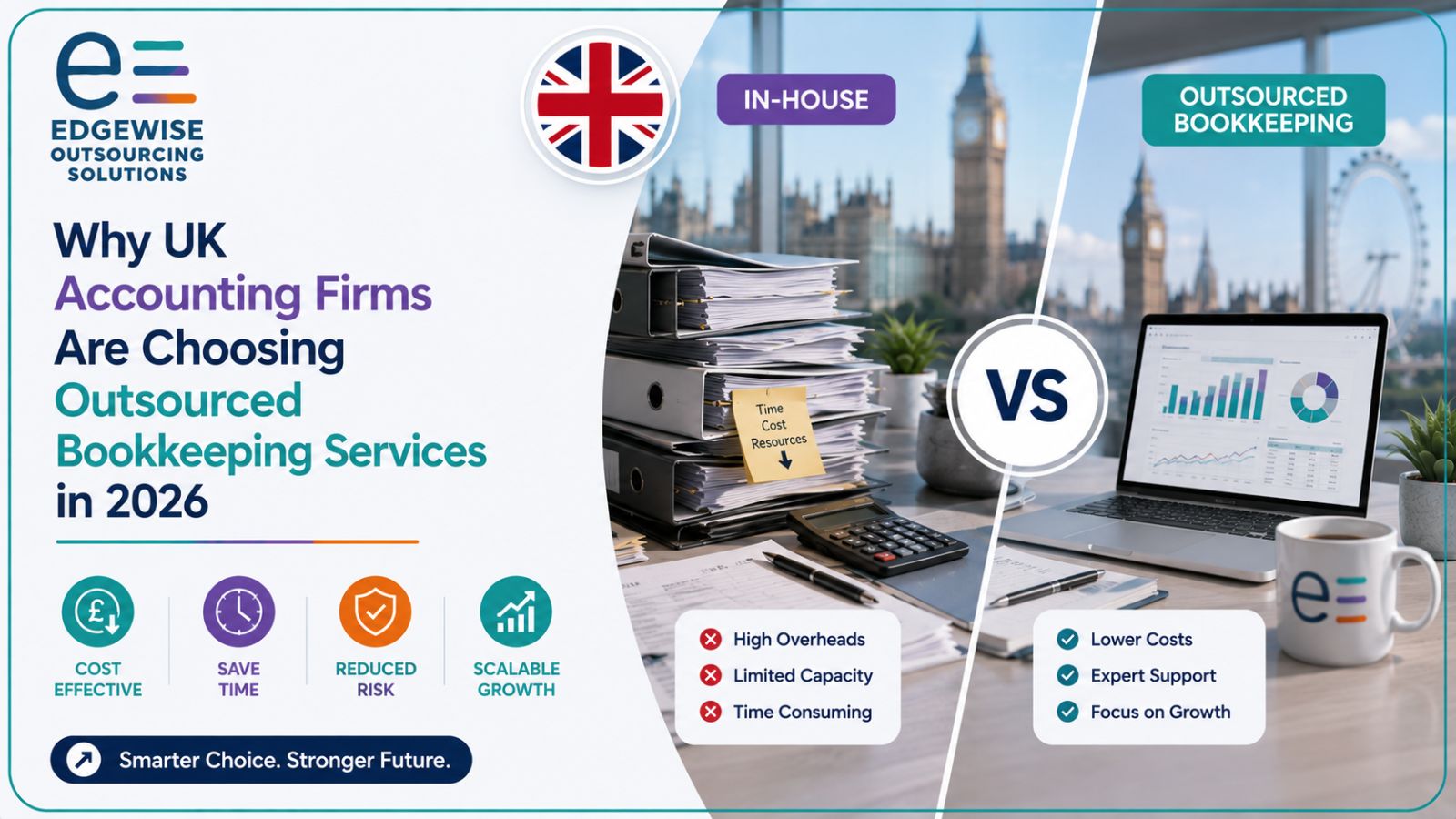
As 2026 unfolds, UK accounting firms are operating in a more demanding and competitive environment than ever before. Clients are no longer looking only for basic compliance support. They expect faster turnaround, accurate bookkeeping, real-time financial visibility, timely reporting, and proactive business advice.
At the same time, many accounting practices are facing serious operational challenges. Staff shortages, rising employment costs, increasing compliance requirements, seasonal workload pressure, and the need to move towards advisory services are forcing firms to rethink their traditional bookkeeping model.
This is where outsourced bookkeeping is becoming a practical and strategic solution.
For UK accounting firms, outsourcing bookkeeping is not merely a cost-saving exercise. It is a way to improve capacity, strengthen delivery, reduce bottlenecks, and allow internal teams to focus on higher-value work.
Why UK Accounting Firms Are Rethinking Bookkeeping
Bookkeeping has always been a core part of accounting practice. However, it is also one of the most time-consuming and labour-intensive functions.
For many firms, routine bookkeeping work consumes valuable staff time that could otherwise be used for client review, tax planning, management reporting, advisory services, and practice development.
The key reasons firms are reconsidering their bookkeeping strategy include:
1. Staff Shortages and Retention Challenges
Many UK accounting firms are finding it difficult to recruit and retain trained bookkeeping staff. Junior and mid-level resources are becoming harder to find, and firms often need to invest significant time in training new employees.
When staff availability is limited, routine bookkeeping tasks can quickly create delays. This affects VAT deadlines, payroll support, year-end work, client communication, and overall service quality.
Outsourced bookkeeping helps firms access trained professionals without going through lengthy recruitment and onboarding cycles.
2. Increasing Compliance Requirements
HMRC requirements, Making Tax Digital, VAT compliance, payroll-related processes, CIS support, and evolving reporting expectations have made bookkeeping more process-driven and compliance-sensitive.
Accounting firms need accurate, timely, and properly maintained records to avoid errors, penalties, and client dissatisfaction.
A structured outsourced bookkeeping arrangement can help firms maintain better discipline in routine accounting work, ensuring that records are updated, reconciled, and ready for review.
3. Rising Cost Pressure
Hiring an in-house bookkeeping team involves more than salary cost. Firms also need to consider training, supervision, software access, employee benefits, infrastructure, and management time.
For firms with fluctuating workloads, maintaining a large in-house team throughout the year may not always be commercially efficient.
Outsourcing gives firms a more flexible cost structure. They can increase or reduce support based on actual work volume, seasonal deadlines, and client requirements.
4. Need for Faster Turnaround
Clients expect faster responses and updated financial information. Delays in bookkeeping can delay VAT returns, management accounts, year-end accounts, tax planning, and advisory discussions.
With outsourced bookkeeping support, accounting firms can process routine work faster and reduce backlog during busy periods.
This helps improve client experience and allows partners and managers to review completed work more efficiently.
5. Shift Towards Advisory Services
Modern accounting firms are increasingly moving from compliance-led services to advisory-led services.
Clients want support with budgeting, cash flow planning, tax efficiency, financial controls, profitability analysis, and business decision-making.
However, advisory services require time, attention, and senior-level involvement. If the internal team remains occupied with repetitive bookkeeping tasks, it becomes difficult to build a strong advisory practice.
Outsourcing bookkeeping allows firms to free up internal resources and focus on higher-value client work.
What Is Outsourced Bookkeeping?
Outsourced bookkeeping means delegating routine bookkeeping and accounting support tasks to an external professional team.
This may include:
- Bank reconciliation
- Sales and purchase ledger maintenance
- Invoice processing
- Expense coding
- VAT return support
- Payroll data support
- Cloud accounting updates
- Management accounts support
- Accounts payable and receivable support
- Client bookkeeping clean-up
- Regular reporting and task tracking
The outsourced team works as an extension of the accounting firm’s internal team. The firm continues to retain control over client relationships, review, finalisation, and advisory decisions.
- Key Benefits of Outsourced Bookkeeping for UK Accounting Firms
1. Improved Operational Efficiency
Outsourcing helps firms reduce time spent on repetitive accounting tasks. With a dedicated team handling routine bookkeeping, internal staff can work more efficiently and focus on review, reporting, and client communication.
This creates a smoother workflow and helps reduce last-minute pressure.
2. Better Scalability
Accounting firms often face seasonal spikes during VAT quarters, payroll deadlines, January self-assessment season, and year-end closures.
Outsourcing allows firms to scale capacity during peak periods without permanently increasing fixed payroll costs.
This flexibility is especially useful for growing firms that want to take on more clients without immediately expanding their in-house team.
3. Faster Turnaround Time
A professional outsourced bookkeeping team works with defined processes, checklists, timelines, and review systems.
This helps ensure that bookkeeping work is completed on time and that records are available for internal review when required.
Faster turnaround improves client satisfaction and helps accounting firms stay ahead of filing and compliance deadlines.
4. Access to Trained Professionals
Outsourced bookkeeping providers typically have professionals trained in commonly used accounting platforms such as Xero, QuickBooks, Sage, FreeAgent, Dext, Hubdoc, and other cloud accounting tools.
This reduces the burden of training and allows accounting firms to access ready-to-work bookkeeping support.
5. Reduced Errors and Better Review Discipline
Bookkeeping errors can lead to incorrect VAT returns, inaccurate ledgers, poor management reports, and client dissatisfaction.
A structured outsourcing model can include multi-level checks, defined workflows, reconciliation procedures, and task monitoring.
This helps improve accuracy and reduces the time spent correcting avoidable mistakes.
6. More Time for Advisory and Client Relationships
When routine bookkeeping is managed efficiently, partners and senior team members can focus on higher-value services such as:
- Business advisory
- Management reporting
- Tax planning
- Cash flow forecasting
- Budgeting
- Profitability review
- Client relationship management
- Practice growth
This helps firms improve both profitability and client engagement.
7. Better Use of Technology
Outsourced bookkeeping teams can work with cloud accounting platforms and digital workflow tools already used by UK accounting firms.
This may include Xero, QuickBooks, Sage, FreeAgent, Dext, Hubdoc, Microsoft Teams, shared folders, secure client portals, and workflow management tools.
A good outsourcing partner adapts to the firm’s existing process rather than forcing the firm to change its entire system.
8. Reduced Pressure on Internal Teams
Bookkeeping pressure can lead to stress, missed deadlines, and staff burnout, especially during busy periods.
By outsourcing routine tasks, accounting firms can create a more balanced workload for their internal team.
This improves staff morale, reduces pressure, and allows junior team members to develop skills in review, reporting, tax, and advisory areas.
When Should an Accounting Firm Consider Outsourcing?
A UK accounting firm should consider outsourced bookkeeping if it is facing any of the following situations:
- The team is regularly overloaded with bookkeeping work
- VAT, payroll, or year-end deadlines are becoming difficult to manage
- The firm is struggling to hire or retain bookkeeping staff
- Senior staff are spending too much time on routine tasks
- Client records are not being updated on time
- The firm wants to grow but does not want to increase fixed overheads immediately
- The practice wants to move towards advisory services
- There is a need for faster reporting and improved workflow discipline
If these issues are affecting your firm, outsourcing can be an effective way to improve capacity, quality, and service delivery.
How Edgewise Training Solutions Pvt Ltd Can Support UK Accounting Firms
At Edgewise Training Solutions Pvt Ltd, we understand that bookkeeping is not just a back-office function. It is the foundation for accurate reporting, timely compliance, and better client advisory.
We support UK accounting firms with structured bookkeeping and back-office accounting services designed to reduce workload pressure and improve operational efficiency.
Our support can include:
- Day-to-day bookkeeping
- Bank reconciliation
- Purchase and sales ledger maintenance
- VAT support
- Cloud accounting updates
- Management accounts support
- Accounts payable and receivable support
- Bookkeeping clean-up
- Reporting support
- Scalable back-office assistance during peak workload periods
Our objective is to work as an extension of your team, helping your firm reduce bottlenecks, improve turnaround time, and focus on higher-value services.
Conclusion
As 2026 unfolds, UK accounting firms that embrace outsourcing are gaining a real competitive advantage.
With the right outsourcing partner, bookkeeping becomes faster, more accurate, and less of a bottleneck. This allows your internal team to focus on advisory services, client relationships, strategic reviews, and practice growth.
For firms looking to scale without increasing fixed costs, outsourced bookkeeping is no longer just an operational support option. It is a strategic growth enabler.
At Edgewise Training Solutions Pvt Ltd, we are committed to supporting UK accounting firms with reliable, scalable, and process-driven bookkeeping support.
If your firm is facing capacity pressure, staff shortage, recurring bookkeeping backlog, or increasing compliance workload, now may be the right time to explore a smarter outsourcing model.
Get in touch with Edgewise Training Solutions Pvt Ltd to understand how our bookkeeping support can help your practice work more efficiently, serve clients better, and grow with confidence.