Making Tax Digital (MTD) for Income Tax is transforming how UK accounting practices manage tax reporting for self-employed individuals and landlords.
With the first phase of MTD for Income Tax becoming mandatory on 6 April 2026, accounting practices are facing additional responsibilities involving digital recordkeeping, quarterly updates, software integration and annual tax return preparation.
For firms already managing Self Assessment returns, VAT, payroll, bookkeeping and statutory accounts, these additional requirements can create significant pressure on internal resources.
Consider a UK accounting practice managing 150 self-employed and landlord clients.
Under the traditional Self Assessment approach, the practice may have concentrated much of its tax return preparation around the annual filing cycle.
Under MTD, qualifying clients must maintain digital records and submit quarterly updates throughout the year, in addition to completing their annual tax return requirements.
For 150 qualifying clients with one reportable business each, this could mean 600 quarterly update submissions annually, alongside bookkeeping, reconciliations, client queries and year-end tax work.
This raises an important question:
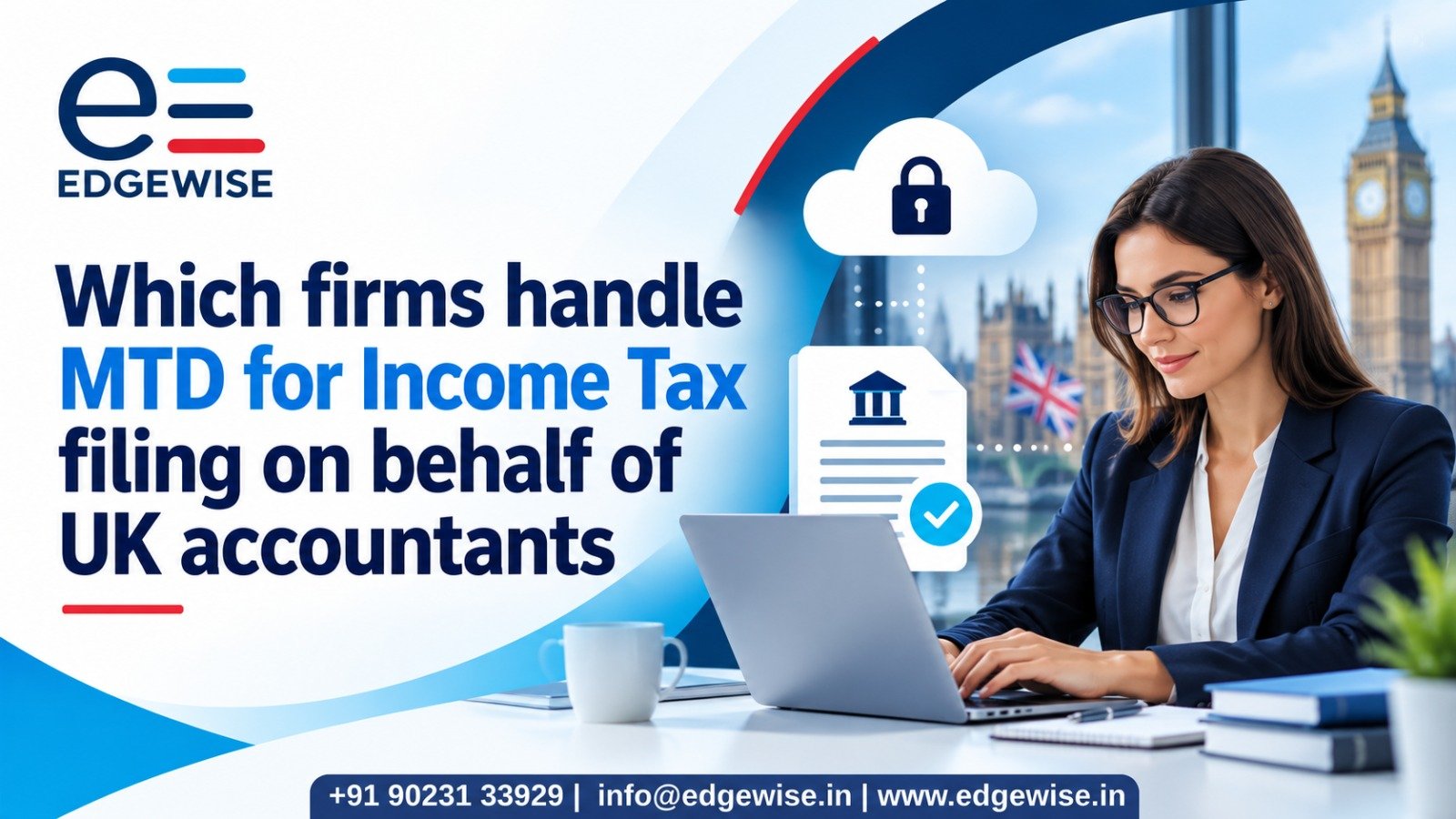
Which firms handle MTD for Income Tax filing on behalf of UK accountants, and how can accounting practices select the right outsourcing partner?
Several accounting outsourcing providers offer services ranging from digital bookkeeping and quarterly update preparation to HMRC submission support.
This guide examines the available options, explains the scope of MTD outsourcing and outlines the key factors accounting firms should consider before selecting a service provider.
1. Understanding MTD for Income Tax and Its Impact on UK Accountants
Making Tax Digital for Income Tax is an HMRC initiative designed to modernise income tax recordkeeping and reporting through compatible digital software.
Under MTD, eligible self-employed individuals and landlords must generally:
- Maintain digital records of relevant business income and expenditure.
- Use MTD-compatible accounting software.
- Submit quarterly updates to HMRC.
- Make applicable year-end accounting and tax adjustments.
- Submit their annual tax return through compatible software.
- Pay the relevant tax liabilities within the prescribed deadlines.
Quarterly updates are summaries of recorded income and expenses rather than separate tax returns.
MTD for Income Tax Implementation Timeline
| Qualifying Income | MTD Start Date |
|---|---|
| More than £50,000 | 6 April 2026 |
| More than £30,000 | 6 April 2027 |
| More than £20,000 | 6 April 2028 |
Qualifying income generally refers to combined gross income from self-employment and property before deducting expenses.
The relevant income is assessed using the applicable earlier Self Assessment tax return, subject to eligibility rules and exemptions.
For example, an individual earning £35,000 from self-employment and £20,000 from property income has combined qualifying income of £55,000.
Assuming the relevant income is assessed for the applicable threshold year and no exemption applies, the individual may fall within MTD requirements.
Why This Matters for Accounting Practices
MTD changes the frequency of interaction between accounting firms and their clients.
Instead of gathering financial information mainly at year-end, practices must establish more regular processes for collecting records, maintaining digital books, reviewing figures and managing quarterly reporting.
This creates demand for dependable bookkeeping and tax preparation support throughout the year.
2. Important MTD Quarterly Filing Deadlines
For taxpayers using standard update periods, the deadlines for the first mandatory MTD tax year are:
| Quarterly Update | Submission Deadline |
|---|---|
| First quarterly update | 7 August 2026 |
| Second quarterly update | 7 November 2026 |
| Third quarterly update | 7 February 2027 |
| Fourth quarterly update | 7 May 2027 |
| Annual tax return for 2026-27 | 31 January 2028 |
As at October 2026, the first quarterly deadline has passed, and the second deadline is approaching.
HMRC provides standard and calendar update periods, depending on the relevant accounting period and arrangements.
Quarterly summaries are generally cumulative from the beginning of the tax year or relevant recording period.
For 2026-27, HMRC has confirmed that penalty points will not be applied for missed quarterly update deadlines. However, taxpayers must still maintain digital records and complete the necessary updates before submitting their annual tax return.
The absence of first-year quarterly late-submission penalties does not remove the underlying reporting obligation.
3. Why Are UK Accounting Practices Outsourcing MTD Work?
The introduction of MTD creates operational challenges, particularly for small and medium-sized accounting practices.
Increased Reporting Frequency
Qualifying clients generally require four quarterly updates alongside annual tax reporting.
This increases the number of recurring reporting deadlines across the practice.
Greater Bookkeeping Requirements
Accurate digital records are essential for preparing quarterly updates.
Accounting firms may need to provide additional support to clients who previously maintained incomplete spreadsheets or submitted records only at year-end.
Additional Software Responsibilities
Practices must consider software compatibility, client onboarding, digital recordkeeping processes and HMRC authorisations.
Staff Capacity Constraints
Managing additional reporting periods may place pressure on existing employees, particularly where the practice already handles VAT, payroll and year-end accounting assignments.
Need for Consistent Quality Controls
Quarterly reporting requires repeatable workflows for transaction processing, record checks, reconciliation, query management and submission monitoring.
Outsourcing selected activities can help accounting practices address these challenges without necessarily increasing permanent headcount.
4. Which Firms Handle MTD for Income Tax on Behalf of UK Accountants?
Several accounting outsourcing firms and service providers offer solutions relevant to MTD for Income Tax.
The providers differ in their service coverage, technology capabilities, client engagement model and level of support.
4.1 Corient
Corient provides accounting outsourcing services for UK accounting practices, including services related to MTD for VAT and Income Tax.
Its published service descriptions cover:
- Digital recordkeeping support.
- Bookkeeping and reconciliation.
- Quarterly Income Tax update preparation.
- HMRC submission support.
- Software integration.
- MTD compliance workflow monitoring.
The firm’s outsourcing approach includes white-label support, allowing the accounting practice to maintain the primary client relationship.
Corient also offers wider bookkeeping and tax preparation support, which may be relevant where practices require assistance with both quarterly reporting and underlying accounting records.
4.2 Equallto
Equallto offers outsourced accounting and bookkeeping support aimed particularly at smaller accounting practices.
Its service model emphasises flexible accounting capacity and support for recurring financial processing activities.
Relevant capabilities include:
- Bookkeeping support.
- Transaction processing.
- Bank reconciliations.
- Accounting record maintenance.
- Support for digital accounting workflows.
- MTD-related accounting assistance.
For firms experiencing increased bookkeeping workloads because of MTD, such support may help establish more efficient reporting processes.
Practices should confirm whether direct MTD for Income Tax submissions are included in Equallto’s current service arrangements.
4.3 Affinity Outsourcing
Affinity Outsourcing provides accounting outsourcing services for accounting professionals and practices.
Its published MTD-related service descriptions include:
- MTD-compliant digital recordkeeping.
- VAT reporting support.
- Income Tax quarterly update preparation.
- Software migration and integration assistance.
- Digital accounting workflows.
- MTD compliance support.
The provider may be relevant to accounting firms looking for operational assistance with both MTD setup and recurring reporting activities.
Specific filing permissions, responsibilities and review arrangements should be confirmed before engagement.
4.4 Pacific Global Solutions
Pacific Global Solutions provides accounting and bookkeeping outsourcing support for accountants, bookkeepers and tax professionals.
Its published services include assistance with digital accounting systems and bookkeeping processes relevant to MTD.
Depending on the service agreement, practices may obtain support with:
- Accounting software workflows.
- Bookkeeping and record maintenance.
- Reconciliation activities.
- Financial data preparation.
- MTD-related accounting processes.
For practices that prefer to retain final HMRC submission responsibilities internally, outsourced preparation support may offer a practical alternative to outsourcing the entire reporting process.
4.5 The Accountancy Partnership
The Accountancy Partnership offers accounting services for UK businesses, including MTD-related support.
Its published service information includes bookkeeping assistance, MTD-compatible software and quarterly Income Tax update services.
The service is primarily positioned as a managed accounting offering rather than necessarily as a white-label subcontracting arrangement for other accounting practices.
UK accountants considering this provider should therefore confirm whether it accepts outsourced assignments on behalf of another accounting firm.
Comparison of MTD Outsourcing Providers
| Provider | Relevant MTD Services | Service Model |
|---|---|---|
| Corient | Digital records, quarterly updates, submission support | White-label accounting outsourcing |
| Equallto | Bookkeeping, reconciliations, MTD-related support | Flexible accounting outsourcing |
| Affinity Outsourcing | MTD setup, digital records, quarterly reporting | Accounting outsourcing |
| Pacific Global Solutions | Digital bookkeeping and MTD-related support | Back-office accounting support |
| The Accountancy Partnership | MTD quarterly updates and bookkeeping | Primarily direct accounting services |
The above comparison summarises publicly described services and is not an independent ranking, accreditation or guarantee of direct filing availability. Current offerings should be verified with each provider.
5. What MTD Activities Can Accounting Firms Outsource?
Accounting practices do not necessarily need to outsource the entire MTD process.
Tasks can be allocated between the accounting practice, client and outsourcing provider according to expertise, capacity and compliance responsibilities.
| MTD Activity | Potential Outsourced Support | Accounting Practice Responsibility |
|---|---|---|
| Client onboarding | Information collection and setup | Client relationship and oversight |
| Digital recordkeeping | Transaction recording and classification | Review and accounting policy decisions |
| Bank reconciliation | Preparation and exception identification | Review of material discrepancies |
| Quarterly update preparation | Income and expense summaries | Review and approval controls |
| HMRC quarterly submissions | Possible with appropriate authorisation | Authorisation and agreed oversight |
| Year-end adjustments | Supporting schedules and computations | Technical tax decisions |
| Annual tax return | Preparation support | Final review and approved filing |
| Client queries | Routine information requests | Complex tax and advisory matters |
| MTD deadline monitoring | Tracking reporting dates | Overall client compliance management |
The exact allocation should be documented in the engagement terms.
Importantly, HMRC allows clients to appoint main and supporting agents for MTD.
A supporting agent may assist with digital records and quarterly updates, but cannot submit the client’s annual tax return.
This distinction is particularly relevant when accounting firms engage an external service provider.
6. Important Factors to Consider When Choosing an MTD Outsourcing Firm
Selecting an MTD service provider requires more than comparing monthly fees.
Understanding of UK Accounting Requirements
The provider should understand relevant bookkeeping standards, HMRC processes, digital recordkeeping requirements and the operational expectations of UK accounting practices.
Software Compatibility
Businesses should confirm whether the provider can work within the accounting and tax software used by the practice.
Common systems include Xero, QuickBooks, Sage, FreeAgent, TaxCalc and other compatible platforms.
Not every function or software product automatically supports every MTD reporting requirement.
White-Label Service Availability
For accounting practices, preserving the existing client relationship may be essential.
A white-label arrangement allows the outsourcing provider to work behind the accounting practice without necessarily communicating directly with the end client.
Quality Review Procedures
The provider should have appropriate processes for identifying discrepancies, documenting missing information and preparing files for review.
HMRC Submission Responsibilities
The parties should agree who is authorised to submit quarterly updates, who approves them and how the filing acknowledgement is retained.
Confidentiality and Data Protection
Where client information is shared with an offshore team, the accounting practice should consider UK GDPR requirements, confidentiality obligations and applicable international data-transfer safeguards.
Service-Level Agreements
The agreement should specify:
- Tasks and deliverables.
- Preparation deadlines.
- Reporting responsibilities.
- Query-resolution procedures.
- Data security obligations.
- Escalation arrangements.
- Fees and additional charges.
- Termination and handover procedures.
A clear agreement helps prevent operational misunderstandings.
7. How Does MTD Outsourcing Work in Practice?
A structured MTD outsourcing arrangement can be implemented through six stages.
Step 1: Identify Clients Affected by MTD
Review client income sources and determine which individuals fall within the applicable MTD thresholds.
Maintain a tracker showing each client’s expected MTD commencement date.
Step 2: Assess Existing Accounting Workloads
Estimate the number of clients, businesses, transactions and quarterly updates requiring processing.
Identify areas where internal capacity is limited.
Step 3: Define the Scope of Outsourcing
Determine which responsibilities will remain with the accounting practice and which can be performed by the external provider.
Step 4: Establish Software and Recordkeeping Processes
Confirm compatible software, digital recordkeeping procedures, secure access and relevant authorisations.
Step 5: Implement Review and Submission Workflows
Create a standard process covering transaction preparation, reconciliation, query resolution, review, approval and submission.
Step 6: Monitor Performance
Track performance indicators such as:
- Timely preparation of quarterly updates.
- Outstanding client queries.
- Reconciliation completion.
- Number of review corrections.
- Compliance with agreed service timelines.
- Internal staff hours allocated to preparation.
Regular performance reviews can help determine whether outsourcing is delivering the expected operational benefits.
8. How Much Does MTD for Income Tax Outsourcing Cost?
The cost of MTD outsourcing varies depending on the scope of the engagement.
A provider offering only basic quarterly reporting preparation may charge differently from one responsible for complete digital bookkeeping, reconciliation and preparation support.
Important pricing factors include:
- Number of clients.
- Monthly transaction volumes.
- Number of income sources and businesses per taxpayer.
- Quality of existing records.
- Accounting software requirements.
- Quarterly reporting responsibilities.
- Year-end preparation requirements.
- Complexity of reconciliations.
- Additional support and reporting needs.
Some service providers offer fixed monthly fees, while others charge according to transaction volumes or agreed assignments.
Accounting practices should request a detailed quotation and confirm which services are included.
The lowest price may not provide the best overall value if substantial additional internal review or correction work is required.
9. Common Challenges in MTD Outsourcing
Although MTD outsourcing can improve operational capacity, implementation challenges should be addressed at the outset.
Incomplete Client Records
Missing invoices, unrecorded income or unreconciled transactions can delay quarterly processing.
Recommended approach: Establish regular document collection procedures and maintain an outstanding information tracker.
Inconsistent Bookkeeping
Different accounting methods or classification practices across clients may create reporting inconsistencies.
Recommended approach: Maintain standardised bookkeeping instructions and client-specific procedures.
Software Integration Issues
Not all accounting applications provide identical MTD functionality.
Recommended approach: Test software compatibility and authorisation before the first reporting deadline.
Unclear Submission Authority
Confusion over who approves and submits quarterly updates can create compliance risks.
Recommended approach: Document the agent role, approval process and filing responsibilities.
Inadequate Review Procedures
Outsourcing transaction preparation does not eliminate the need for professional oversight.
Recommended approach: Introduce appropriate checks and clear escalation procedures for technical tax matters.
10. Frequently Asked Questions
Who Can File MTD for Income Tax on Behalf of a Taxpayer?
An appropriately authorised agent can submit MTD quarterly updates and, where their authorisation permits, the annual tax return using compatible software.
Accounting practices may also use external preparation teams without granting those teams direct HMRC filing authority.
Can an Outsourcing Firm Submit MTD Updates for an Accounting Practice?
Potentially, yes, subject to the relevant HMRC authorisation, software access and agreed responsibilities.
Alternatively, an outsourcing provider may prepare the records and updates for the accounting practice to review and submit.
Is MTD Based on Turnover or Profit?
MTD qualifying income generally refers to gross income from self-employment and property before expenses, rather than net taxable profit.
Is MTD for Income Tax the Same as MTD for VAT?
No. Although both involve digital recordkeeping and compatible software, they apply to different taxes and have distinct reporting requirements.
Does MTD Replace the Annual Self Assessment Tax Return?
No. Eligible taxpayers must generally submit quarterly updates and continue to complete an annual tax return through the MTD process.
Can Small Accounting Practices Outsource Only Bookkeeping?
Yes. Practices can outsource routine bookkeeping and reconciliation while retaining quarterly submissions, tax calculations and client advice internally.
How Can Accountants Prepare for Future MTD Expansion?
Accounting firms should identify affected clients, establish compatible digital systems, evaluate reporting workloads and review whether additional internal or outsourced processing capacity is required.
11. Why Choose Edgewise Training Solutions Pvt Ltd?
At Edgewise Training Solutions Pvt Ltd, we recognise that the introduction of Making Tax Digital for Income Tax creates additional operational responsibilities for UK accounting practices.
From maintaining digital financial records and reconciling transactions to organising supporting schedules and preparing information for periodic reporting, consistent accounting processes are essential for efficient compliance workflows.
Edgewise focuses on structured accounting and back-office support designed to complement the work of professional accounting firms.
How Edgewise Can Support Accounting Practices
1. Digital Bookkeeping and Financial Record Support
Accurate accounting records are the foundation of reliable MTD reporting.
Edgewise can assist with routine transaction recording, ledger maintenance and organisation of supporting financial information within the agreed engagement scope.
2. Bank Reconciliation and Accounting Data Review
Regular reconciliations help identify missing transactions, incorrect classifications and other discrepancies that may affect financial reporting.
Our approach emphasises organised reconciliations and systematic documentation.
3. MTD-Related Preparation Support
Depending on service capabilities and contractual arrangements, Edgewise can assist accounting practices with preparing financial schedules and supporting information relevant to MTD quarterly reporting.
Direct HMRC submission services, where required, would need to be separately confirmed and supported by appropriate authorisation.
4. Standardised Accounting Workflows
Consistent working papers, reporting checklists and documented accounting procedures can help practices manage recurring assignments more efficiently.
5. Flexible Back-Office Support
As MTD requirements expand, UK accounting practices may experience increased bookkeeping and reporting workloads.
Edgewise aims to provide accounting support arrangements aligned with agreed responsibilities and operational requirements.
6. Collaboration with Accounting Professionals
We recognise the importance of maintaining effective communication between accounting support teams and professional accountants.
Our approach is designed to complement existing accounting workflows while allowing practices to retain responsibility for client relationships, technical tax decisions and final statutory approvals.
Why Consider Edgewise as an Accounting Support Partner?
A successful MTD outsourcing arrangement should begin with reliable bookkeeping and clearly documented responsibilities.
Simply delegating quarterly submission tasks may not resolve the underlying challenges if financial records are incomplete or inconsistent.
By supporting routine accounting and preparation activities, Edgewise seeks to help UK accounting practices:
- Improve the organisation of financial records.
- Establish more consistent accounting processes.
- Reduce routine administrative workloads.
- Strengthen supporting documentation.
- Maintain clearer preparation and review workflows.
- Allocate additional professional time to tax planning and client advisory services.
Our objective is to support accounting practices with dependable back-office processes while preserving appropriate professional oversight.
Explore MTD-Related Accounting Support with Edgewise
Looking to streamline your accounting practice’s digital bookkeeping and MTD preparation workflows?
Connect with Edgewise Training Solutions Pvt Ltd to discuss how structured outsourced accounting support may complement your firm’s existing processes.
The availability of specific MTD for Income Tax services, compatible software capabilities, HMRC submission support and turnaround commitments should be verified and agreed before engagement.
Disclaimer
The information contained in this blog is provided by Edgewise Training Solutions Pvt Ltd for general informational and educational purposes only. It does not constitute professional accounting, taxation, financial, legal or regulatory advice.
Although reasonable efforts have been made to ensure the accuracy of the content, HM Revenue & Customs (HMRC) guidance, Making Tax Digital requirements, qualifying income thresholds, filing deadlines, software requirements and applicable legislation may change over time.
Information concerning third-party accounting outsourcing providers is based on publicly available service descriptions and is included for general comparison purposes. Edgewise Training Solutions Pvt Ltd does not independently certify, endorse or guarantee the services, qualifications, performance, pricing or regulatory compliance of the providers mentioned.
The examples, service comparisons and operational considerations in this article are illustrative and may not apply to every accounting practice or taxpayer.
Readers should verify current requirements with HMRC and consult an appropriately qualified UK accounting, tax or legal professional before making compliance or business decisions.
Any accounting, bookkeeping or MTD-related preparation services provided by Edgewise are subject to mutually agreed engagement terms, applicable legislation, professional oversight and confirmation of service capabilities.
Edgewise Training Solutions Pvt Ltd does not guarantee specific financial savings, regulatory outcomes, error-free submissions or operational improvements arising from reliance on this article.
Responsibility for relevant statutory filings, authorisations, tax decisions and regulatory compliance remains with the taxpayer and the appropriately authorised accounting or tax professionals, as applicable.