
Bookkeeping is essential for every business, but it can quickly become time-consuming as transaction volumes increase, invoices accumulate and reporting deadlines become more frequent.
For many businesses and accounting firms, outsourced bookkeeping offers a practical way to maintain accurate financial records without building a large in-house finance team.
What Is Outsourced Bookkeeping?
Outsourced bookkeeping means assigning routine financial record-keeping activities to an external professional or accounting team instead of handling everything internally.
Typical outsourced bookkeeping activities include:
- Recording financial transactions;
- Bank and credit card reconciliations;
- Accounts payable and receivable;
- Supplier and customer invoice processing;
- Maintaining ledgers and journals;
- Payroll support;
- Month-end reconciliations;
- Preparing management reports; and
- Monitoring cash flow.
The objective is to keep the books accurate and current while allowing the business to focus on operations, customers and growth.
Why Do Businesses Outsource Bookkeeping?
Businesses usually consider outsourcing when bookkeeping begins consuming more internal time than it should.
Some of the main benefits include:
Access to Skilled Professionals
Businesses gain access to experienced bookkeeping professionals without having to recruit and train a full-time employee.
Reduced Internal Workload
Routine accounting work is handled externally, allowing management and finance teams to concentrate on higher-value activities.
Lower Fixed Costs
An outsourced arrangement may reduce expenditure relating to:
- Salaries;
- Employee benefits;
- Recruitment;
- Training;
- Accounting infrastructure; and
- Additional internal resources.
Actual savings will depend on the business, transaction volume and service provider.
Scalability
As the number of transactions, entities or customers grows, outsourced support can generally be increased without going through another recruitment cycle.
Better Financial Accuracy
Regular reconciliations and structured review processes can help identify:
- Duplicate transactions;
- Incorrect classifications;
- Missing invoices;
- Unreconciled balances; and
- Posting errors.
Improved Tax and Compliance Readiness
When bookkeeping is maintained throughout the year, tax returns and year-end accounts can generally be prepared more efficiently because the underlying records are already organised.
These advantages, particularly access to expertise, scalability, better reconciliation and reduced recruitment requirements, are central to the outsourcing model.
What Does Outsourced Bookkeeping Cost?
There is no single price for outsourced bookkeeping.
Pricing will normally depend on:
- Number of monthly transactions;
- Number of bank accounts;
- Number of entities;
- Accounts payable and receivable requirements;
- Payroll requirements;
- Reporting frequency;
- Accounting software used;
- Complexity of reconciliations; and
- Whether historical records require clean-up.
Providers may use several pricing structures.
Monthly Fixed Fee
A business pays a fixed monthly amount for an agreed scope of bookkeeping services.
This model works well where transaction volumes are reasonably predictable.
Hourly Pricing
Hourly billing may be more appropriate for:
- Catch-up bookkeeping;
- Historical clean-up;
- Accounting system migration; or
- Short-term projects.
Dedicated Resource Model
Some businesses engage a dedicated bookkeeper or accounting team for a fixed monthly cost.
Outsourced bookkeeping pricing commonly varies according to business size, transaction volume and reporting requirements rather than following a single standard fee.
Businesses should therefore compare scope and quality, not simply headline pricing.
A low-cost service that requires substantial internal rework may ultimately be more expensive than a provider delivering properly reconciled and reviewer-ready books.
How Does the Outsourced Bookkeeping Process Work?
A structured outsourcing arrangement normally follows several stages.
1. Initial Assessment
The outsourcing provider reviews:
- Existing books;
- Accounting software;
- Bank accounts;
- Current processes;
- Outstanding reconciliations; and
- Reporting requirements.
The objective is to understand the existing position before routine processing begins.
2. System and Software Setup
The provider is given controlled access to relevant systems such as:
- Xero;
- QuickBooks;
- Sage;
- NetSuite; or
- Other accounting platforms.
Bank feeds, invoicing systems and supporting applications may also be integrated where appropriate.
3. Regular Bookkeeping
Daily or weekly activities may include:
- Transaction classification;
- Invoice posting;
- Supplier bill processing;
- Customer receipt allocation;
- Expense recording; and
- Ledger maintenance.
4. Monthly Reconciliation
At month-end, the outsourced team typically reconciles:
- Bank accounts;
- Credit cards;
- Payment gateways;
- Customer balances;
- Supplier balances; and
- Other control accounts.
Unusual or unsupported transactions should be raised through a structured query process.
5. Reporting and Review
Depending on the engagement, the provider may prepare:
- Profit and loss statements;
- Balance sheets;
- Cash-flow reports;
- Aged receivables;
- Aged payables; and
- Management information.
The business or accounting practice then reviews the output and addresses any outstanding matters.
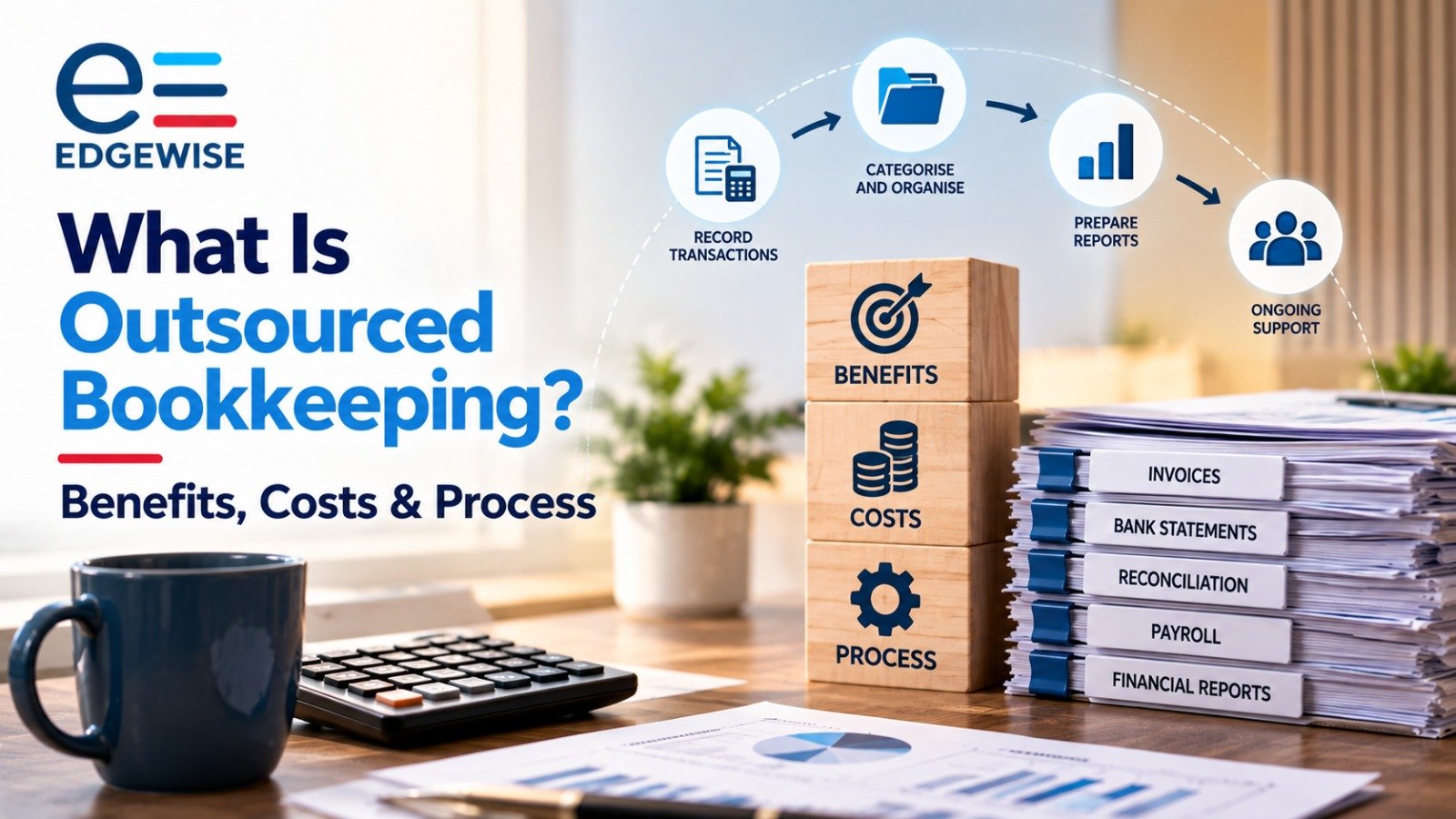
The overall process therefore covers onboarding, software integration, regular bookkeeping, reconciliations, financial reporting and ongoing communication.
What Should You Check Before Choosing a Provider?
Before outsourcing financial records, businesses should review more than just cost.
Important areas include:
- Relevant bookkeeping experience;
- Knowledge of your accounting software;
- Quality-control procedures;
- Data-security controls;
- Confidentiality arrangements;
- Turnaround times;
- Backup staffing;
- Communication procedures;
- Escalation process; and
- Scope of services.
It is also useful to understand exactly what the provider will deliver each month.
For example, a strong monthly bookkeeping file should ideally include reconciled accounts, explained outstanding items, supporting schedules and a clear query list.
When Does Outsourced Bookkeeping Make Sense?
Outsourcing can be particularly useful where:
- Transaction volumes are increasing;
- Bookkeeping is regularly falling behind;
- Management is spending too much time on routine accounting;
- Recruiting an internal bookkeeper is not economical;
- The business requires additional accounting capacity;
- Historical books require clean-up; or
- The business wants more regular financial reporting.
It can also work well for accounting practices that need additional processing capacity during busy periods.
Why Choose Edgewise Training Solutions Pvt Ltd?
At Edgewise Training Solutions Pvt Ltd, our focus is on providing structured and reliable accounting support that integrates with the client’s existing finance processes.
Edgewise can assist with:
- Day-to-day bookkeeping;
- Bank and credit card reconciliations;
- Accounts payable and receivable;
- Ledger scrutiny;
- Historical bookkeeping clean-up;
- Month-end accounting support;
- Payroll-related accounting support;
- Management accounts preparation;
- Financial reporting; and
- Supporting schedules for year-end accounts and tax work.
Our approach is based on accuracy, process discipline, timely communication and clear review procedures.
Rather than simply processing transactions, we aim to provide organised and review-ready accounting records that help businesses and accounting practices maintain better control over their financial information.
Whether you require ongoing bookkeeping support or additional capacity during busy periods, Edgewise can provide a scalable accounting support model based on your requirements.
Disclaimer
This article is provided by Edgewise Training Solutions Pvt Ltd for general information and educational purposes only.
It does not constitute accounting, tax, legal, financial or regulatory advice and should not be relied upon as a substitute for professional advice based on your specific circumstances.
The cost, suitability and potential benefits of outsourced bookkeeping will vary depending on transaction volumes, business complexity, accounting systems, service scope and the outsourcing provider selected.
Businesses should carry out appropriate due diligence before sharing financial information with an external provider and should ensure that suitable confidentiality, data-security and contractual arrangements are in place.
Readers should obtain appropriate professional advice before making decisions regarding their accounting, tax or outsourcing arrangements.