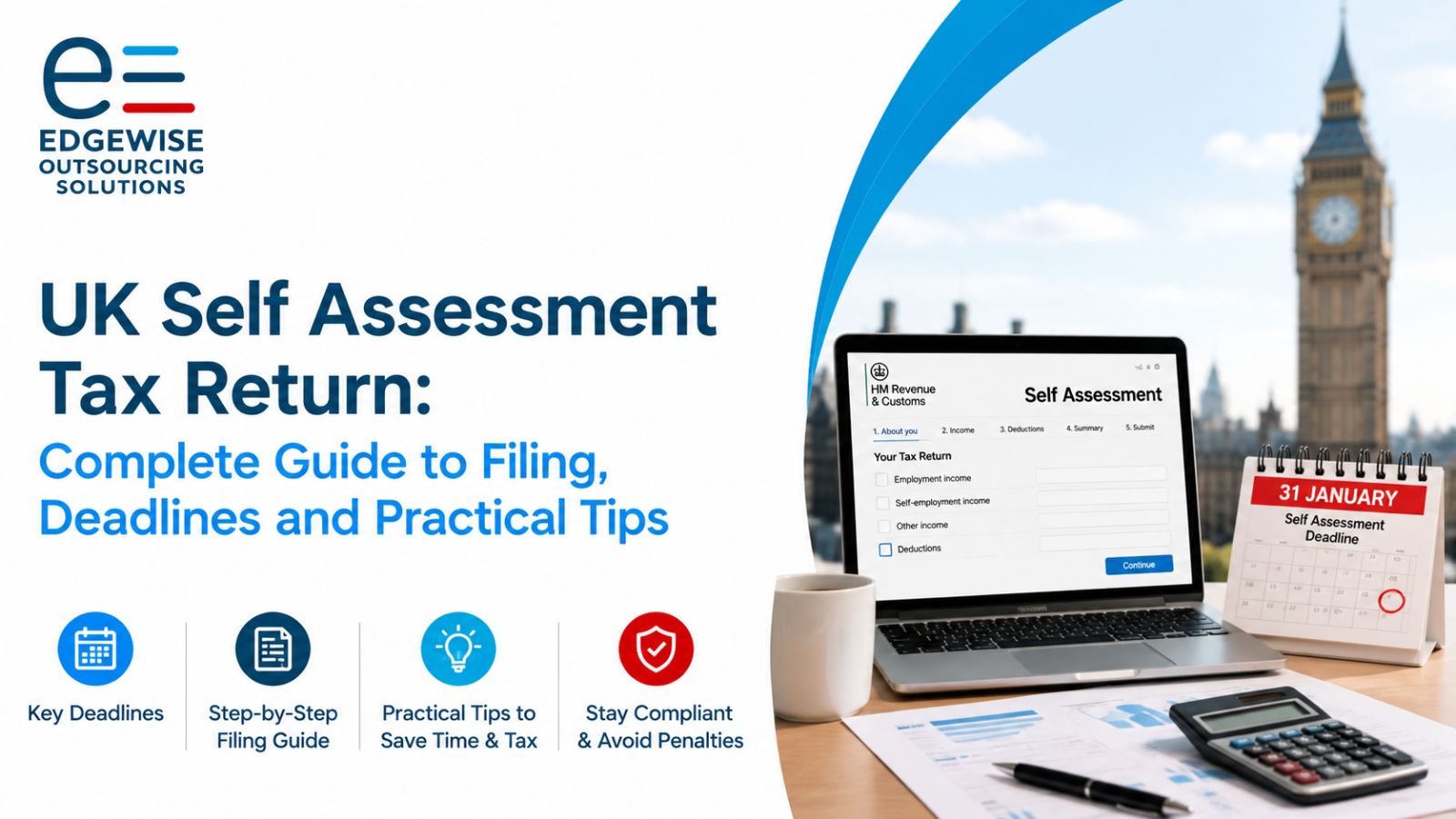
- Self Assessment Tax Return 2025/26: A Simple Guide for UK Taxpayers
Paying tax is not something most people look forward to, but for many individuals in the UK, filing a Self Assessment tax return is an important annual responsibility.
If you are self-employed, a freelancer, a landlord, a company director with untaxed income, or someone earning income outside PAYE, you may need to submit a Self Assessment tax return to HMRC.
For many taxpayers, the process can feel confusing at first. There are deadlines to remember, records to maintain, income to report, expenses to claim, and penalties to avoid. However, once you understand the basic process, Self Assessment becomes much more manageable.
At Edgewise Training Solutions Private Limited, we believe that tax compliance should be understood clearly and handled in a timely manner. This guide explains what Self Assessment is, who needs to file it, the important deadlines for the 2025/26 tax year, common mistakes, and why early filing is always better.
What Is a Self Assessment Tax Return?
Self Assessment is the system used by HMRC to collect Income Tax from individuals whose income is not fully taxed at source.
For most employees, tax is deducted automatically through PAYE by the employer. In such cases, the employee may not need to file a tax return unless they have additional income or specific tax circumstances.
However, if you earn income that has not already been taxed, HMRC may require you to report it through a Self Assessment tax return.
In simple words, a Self Assessment tax return tells HMRC:
- How much income you earned during the tax year
- What expenses or reliefs you are claiming
- Whether you made any gains, losses, or taxable profits
- How much tax and National Insurance you need to pay
- Whether you are due a refund
The UK tax year runs from 6 April to 5 April. For the 2025/26 tax year, the period is from 6 April 2025 to 5 April 2026.
Who Needs to File a Self Assessment Tax Return?
You may need to file a Self Assessment tax return if you have income that is not fully taxed through PAYE or if HMRC specifically asks you to file one.
Common situations include:
- You are self-employed as a sole trader
- You are a partner in a business partnership
- You receive rental income from property
- You earn freelance, consultancy, or side income
- You receive dividends or investment income
- You have foreign income
- You have capital gains to report
- You are a company director receiving untaxed income
- You need to claim certain expenses, reliefs, or tax repayments
- You are liable for the High Income Child Benefit Charge
- HMRC has issued you a notice to file a return
It is important not to assume that Self Assessment applies only to self-employed individuals. Many landlords, investors, directors, consultants, and professionals may also fall under Self Assessment.
If you are unsure, you should check your position early instead of waiting until the filing deadline.
Important Self Assessment Deadlines for 2025/26
Deadlines are one of the most important parts of Self Assessment compliance. Missing them can result in penalties and interest.
For the 2025/26 tax year, the key dates are:
- 5 October 2026
Deadline to register for Self Assessment if you need to file a return for the first time or need to reactivate your account.
31 October 2026
Deadline for filing a paper tax return.
30 December 2026
Deadline if you want HMRC to collect the tax through your PAYE tax code, where eligible.
31 January 2027
Deadline for filing your online Self Assessment tax return.
31 January 2027
Deadline for paying any tax due for the 2025/26 tax year.
31 July 2027
Second payment on account deadline, if applicable.
These dates should be treated seriously. Filing early gives you more time to review the return, correct errors, and plan for the tax payment.
What Is a UTR Number?
A UTR, or Unique Taxpayer Reference, is a 10-digit number issued by HMRC. It is used to identify your Self Assessment record.
If you are filing a Self Assessment tax return for the first time, you need to register with HMRC and obtain your UTR before you can submit the return.
You may need to provide details such as:
- Full name
- Address
- National Insurance number
- Date of birth
- Nature of income
- Business or self-employment details, if applicable
It is advisable to register well before the deadline because receiving and activating your UTR can take time, especially during busy periods.
How to Complete a Self Assessment Tax Return Online
Most taxpayers now file their returns online. The online process is more convenient and allows you to save progress, review details, calculate tax, and submit the return electronically.
Step 1: Sign in to your HMRC account
Log in using your Government Gateway user ID and password. If you do not already have an account, you will need to create one.
Step 2: Select the correct tax return
Once logged in, go to the Self Assessment section and choose the return for the relevant tax year.
Step 3: Enter your personal details
Check that your name, address, National Insurance number, and other personal details are correct.
- Step 4: Report your income
You need to include all relevant sources of income, such as:
- Employment income
- Self-employment income
- Partnership income
- Rental income
- Dividends
- Savings interest
- Foreign income
- Pension income
- Capital gains, where applicable
Accuracy is very important. Omitting income can lead to enquiries, penalties, and interest.
Step 5: Claim allowable expenses and reliefs
If you are self-employed or earn rental income, you may be able to claim expenses that are wholly and exclusively related to your business or property income.
Common examples may include:
- Office or business expenses
- Professional fees
- Travel costs
- Software subscriptions
- Telephone and internet expenses
- Property repairs and maintenance
- Bank charges
- Insurance
- Accountancy fees
Only genuine allowable expenses should be claimed. Personal expenses should not be mixed with business expenses.
Step 6: Review the tax calculation
The HMRC system will calculate the tax payable based on the information entered. Review the calculation carefully before submission.
Step 7: Submit the return and save confirmation
Once submitted, save the confirmation receipt and keep a copy of the return for your records.
Why Filing Early Is a Good Idea
Many people leave Self Assessment until January. This often creates pressure, mistakes, and last-minute stress.
Filing early does not mean you have to pay early. It simply means you know your tax position in advance.
Early filing helps you:
- Understand how much tax is payable
- Plan your cash flow
- Avoid last-minute errors
- Collect missing information in time
- Claim refunds earlier, if eligible
- Reduce the risk of penalties
- Get professional help before deadlines become tight
For self-employed professionals and landlords, early filing is especially useful because it allows better financial planning.
- Common Self Assessment Mistakes to Avoid
1. Missing the filing deadline
Even if no tax is payable, late filing can still result in penalties. The return should be submitted on time.
2. Not reporting all income
All taxable income must be considered. This includes side income, rental income, dividends, foreign income, and gains where applicable.
3. Claiming incorrect expenses
Only allowable expenses should be claimed. Personal expenses, unsupported claims, or estimated figures can create problems during HMRC review.
4. Poor record-keeping
Bank statements, invoices, receipts, rent statements, dividend vouchers, and expense records should be maintained properly.
5. Forgetting payments on account
Many taxpayers are surprised by payments on account. These are advance payments towards the next tax bill and can significantly affect cash flow.
6. Mixing personal and business transactions
This is a common issue for small businesses and freelancers. Keeping separate business and personal records makes tax filing much easier.
7. Waiting until the last minute
Last-minute filing increases the risk of mistakes, missing documents, and payment delays.
Penalties for Late Filing and Late Payment
HMRC applies penalties if a taxpayer is required to file a return but misses the deadline.
Late filing may result in an initial penalty, and further penalties can apply if the delay continues. Late payment can also attract penalties and interest.
This is why it is always better to file the return and pay the tax on time. If you cannot pay the full amount immediately, you should still file the return and explore available payment options with HMRC.
How Professional Support Can Help
Self Assessment may appear simple in basic cases, but it can become complicated when there are multiple income sources, rental properties, dividends, foreign income, capital gains, business expenses, or payments on account.
Professional support can help you:
- Identify whether you need to file a return
- Register for Self Assessment
- Review income and expenses
- Claim eligible reliefs
- Avoid common errors
- Submit the return on time
- Plan tax payments properly
- Maintain better financial records
Good tax compliance is not only about filing a return. It is also about filing it correctly, on time, and with proper documentation.
How Edgewise Training Solutions Private Limited Can Assist
Edgewise Training Solutions Private Limited supports individuals, professionals, and businesses with structured accounting, tax support, financial reporting, and compliance assistance.
We help clients understand their financial obligations in a simple and practical manner. Our focus is to make compliance smoother, reduce last-minute pressure, and ensure that financial information is properly organised.
We can assist with:
- Self Assessment support
- Bookkeeping and record review
- Income and expense classification
- Tax return preparation support
- Rental income reporting support
- Dividend and investment income reporting support
- Management accounts and financial reporting
- Outsourced accounting support
With timely support and proper records, Self Assessment becomes easier, clearer, and less stressful.
Final Thoughts
Filing a Self Assessment tax return may feel difficult at first, but the process becomes much easier when you understand the requirements and prepare early.
The most important things are simple: know whether you need to file, register on time, maintain proper records, report all income correctly, claim only valid expenses, and meet the filing and payment deadlines.
For the 2025/26 tax year, early preparation can save you from unnecessary stress, penalties, and last-minute confusion.
At Edgewise Training Solutions Private Limited, we help businesses and individuals manage tax and accounting requirements with clarity, accuracy, and practical support.
A well-prepared tax return is not just a compliance formality. It is an important step towards better financial discipline.