Good bookkeeping is one of the foundations of a well-managed business.
For small businesses, accurate financial records help track income and expenses, monitor cash flow, prepare tax information and understand whether the business is actually profitable.
Bookkeeping does not need to be complicated, but it does need to be consistent.
This guide explains the basic bookkeeping concepts, common methods, essential tasks and signs that a small business may need professional support.
What Is Bookkeeping?
Bookkeeping is the regular process of recording and organising financial transactions such as:
- Sales;
- Purchases;
- Customer receipts;
- Supplier payments;
- Payroll;
- Business expenses; and
- Other money received or paid by the business.
Accurate bookkeeping provides the information needed for financial reports, tax preparation and day-to-day business decisions.
Single-Entry vs Double-Entry Bookkeeping
There are two common bookkeeping systems.
Single-Entry Bookkeeping
Single-entry bookkeeping records each transaction once.
It may be suitable for very small businesses with simple transactions and limited reporting requirements.
However, it provides less financial information and may become difficult to manage as the business grows.
Double-Entry Bookkeeping
Double-entry bookkeeping records each transaction through corresponding debit and credit entries.
It provides a more complete financial record and supports the preparation of reports such as:
- Profit and Loss Statement;
- Balance Sheet;
- Accounts Receivable; and
- Accounts Payable.
Growing businesses generally require a more structured double-entry system.
How to Set Up Bookkeeping for a Small Business
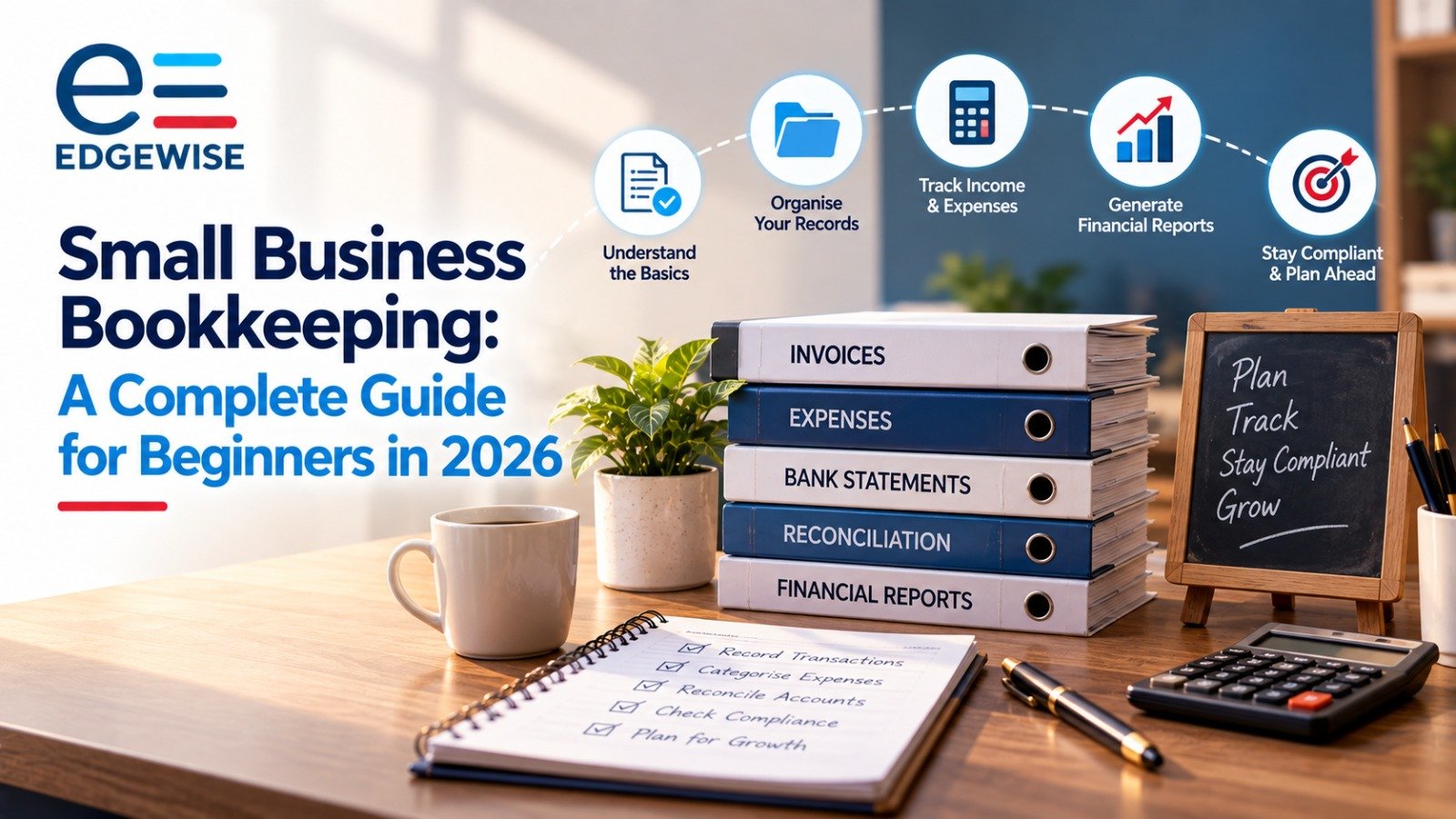
A simple bookkeeping system can be built through a few basic steps.
1. Separate Personal and Business Finances
Avoid mixing personal and business transactions.
Using a dedicated business bank account makes bookkeeping and reconciliation much easier.
2. Choose an Accounting Method
Businesses may use a cash or accrual basis depending on applicable accounting and tax requirements.
Under the cash basis, income and expenses are generally recognised when money is received or paid.
Under the accrual basis, income is generally recognised when earned and expenses when incurred.
3. Create a Chart of Accounts
Transactions should be organised into categories such as:
- Income;
- Expenses;
- Assets;
- Liabilities; and
- Equity.
A properly structured chart of accounts improves reporting and makes transactions easier to review.
4. Choose a Bookkeeping System
Very small businesses may initially use spreadsheets.
However, accounting software can help automate:
- Bank feeds;
- Invoicing;
- Expense recording;
- Reconciliations; and
- Financial reporting.
5. Record Transactions Regularly
Transactions should be recorded consistently throughout the year rather than waiting until tax season.
Each record should normally include the date, amount, description and appropriate account category.
6. Reconcile Bank Accounts
Compare your accounting records with bank and credit card statements regularly.
Reconciliations help identify:
- Missing transactions;
- Duplicate entries;
- Bank charges;
- Incorrect amounts; and
- Unpresented or uncleared transactions.
Monthly reconciliation is a common approach for many small businesses.
A Simple Bookkeeping Routine
Consistency is more important than trying to complete everything at year-end.
A practical schedule could look like this:
Daily
- Record sales and income;
- Record business expenses;
- Save receipts and invoices.
Weekly
- Categorise transactions;
- Review unpaid customer invoices;
- Check supplier bills;
- Review incoming and outgoing payments.
Monthly
- Reconcile bank accounts;
- Reconcile credit cards;
- Review Profit and Loss;
- Review cash flow;
- Check overdue customer balances.
Quarterly
- Review business performance;
- Review tax obligations where applicable;
- Analyse unusual movements in income or expenses.
Annually
- Organise financial records;
- Resolve outstanding bookkeeping issues;
- Prepare information required for tax filing;
- Review annual financial statements.
A daily, weekly, monthly, quarterly and annual routine of this kind keeps the records current throughout the year.
Key Financial Reports Every Small Business Should Understand
Good bookkeeping should ultimately produce useful financial information.
Three reports are particularly important.
Profit and Loss Statement
Shows:
Revenue - Expenses = Profit or Loss
It helps business owners understand whether operations are profitable.
Balance Sheet
Shows the business’s:
- Assets;
- Liabilities; and
- Equity
at a particular date.
Cash Flow Information
Shows where cash is coming from and where it is being spent.
A business may be profitable on paper but still face cash-flow problems, which is why both profitability and liquidity should be monitored.
Common Small Business Bookkeeping Mistakes
Some common bookkeeping problems include:
- Mixing personal and business transactions;
- Delaying bookkeeping for several months;
- Failing to retain receipts and supporting documents;
- Incorrectly categorising expenses;
- Not reconciling bank accounts;
- Ignoring overdue customer invoices;
- Not reviewing financial reports; and
- Waiting until tax season to organise records.
These issues can reduce the reliability of financial information and create unnecessary work at year-end.
Choosing Bookkeeping Software
The right software depends on the size and complexity of the business.
When selecting a system, consider:
- Number of transactions;
- Invoicing requirements;
- Bank-feed integration;
- Payroll requirements;
- Inventory;
- Multi-currency needs;
- Reporting;
- Number of users; and
- Integration with other systems.
Popular cloud-based accounting platforms include QuickBooks, Xero and Wave, although the most suitable software will depend on the business’s requirements.
Businesses should avoid choosing software based only on price. The system should be simple enough to maintain but capable of supporting future growth.
When Should You Hire or Outsource a Bookkeeper?
Managing bookkeeping internally can work when the business is small and transactions are straightforward.
Professional support may become useful when:
- Bookkeeping is regularly behind;
- Transaction volume has increased;
- Bank accounts are not being reconciled;
- The owner spends too much time maintaining records;
- Payroll has become more complicated;
- There are multiple revenue streams;
- Management requires more detailed financial reporting; or
- Historical records need significant clean-up.
As the business grows, outsourcing routine bookkeeping can free management to focus more on operations and growth.
Why Choose Edgewise Training Solutions Pvt Ltd?
At Edgewise Training Solutions Pvt Ltd, we help businesses establish organised, reliable and scalable bookkeeping processes.
Our accounting support can include:
- Transaction recording;
- Bank and credit card reconciliations;
- Accounts payable and receivable;
- Ledger review;
- Bookkeeping clean-up;
- Month-end accounting;
- Management accounts;
- Financial reporting;
- Supporting schedules for accountants and tax advisers; and
- Assistance with accounting software and bookkeeping processes.
Our focus is on accuracy, consistency, timely reporting and practical financial information.
Whether you are a new business establishing its first bookkeeping system or a growing company that needs additional accounting support, Edgewise can help you maintain organised financial records while allowing you to focus on running your business.
Disclaimer
This article is provided by Edgewise Training Solutions Pvt Ltd for general information and educational purposes only.
It does not constitute accounting, tax, legal, financial or regulatory advice and should not be relied upon as a substitute for professional advice based on your specific circumstances.
Bookkeeping methods, accounting requirements, tax treatment and record-keeping obligations can vary depending on the jurisdiction, business structure and nature of the business.
Businesses should consider their specific circumstances and obtain advice from an appropriately qualified accountant, tax adviser or other professional where necessary.
Software features, pricing and regulatory requirements may also change over time, so users should review the latest information before making accounting or bookkeeping decisions.