
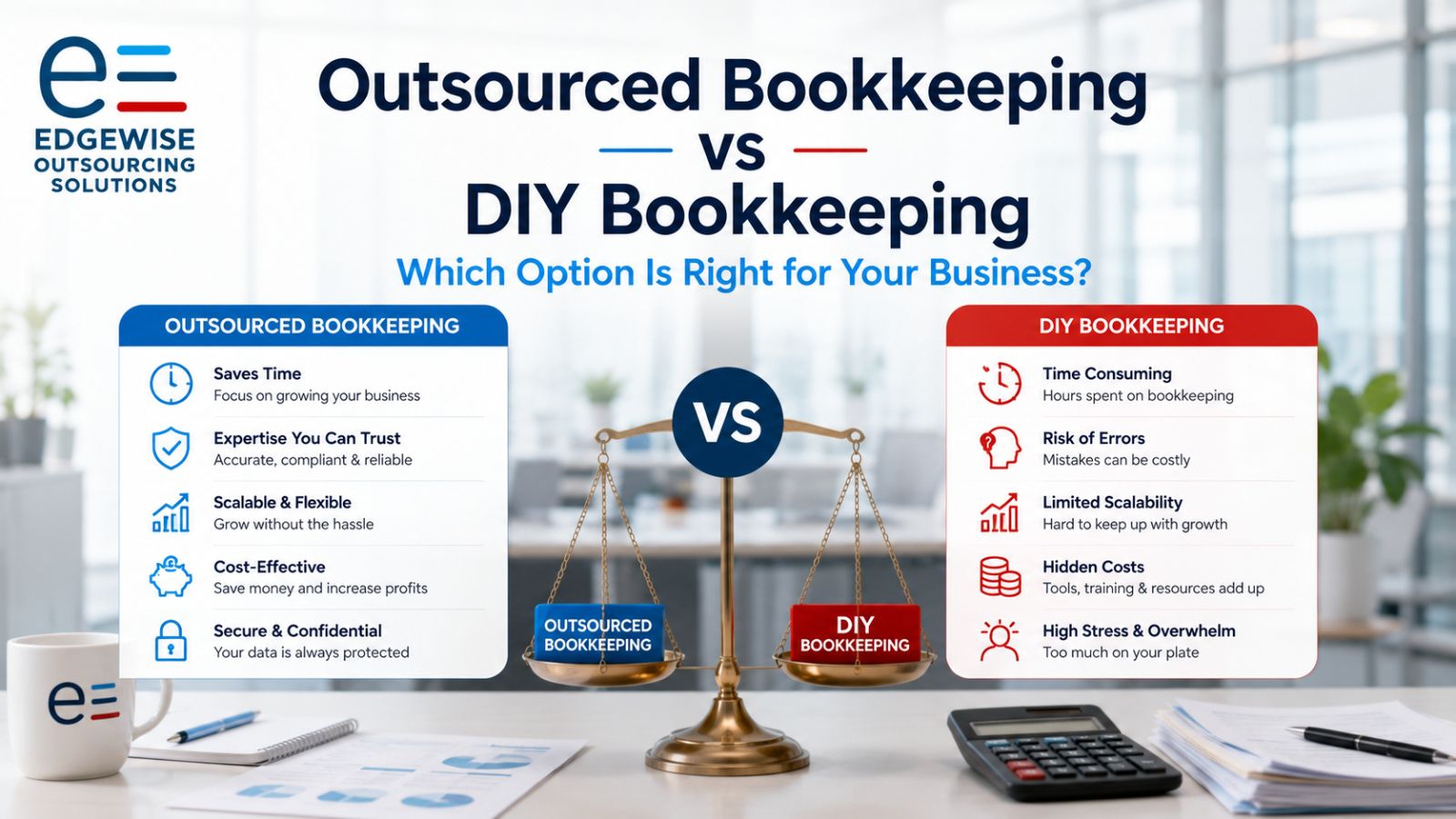
Many UK business owners face an important question: should bookkeeping be managed in-house, or should it be outsourced to professionals?
At the early stage of a business, managing books internally may appear simple. With basic accounting software and a limited number of transactions, business owners or small internal teams may be able to handle invoices, receipts, bank reconciliations, and VAT records.
However, as the business grows, bookkeeping becomes more time-consuming and complex. Transaction volumes increase, compliance requirements become stricter, payroll and VAT responsibilities expand, and management needs more accurate financial reports.
In this situation, outsourced bookkeeping can become a practical and strategic solution.
This article compares in-house bookkeeping and outsourced bookkeeping across key areas such as time, accuracy, compliance, cost, scalability, data security, technology, and financial reporting.
What Is In-House Bookkeeping?
In-house bookkeeping means managing bookkeeping activities within the business. This may be done by the business owner, an internal accountant, an admin employee, or a dedicated bookkeeper.
In-house bookkeeping may include:
- Recording invoices and receipts
- Bank reconciliation
- Payroll data support
- VAT record maintenance
- Expense categorisation
- Accounts payable tracking
- Accounts receivable tracking
- Financial report preparation
- Document management
The main advantage of in-house bookkeeping is direct control. However, it also requires time, technical knowledge, software access, regular updates, and compliance awareness.
What Is Outsourced Bookkeeping?
Outsourced bookkeeping means delegating bookkeeping tasks to an external professional team.
The outsourced team manages routine bookkeeping work remotely using cloud accounting software, secure file-sharing systems, and structured reporting processes.
Outsourced bookkeeping may include:
- Day-to-day bookkeeping
- Sales and purchase ledger support
- Bank reconciliation
- VAT support
- Payroll data support
- Expense classification
- Management accounts assistance
- Accounts payable and receivable support
- Financial reporting support
- Cloud accounting updates
The business continues to retain oversight and decision-making control, while routine processing is handled by trained professionals.
1. Time and Efficiency
In-House Bookkeeping
In-house bookkeeping may work well when the business is small and transactions are limited. However, as business activity grows, bookkeeping can become time-consuming.
Business owners may start spending significant time on invoices, reconciliations, payroll records, VAT data, and financial reports. This can reduce focus on sales, operations, customer service, and business development.
If an internal employee is handling bookkeeping without proper training, the process may become slower and less efficient.
Outsourced Bookkeeping
Outsourced bookkeeping helps save time by transferring routine bookkeeping tasks to a dedicated support team.
This allows business owners and internal teams to focus on core business activities such as client acquisition, service delivery, operations, and strategic planning.
With cloud-based systems and dashboards, businesses can still review financial information without manually processing every entry.
Better Choice
For businesses looking to save time and improve operational efficiency, outsourced bookkeeping is often a stronger option.
2. Accuracy and Error Reduction
In-House Bookkeeping
In-house bookkeeping may lead to errors if the person managing books does not have proper accounting training or is handling multiple responsibilities.
Common errors include:
- Wrong expense classification
- Missing receipts
- Incorrect VAT treatment
- Duplicate entries
- Unreconciled bank transactions
- Delayed postings
- Incomplete records
Even small errors can affect VAT returns, financial reports, and business decisions.
Outsourced Bookkeeping
Outsourced bookkeeping teams generally follow structured processes, review checks, and software-supported workflows.
This helps reduce errors and maintain cleaner financial records.
Professional bookkeepers are trained to handle routine accounting tasks more consistently, which improves the quality of financial reporting.
Better Choice
For businesses that want accurate and reliable records, outsourced bookkeeping can provide better process discipline and review support.
3. Compliance and Tax Readiness
In-House Bookkeeping
UK businesses need to maintain proper financial records and stay prepared for HMRC requirements, VAT submissions, Making Tax Digital, payroll-related records, and other compliance obligations.
Managing these requirements internally can become difficult when the business owner or bookkeeper is already occupied with day-to-day operations.
Missed deadlines or inaccurate submissions can result in penalties, queries, and unnecessary stress.
Outsourced Bookkeeping
A professional bookkeeping team can help businesses maintain better compliance discipline by keeping records updated, organised, and ready for review.
Outsourced bookkeeping support can assist with:
- VAT records
- Digital bookkeeping
- Bank reconciliations
- Payroll data support
- Expense records
- Management reports
- HMRC-related documentation support
This helps reduce last-minute pressure and improves readiness for compliance deadlines.
Better Choice
For businesses that want better compliance support and reduced stress, outsourced bookkeeping provides a practical advantage.
4. Control vs Professional Expertise
In-House Bookkeeping
One reason businesses prefer in-house bookkeeping is direct control. The bookkeeper is available internally, records can be accessed quickly, and changes can be made immediately.
However, control without expertise may not always produce the best result. If the internal person is not sufficiently trained, the business may miss opportunities for better reporting, cost control, cash flow analysis, or compliance improvement.
Outsourced Bookkeeping
Outsourcing does not mean losing control. With the right systems, businesses can still access reports, dashboards, ledgers, and financial updates regularly.
The difference is that routine work is handled by trained professionals, while the business owner retains oversight and decision-making authority.
A good outsourcing arrangement provides both visibility and expertise.
Better Choice
For businesses that want professional support while retaining oversight, outsourced bookkeeping offers a balanced solution.
5. Scalability and Flexibility
In-House Bookkeeping
As the business grows, bookkeeping workload also increases. More sales, more suppliers, more employees, more bank transactions, and more reporting requirements can quickly stretch an internal team.
Scaling in-house usually means hiring more people, training them, providing software access, and managing additional payroll costs.
This can be expensive and time-consuming.
Outsourced Bookkeeping
Outsourced bookkeeping is more flexible. Businesses can increase or reduce support based on transaction volume, seasonal workload, or growth stage.
This is useful for:
- Growing SMEs
- Seasonal businesses
- Ecommerce businesses
- Startups
- Businesses expanding into new locations
- Companies with fluctuating transaction volumes
- Better Choice
For businesses with growth plans, outsourced bookkeeping offers better scalability without immediate fixed hiring costs.
6. Cost of Operations
- In-House Bookkeeping
In-house bookkeeping involves several direct and indirect costs, such as:
- Salary
- Recruitment cost
- Training
- Payroll cost
- Employee benefits
- Software subscriptions
- Office infrastructure
- Supervision time
- Replacement cost if staff leave
For small and medium-sized businesses, these costs can become significant.
Outsourced Bookkeeping
Outsourced bookkeeping generally offers a more flexible cost structure. Businesses can choose support based on actual requirements and transaction volume.
This helps reduce fixed overheads and gives more predictability over bookkeeping costs.
Better Choice
For businesses that want cost flexibility and lower fixed overheads, outsourced bookkeeping can be more efficient.
7. Data Security and Backup
In-House Bookkeeping
When bookkeeping is handled internally, the business is responsible for securing financial data.
This may require:
- Secure systems
- Regular backups
- Antivirus protection
- Access controls
- GDPR compliance
- Data recovery planning
- Software updates
For many SMEs, maintaining these systems properly can be costly and time-consuming.
Outsourced Bookkeeping
Professional outsourced bookkeeping providers usually use secure cloud systems, encrypted access, restricted permissions, backups, and structured data-sharing processes.
This can improve data safety and reduce the risk of data loss.
However, businesses should always check the provider’s data security practices before sharing financial information.
Better Choice
For businesses that want stronger data handling and backup discipline, outsourced bookkeeping can provide better support, subject to choosing the right provider.
8. Technology and Reporting
In-House Bookkeeping
Many businesses use accounting tools such as Xero, QuickBooks, or Sage. However, simply having software is not enough.
The internal team must know how to use the software properly, keep it updated, generate useful reports, and interpret financial data.
Without proper training, businesses may not get full value from these tools.
Outsourced Bookkeeping
Outsourced bookkeeping teams are usually familiar with cloud accounting tools and reporting systems.
They can help businesses maintain updated records, generate regular reports, and improve financial visibility.
This gives business owners better access to information for decision-making.
Better Choice
For businesses that want better use of technology and reporting, outsourced bookkeeping can provide stronger support.
- Summary: In-House vs Outsourced Bookkeeping
- Area
- In-House Bookkeeping
- Outsourced Bookkeeping
- Time
- Can become time-consuming as business grows
- Saves time and reduces routine workload
- Accuracy
- Depends on internal skill level
- Supported by trained professionals and review processes
- Compliance
- Can be difficult to manage internally
- Better compliance discipline and organised records
- Control
- Direct internal control
- Oversight retained with professional execution
- Scalability
- Requires hiring and training
- Flexible support based on workload
- Cost
- Higher fixed costs
- More flexible cost structure
- Data Security
- Business must manage security internally
- Secure systems and controlled access, subject to provider standards
- Technology
- Requires training and ongoing software management
- Access to experienced users of cloud accounting tools
When Should a Business Consider Outsourcing Bookkeeping?
A UK business should consider outsourcing bookkeeping if:
- The owner spends too much time on bookkeeping
- Bank reconciliations are delayed
- VAT records are not updated regularly
- Errors are increasing
- Internal staff are overloaded
- Reports are not available on time
- The business is growing quickly
- Hiring a full-time bookkeeper is not cost-effective
- Financial data is not giving useful insights
- Compliance deadlines are becoming stressful
If these signs are visible, outsourcing may help improve efficiency, accuracy, and control.
How Edgewise Training Solutions Pvt Ltd Can Support
At Edgewise Training Solutions Pvt Ltd, we support UK businesses and accounting firms with reliable bookkeeping and back-office accounting assistance.
Our support can include:
- Day-to-day bookkeeping
- Invoice processing
- Sales and purchase ledger support
- Bank reconciliation
- Expense categorisation
- VAT support
- Payroll data support
- Accounts payable and receivable support
- Management reporting assistance
- Cloud accounting support
- Back-office accounting assistance
Our objective is to help businesses reduce routine workload, improve accuracy, strengthen financial reporting, and focus more on growth.
We work as an extended support team, allowing businesses to retain oversight while routine bookkeeping is managed through structured processes.
Conclusion
In-house bookkeeping may work at the early stage of a business. However, as the business grows, bookkeeping becomes more time-consuming, technical, and compliance-sensitive.
Outsourced bookkeeping offers a flexible, cost-effective, and scalable alternative. It helps businesses save time, reduce errors, maintain better records, improve financial visibility, and focus more on long-term growth.
The right choice depends on the size, complexity, budget, and growth plans of the business.
For many UK SMEs and growing businesses, outsourced bookkeeping provides the right balance between professional expertise, cost control, scalability, and retained oversight.
At Edgewise Training Solutions Pvt Ltd, we help businesses and accounting firms build reliable bookkeeping support systems so they can operate with clarity, confidence, and control.
If your business is spending too much time managing books internally, now may be the right time to explore outsourced bookkeeping support.