
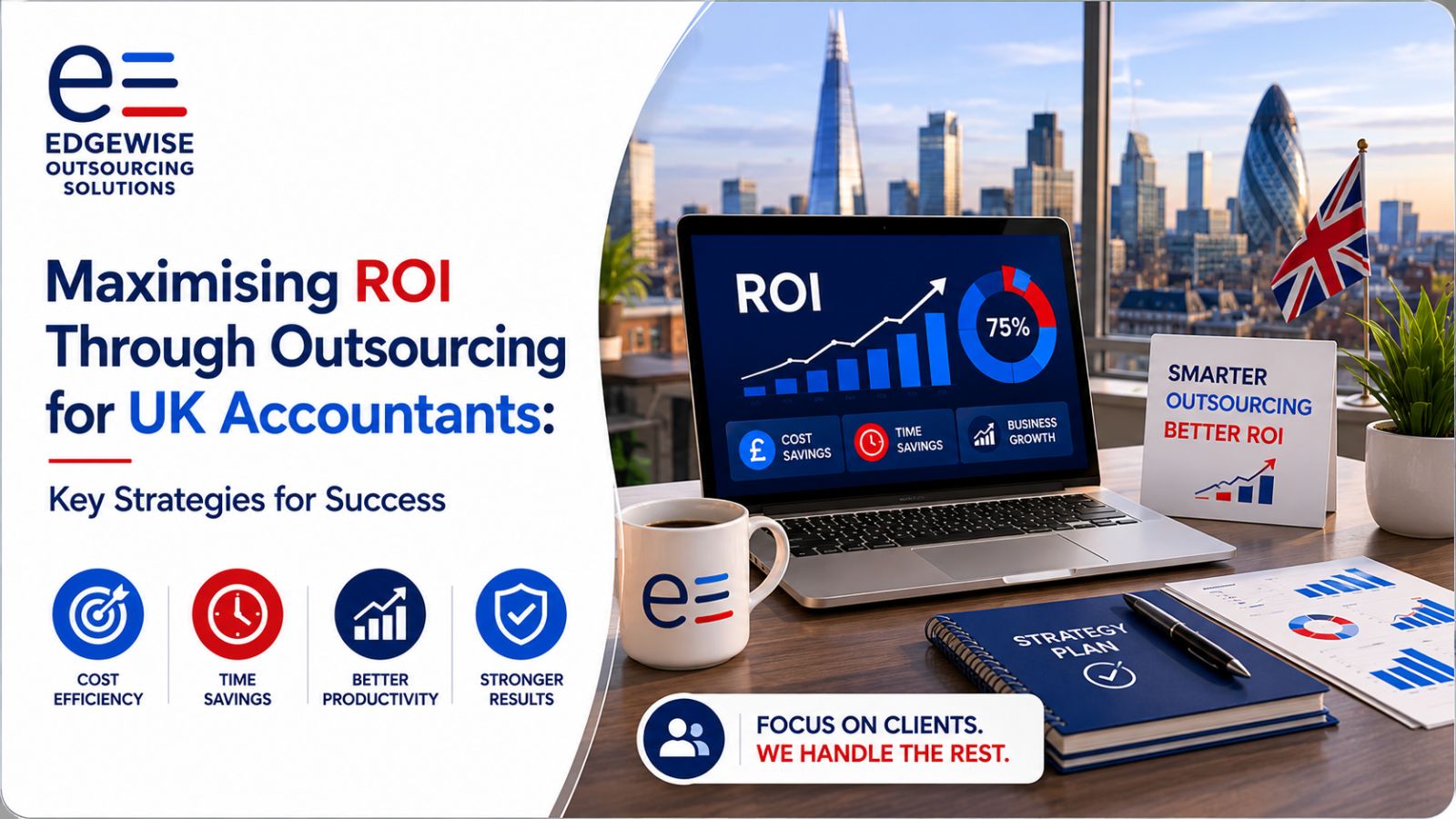
Outsourcing has become an important growth tool for UK accountants and accounting firms. What was once seen mainly as a cost-saving arrangement is now being used as a strategic operating model to improve efficiency, increase capacity, manage compliance pressure, and deliver better client service.
UK accounting firms are operating in a competitive and demanding environment. Clients expect faster turnaround, accurate reporting, timely compliance, and more advisory support. At the same time, firms are dealing with rising employment costs, talent shortages, technology changes, and increasing regulatory requirements.
In such a situation, outsourcing can help accounting practices delegate routine and time-consuming tasks to trained professionals while allowing internal teams to focus on client engagement, advisory services, and strategic growth.
However, outsourcing delivers maximum value only when it is planned and managed properly. The right outsourcing strategy can improve return on investment, reduce operational pressure, and support long-term profitability.
Why Outsourcing Has Become Important for UK Accountants
Accounting firms today are expected to do more with limited resources.
They need to manage bookkeeping, payroll, VAT, year-end accounts, corporation tax support, reporting, client queries, compliance deadlines, and advisory work. Managing all these tasks internally can become expensive and inefficient, especially for small and mid-sized practices.
Outsourcing helps firms delegate non-core and repetitive accounting tasks to an external professional team. This allows internal staff to concentrate on higher-value work such as client advisory, tax planning, business consultancy, management reporting, and relationship management.
For many UK accountants, outsourcing is no longer optional. It is becoming a practical requirement for maintaining efficiency, profitability, and service quality.
- Key Benefits of Outsourcing for UK Accounting Firms
1. Reduction in Overhead Costs
One of the major advantages of outsourcing is cost reduction.
Hiring and maintaining an in-house team involves several expenses, including salaries, benefits, training, software licences, office infrastructure, payroll costs, and management supervision.
Outsourcing allows accounting firms to reduce fixed overheads and pay for support based on actual requirements.
This creates a more flexible cost structure and allows firms to reinvest savings into technology, client acquisition, advisory services, or practice development.
2. Access to Skilled Accounting Professionals
A professional outsourcing partner can provide access to trained accountants and bookkeeping professionals with experience in handling accounting tasks, tax support, payroll processing, VAT workflows, and year-end preparation.
This helps firms avoid long recruitment cycles and reduces the burden of training new staff internally.
With the right outsourcing support, accounting firms can access technical expertise without immediately expanding their permanent team.
3. Better Scalability
Client workload is not always consistent. Accounting firms often experience spikes during VAT quarters, payroll cycles, January tax season, year-end accounts preparation, and new client onboarding.
Outsourcing helps firms scale their capacity based on workload.
This means firms can increase support during peak periods and reduce dependency during quieter months, without the financial burden of permanent hiring.
Scalability is one of the strongest reasons why accounting firms are adopting outsourcing as a long-term operating strategy.
4. Improved Efficiency and Turnaround Time
When routine accounting tasks are managed by a dedicated outsourcing team, internal staff can focus on review, client communication, advisory, and finalisation.
This improves workflow efficiency and helps reduce backlogs.
Outsourcing can support faster delivery of:
- Bookkeeping updates
- Payroll processing
- VAT workings
- Year-end working papers
- Management reports
- Accounts payable and receivable support
- Routine back-office accounting tasks
Faster turnaround leads to better client satisfaction and improved internal productivity.
5. More Focus on Core and Advisory Services
Outsourcing allows firms to shift internal focus from routine compliance work to higher-value services.
These may include:
- Tax planning
- Financial advisory
- Business consultancy
- Management reporting
- Cash flow planning
- Budgeting
- Forecasting
- Virtual CFO support
- Client relationship management
These services can improve client retention, increase profitability, and differentiate the firm in a competitive market.
How to Maximise ROI from Outsourcing
Outsourcing does not automatically guarantee success. To achieve maximum return on investment, firms must approach it strategically.
1. Set Clear Objectives
Before selecting an outsourcing partner, the accounting firm should clearly define its objectives.
The objective may be:
- Cost reduction
- Faster turnaround
- Access to skilled professionals
- Better scalability
- Improved compliance support
- Reduced workload pressure
- More time for advisory services
Clear objectives help firms decide which services to outsource and what type of partner they need.
For example, if the goal is cost reduction, routine bookkeeping and data processing may be outsourced first. If the goal is technical support, the firm may need a partner with experience in tax, VAT, payroll, or year-end accounts.
2. Choose the Right Outsourcing Partner
The success of outsourcing depends heavily on choosing the right partner.
Accounting firms should evaluate an outsourcing provider based on:
- Industry experience
- Service capability
- Team expertise
- Technology usage
- Communication process
- Data security standards
- Client references
- Quality control systems
- Ability to scale
- Understanding of UK accounting requirements
The right outsourcing partner should work as an extension of the internal team, not merely as a low-cost service provider.
3. Use Technology and Automation
Modern outsourcing is strongly supported by accounting technology, cloud software, automation tools, secure portals, workflow systems, and reporting dashboards.
A good outsourcing partner can help firms use technology more effectively without heavy upfront investment.
Common tools may include:
- Xero
- QuickBooks
- Sage
- Dext
- Hubdoc
- AutoEntry
- Microsoft Excel
- Workflow management systems
- Secure document-sharing platforms
Technology improves accuracy, speed, transparency, and accountability.
4. Maintain Clear Communication
Communication is one of the most important factors in outsourcing success.
Accounting firms should maintain regular communication with their outsourcing partner through agreed channels such as email, video calls, task management tools, shared trackers, or scheduled review meetings.
Clear communication helps avoid confusion, improves accountability, and ensures that both teams understand priorities, deadlines, and client-specific requirements.
5. Monitor Performance and Quality
To maximise ROI, firms should regularly monitor the performance of their outsourcing partner.
This can be done through measurable KPIs such as:
- Turnaround time
- Error rate
- Deadline adherence
- Client-wise task completion
- Rework percentage
- Response time
- Quality of working papers
- Review comments
- Compliance with agreed process
Regular monitoring ensures quality remains consistent and allows issues to be corrected early.
6. Treat Outsourcing as a Strategic Partnership
One common mistake firms make is treating outsourcing only as a cost-cutting exercise.
A good outsourcing partner can provide much more than basic task completion. They can bring process discipline, technical knowledge, technology support, scalability, and operational efficiency.
When the outsourcing partner is treated as a strategic extension of the firm, the relationship becomes more productive and long-term value improves.
- Top Services Commonly Outsourced by UK Accountants
UK accounting firms commonly outsource the following services:
- Bookkeeping Services
Outsourced bookkeeping helps firms maintain accurate and updated financial records without overloading internal staff.
Payroll Processing
Payroll outsourcing helps ensure timely salary processing, tax deductions, pension-related support, and PAYE compliance assistance.
VAT Support
VAT-related support can help accounting firms manage quarterly VAT deadlines, review VAT workings, and support compliance processes.
Corporation Tax Support
Outsourcing can support corporation tax workings, data preparation, schedules, and related documentation assistance.
Year-End Accounts Support
Year-end outsourcing may include preparation of working papers, ledger review, income and expense analysis, schedules, and accounts finalisation support.
Back-Office Accounting Support
This includes accounts payable, accounts receivable, document management, reporting support, reconciliations, and routine accounting assistance.
- Common Mistakes to Avoid When Outsourcing
1. Selecting a Provider Only on Cost
Low cost alone should not be the deciding factor.
The outsourcing partner must have the right technical knowledge, quality control process, data security standards, and communication structure.
A cheaper provider without quality discipline can create rework, delays, compliance risks, and client dissatisfaction.
2. Not Setting Clear Expectations
If responsibilities, timelines, formats, and review processes are not clearly defined, outsourcing can become inefficient.
Firms should clearly define:
- Scope of work
- Deadlines
- Reporting format
- Communication method
- Review process
- Escalation process
- Quality standards
3. Ignoring Data Security
Accounting firms handle sensitive financial and client information. Therefore, data security must be a priority.
Before outsourcing, firms should evaluate whether the partner follows secure data-sharing practices, access controls, confidentiality standards, and data protection procedures.
4. Poor Communication
Lack of communication can lead to delays, confusion, and quality issues.
Regular coordination and transparent updates are essential for successful outsourcing.
5. Not Reviewing Performance
Outsourcing should be reviewed regularly. Without performance monitoring, firms may not know whether they are actually getting the expected value.
Regular review helps improve process quality and ensures return on investment.
Future Trends in Accounting Outsourcing
The outsourcing model for accountants is evolving rapidly.
Some important trends include:
- Increased Use of AI and Automation
AI and automation are helping reduce repetitive accounting tasks, improve accuracy, identify patterns, and generate faster reports.
This allows accountants to spend more time on analysis and advisory services.
Rise of India as an Accounting Outsourcing Hub
India continues to be a major outsourcing destination due to its large pool of accounting professionals, cost efficiency, technology capability, and familiarity with global accounting processes.
Growing Importance of Advisory Services
Accounting firms are increasingly moving from traditional compliance work towards advisory-led services. Outsourcing supports this shift by freeing internal teams from routine processing work.
Increasing Use of Data Analytics
Big data and analytics are helping accountants provide better insights, forecasting, and business advice to clients.
Outsourcing partners with strong reporting and analytics capability can support firms in delivering more value-added services.
How Edgewise Training Solutions Pvt Ltd Can Support UK Accounting Firms
At Edgewise Training Solutions Pvt Ltd, we support accounting firms with reliable and scalable accounting outsourcing assistance.
Our services can support firms in areas such as:
- Bookkeeping
- Payroll support
- VAT support
- Year-end accounts assistance
- Corporation tax support
- Accounts payable and receivable support
- Management reporting assistance
- Back-office accounting support
- Cloud accounting support
- Workflow and documentation support
Our objective is to help accounting firms reduce routine workload, improve efficiency, control operating costs, and create more time for advisory and client-facing services.
We work as an extended support team, helping firms build a more scalable and efficient delivery model.
Conclusion
Outsourcing has become an important part of modern accounting practice management.
For UK accountants, it offers a practical way to reduce costs, improve efficiency, access expertise, scale services, and focus on higher-value advisory work.
However, maximum ROI from outsourcing depends on selecting the right partner, setting clear objectives, maintaining strong communication, using technology effectively, and monitoring quality consistently.
At Edgewise Training Solutions Pvt Ltd, we help accounting firms build efficient outsourcing support systems so they can serve clients better, reduce operational pressure, and grow with confidence.
If your accounting firm wants to improve profitability, reduce routine workload, and focus more on strategic client services, outsourcing can be the right step forward.