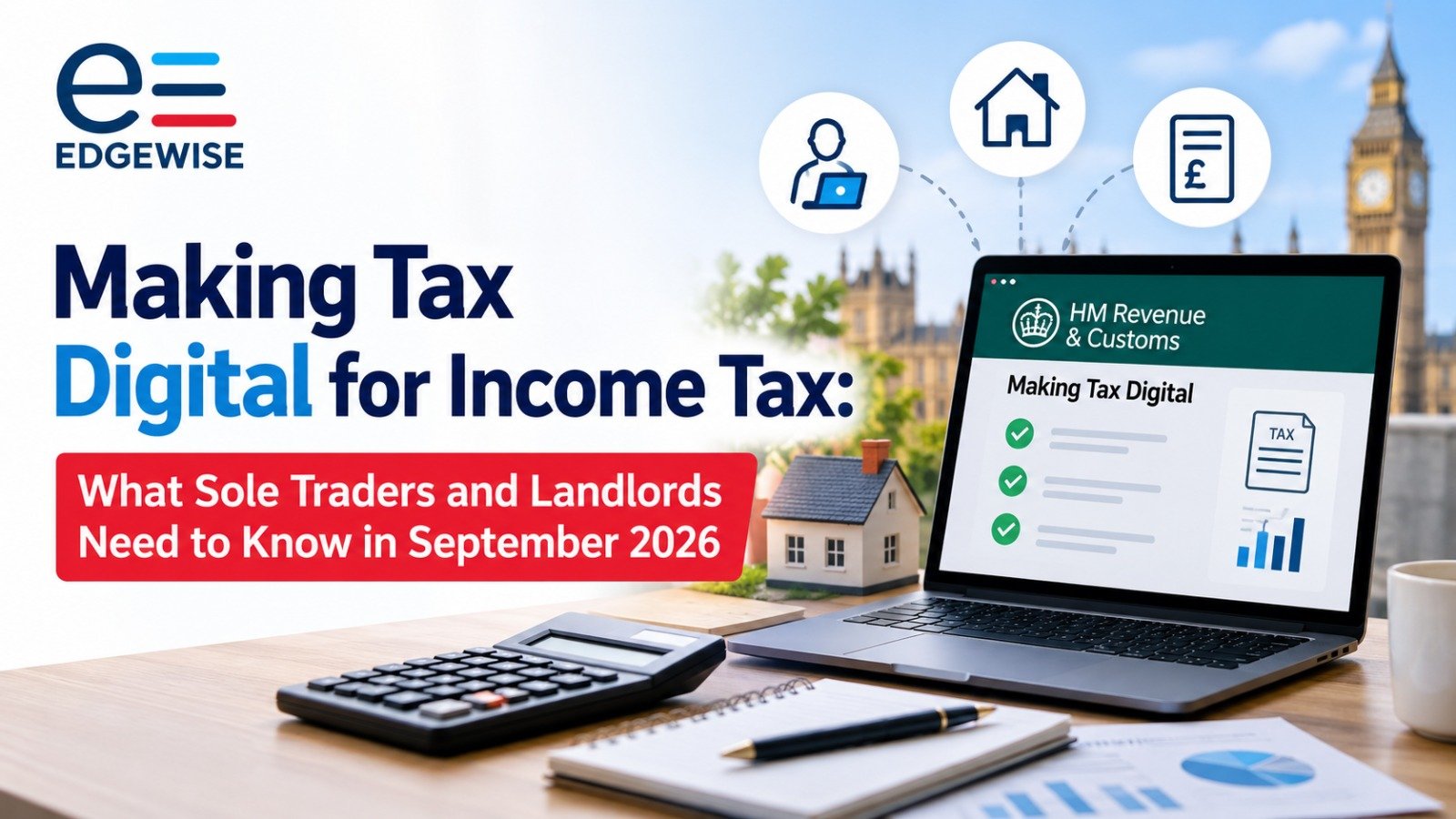
Making Tax Digital for Income Tax (MTD for Income Tax) represents a significant change in the way many UK sole traders and landlords maintain their accounting records and report information to HM Revenue & Customs (HMRC).
From 6 April 2026, MTD for Income Tax became mandatory for certain individuals with income from self-employment and/or property. With HMRC beginning to sign up taxpayers who have not registered themselves from September 2026, affected individuals should review their position and ensure they are prepared.
What Is Making Tax Digital for Income Tax?
Making Tax Digital for Income Tax is HMRC’s digital reporting system for individuals receiving income from self-employment, property, or both.
Under MTD, affected taxpayers are required to:
- Maintain digital accounting records using compatible software;
- Record their self-employment and/or property income and expenses digitally;
- Submit quarterly updates to HMRC; and
- Complete their annual tax return and report other relevant income through compatible software.
MTD does not remove the requirement to complete the year-end tax reporting process. Instead, it introduces digital record keeping and quarterly reporting throughout the tax year.
Who Needs to Use MTD from 6 April 2026?
For the 2026/27 tax year, an individual generally needs to use MTD for Income Tax where:
- They are registered for Self Assessment;
- They receive income from self-employment, property, or both; and
- Their total qualifying income exceeds £50,000.
For determining whether MTD applies from 6 April 2026, HMRC generally looks at the qualifying income reported in the individual’s 2024/25 Self Assessment tax return.
Importantly, qualifying income is generally based on gross self-employment and property income before deducting expenses, rather than taxable profit.
For example, if a sole trader has gross business income of £38,000 and gross rental income of £16,000, the combined qualifying income would generally be £54,000. Subject to the applicable rules and exemptions, the individual may therefore fall within MTD for Income Tax.
Why Is September 2026 Important?
September 2026 is particularly important for taxpayers who were required to join MTD for Income Tax from 6 April 2026 but have not yet signed up.
From September 2026 onwards, HMRC is beginning to sign up affected taxpayers automatically in stages where HMRC’s records indicate that their qualifying income exceeded £50,000 in the 2024/25 tax year.
HMRC will contact taxpayers after signing them up.
However, taxpayers should not rely solely on HMRC’s automatic process. Information held by HMRC may not reflect changes in circumstances since the individual’s last tax return.
Signing up directly, or through an authorised agent, can help ensure that the correct income sources and current circumstances are reflected from the outset.
What Records Need to Be Kept?
Taxpayers within MTD for Income Tax need to maintain digital records of relevant business and property transactions.
Depending on the nature of the activity, these records may include:
- Sales and business income;
- Rental and property income;
- Business expenses;
- Property-related expenses;
- Purchase transactions;
- Other relevant income and expenditure records; and
- Supporting accounting information required for the relevant business or property activity.
The records should be maintained using MTD-compatible software or an appropriate digitally linked system.
Businesses currently relying heavily on manual spreadsheets, paper records or year-end bookkeeping should therefore review whether their existing accounting process will meet MTD requirements.
What Are Quarterly Updates?
Under MTD, affected taxpayers need to send HMRC quarterly updates summarising income and expenses recorded in their digital records.
These quarterly updates are not separate tax returns.
They provide HMRC with periodic summaries of the taxpayer’s self-employment and/or property activity during the year.
For the 2026/27 tax year, the standard quarterly update deadlines are:
| Update | Deadline |
|---|---|
| First quarterly update | 7 August 2026 |
| Second quarterly update | 7 November 2026 |
| Third quarterly update | 7 February 2027 |
| Fourth quarterly update | 7 May 2027 |
The taxpayer must still complete the required year-end tax reporting process and pay any tax due by the applicable deadline.
What Happens If a Quarterly Update Is Late?
HMRC has introduced a penalty regime for MTD-related submissions, but there is an important transitional concession for the first mandatory year.
For the 2026/27 tax year, HMRC has confirmed that penalty points will not be issued for missing quarterly update deadlines.
However, this does not mean that quarterly reporting can simply be ignored.
Any outstanding quarterly updates still need to be submitted before the taxpayer can complete their tax return.
The concession also does not remove the normal consequences of failing to submit the annual tax return or pay tax on time. Penalty rules continue to apply to late tax returns and late tax payments.
From later tax years, late quarterly submissions can result in penalty points and ultimately financial penalties once the relevant threshold is reached.
MTD Thresholds Are Reducing
MTD for Income Tax is being introduced progressively.
The current implementation timetable is:
| Tax Year MTD Starts | Qualifying Income Threshold | Income Generally Tested From |
|---|---|---|
| 2026/27 - from 6 April 2026 | Over £50,000 | 2024/25 tax return |
| 2027/28 - from 6 April 2027 | Over £30,000 | 2025/26 tax return |
| 2028/29 - from 6 April 2028 | Over £20,000 | 2026/27 tax return |
Therefore, even sole traders and landlords who are outside MTD during 2026/27 should monitor their qualifying income, as they may become subject to the requirements in subsequent years.
What Should Sole Traders and Landlords Do Now?
With MTD already operating for the first mandatory group, affected taxpayers should review their position without delay.
Key actions include:
- Check qualifying income
Review gross self-employment and property income reported in the relevant Self Assessment return. - Confirm whether MTD applies
Consider the applicable income threshold and whether any exemption applies. - Check registration status
Confirm whether you have already signed up or whether HMRC has signed you up. - Choose compatible software
Ensure that your accounting or bookkeeping software is compatible with MTD for Income Tax. - Move towards digital record keeping
Income and expense transactions should be recorded digitally rather than being reconstructed only at the end of the year. - Review quarterly reporting deadlines
Establish a process for completing bookkeeping and submitting quarterly updates on time. - Correct any missing updates
If quarterly updates have already been missed during 2026/27, review what needs to be submitted. - Continue planning for the annual tax return
Quarterly updates do not replace the year-end reporting obligation.
How Edgewise Training Solutions Pvt Ltd Can Help
Preparing for Making Tax Digital involves more than simply purchasing accounting software. Businesses and landlords need an effective process for maintaining records, reviewing transactions and ensuring information can be reported correctly throughout the year.
Edgewise Training Solutions Pvt Ltd can support sole traders, landlords and businesses in understanding and preparing for the changing digital reporting environment.
Our support can include:
- Reviewing whether MTD for Income Tax may apply;
- Understanding qualifying income and applicable thresholds;
- Supporting MTD readiness assessments;
- Helping establish structured digital bookkeeping processes;
- Assistance with accounting software and digital record keeping;
- Supporting preparation of quarterly accounting information;
- Identifying gaps in existing bookkeeping processes;
- Helping businesses transition from manual to digital accounting records; and
- Providing practical accounting and compliance support.
Need Help With Making Tax Digital?
If you are a sole trader or landlord and are unsure whether Making Tax Digital for Income Tax applies to you, Edgewise Training Solutions Pvt Ltd can help you assess your position and prepare for the new digital reporting requirements.
Whether you need assistance understanding your MTD obligations, organising digital records, preparing for quarterly reporting or improving your accounting processes, our team can help you take the next steps with greater clarity and confidence.
Disclaimer
This article is intended for general information and educational purposes only and is based on HMRC guidance available as at September 2026. It does not constitute tax, legal, accounting or other professional advice and should not be relied upon as a substitute for advice based on your individual circumstances.
Tax legislation, HMRC guidance, thresholds, deadlines and administrative procedures may change. The application of Making Tax Digital for Income Tax can also depend on an individual’s specific income sources, circumstances and eligibility for exemptions.
Readers should review the latest HMRC guidance and, where appropriate, obtain advice from a suitably qualified UK tax or accounting professional before taking or refraining from any action.