
As an accounting practice grows, responsibilities also increase. Firms need to manage more clients, higher transaction volumes, stricter deadlines, vendor payments, reporting requirements, and compliance-related documentation.
One area that often becomes difficult to manage internally is accounts payable.
Accounts payable is a critical part of financial operations. It affects vendor relationships, cash flow management, payment discipline, internal efficiency, and overall financial control. When AP processes are not handled properly, firms may face delayed payments, duplicate entries, vendor disputes, weak reporting, and increased pressure on internal teams.
For growing UK accounting practices, outsourcing accounts payable can be a practical solution.
It allows firms to delegate routine AP tasks to trained professionals while retaining control over approvals, payments, client relationships, and final review.
This article explains what accounts payable outsourcing means, why firms consider it, the benefits, possible challenges, automation versus outsourcing, and how to choose the right service provider.
What Is Accounts Payable?
Accounts payable refers to the amount a business owes to vendors or suppliers for goods or services received.
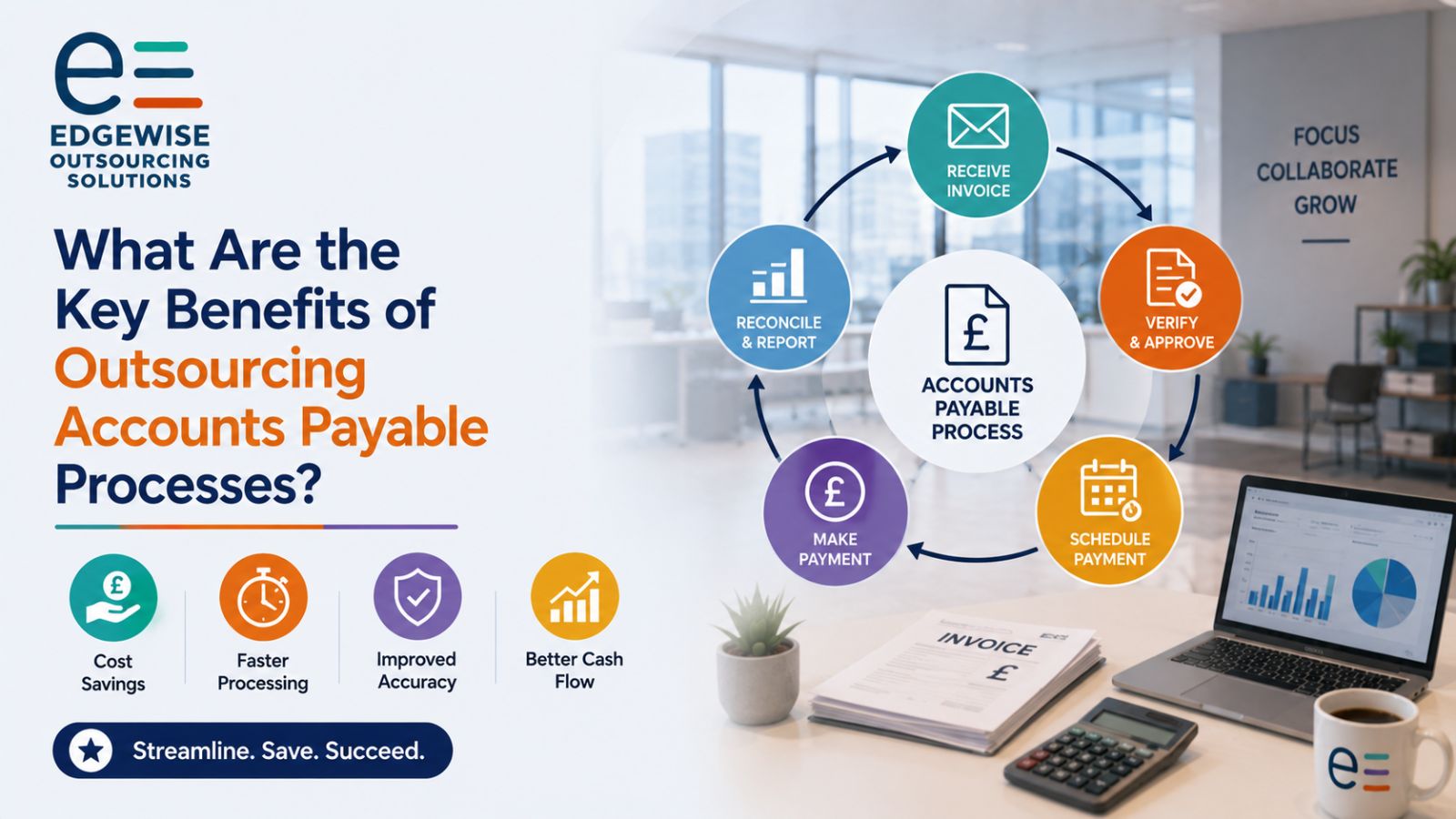
The accounts payable process generally includes:
- Invoice processing
- Purchase order matching
- Data entry
- Approval workflow
- Vendor communication
- Payment processing
- Reconciliation
- Reporting
Efficient AP management is important because delays or errors can affect supplier trust, payment discipline, cash flow visibility, and financial reporting quality.
For accounting firms managing AP on behalf of multiple clients, the workload can become significant as client businesses grow.
Challenges of Managing Accounts Payable In-House
Managing accounts payable internally may work well when transaction volumes are low. However, as client businesses grow, the process becomes more complex and time-consuming.
Common in-house AP challenges include:
- Delayed invoice approvals
- Manual data-entry errors
- Duplicate invoice processing
- Missed vendor payments
- Poor vendor communication
- Unclear outstanding liability position
- Weak cash flow visibility
- Lack of proper documentation
- Staff spending too much time on routine admin
- Difficulty managing workload during peak periods
The AP process involves several steps, including invoice approval, matching invoices with purchase orders or receipts, responding to vendor queries, resolving discrepancies, and ensuring payments are processed on time.
If the internal team is already stretched, AP work can create operational pressure and reduce time available for higher-value services.
What Is Accounts Payable Outsourcing?
Accounts payable outsourcing means appointing an external professional service provider to manage part or all of the accounts payable process.
The outsourced team may handle:
- Invoice processing
- Invoice validation
- Expense recording
- Vendor payment support
- Vendor management
- Accounts payable reporting
- Reconciliation support
- Documentation support
- Query resolution
The accounting firm continues to retain control over approval rules, payment authorisation, client communication, and final review.
In other words, outsourcing helps firms create a structured AP workflow while reducing internal administrative pressure.
Accounts Payable Outsourcing Procedure
A professional AP outsourcing arrangement usually follows a structured process.
1. Onboarding Process
Once the outsourcing provider is selected, the onboarding stage begins.
This involves understanding the firm’s requirements, client-specific processes, existing AP workflow, approval matrix, reporting expectations, and communication structure.
A proper onboarding process helps avoid confusion and ensures that the outsourced team understands how the firm operates.
2. Data Migration and System Access
The next step is data migration or system access setup.
Depending on the agreed model, the outsourcing provider may work through the firm’s accounting software or use its own approved workflow system.
This stage may include:
- Setting up software access
- Migrating vendor records
- Sharing historical AP data
- Defining user permissions
- Organising invoice folders
- Establishing secure data-sharing processes
Data security and access control must be carefully managed at this stage.
3. Invoice Processing
Invoice processing is one of the core AP functions.
The outsourced team verifies purchase invoices, checks supplier details, matches invoices with purchase orders or supporting documents, records expenses, and ensures that invoices are processed accurately.
Accurate invoice processing supports better cash flow management and reduces the risk of duplicate payments, missed liabilities, or incorrect expense recording.
4. Approval Process
After invoice processing, the invoices are sent for review and approval as per the agreed approval matrix.
The accounting firm or client retains control over approvals. If corrections are required, the outsourced team makes the necessary updates before the invoice moves to payment scheduling.
This ensures that outsourcing does not result in loss of control.
5. Payment Process
Payment processing must be handled carefully because it directly affects supplier relationships and cash flow.
In many outsourcing models, the provider prepares payment schedules, tracks due dates, and supports payment planning. Actual payment approval and release should remain subject to the firm’s or client’s authorisation policy.
A structured payment process helps avoid late fees, missed discounts, duplicate payments, and supplier disputes.
6. Vendor Management
Vendor management is an important part of AP.
It may include:
- Vendor onboarding
- Maintaining updated vendor records
- Responding to vendor queries
- Resolving payment discrepancies
- Tracking outstanding invoices
- Supporting supplier communication
Poor vendor management can lead to delayed deliveries, invoice disputes, missed discounts, and relationship issues.
An outsourcing partner can help maintain consistent vendor communication and better payment tracking.
7. Reporting Process
The outsourcing provider should provide regular AP reports.
These may include:
- Outstanding liabilities
- Payment status
- Vendor ageing
- Invoice processing status
- Pending approvals
- Cash flow impact
- Exception reports
- Query reports
Dashboard-based reporting can help firms monitor the AP process without micromanaging every transaction.
- Benefits of Outsourcing Accounts Payable
1. Saving Time and Cost
Accounts payable outsourcing can reduce the time and cost involved in managing AP internally.
Firms can reduce the need for additional hiring, training, software investment, and supervision. The internal team can redirect time towards review, advisory, client communication, and growth-focused work.
Outsourcing can also help reduce penalties, overpayments, and missed early-payment discounts through better process discipline.
2. Improved Efficiency
Outsourcing providers usually use defined workflows, technology, and trained resources to process AP work more efficiently.
This can help reduce delays, improve turnaround time, and create a more predictable AP cycle.
A faster AP process also helps maintain stronger vendor relationships.
3. Access to Better Tools
AP outsourcing can give firms access to technology and systems that may otherwise require internal investment.
These tools can support invoice processing, approval tracking, reporting, documentation, and payment monitoring.
Better tools also reduce manual paperwork and data-entry effort.
4. Better Visibility and Coverage
A structured AP outsourcing model gives firms better visibility over invoices, vendor payments, liabilities, and cash flow impact.
Regular reports and dashboards help firms track AP status in real time and identify risks early.
This improves decision-making and strengthens financial control.
5. Improved Cash Flow Management
Timely payment tracking and proper AP reporting help businesses manage cash flow better.
A good AP process can help clients:
- Avoid late payment penalties
- Prevent overpayments
- Plan cash outflows
- Track upcoming liabilities
- Maintain vendor relationships
- Identify payment priorities
This makes AP outsourcing valuable not only for processing but also for financial planning.
6. Reduced Errors
Manual AP processes are prone to errors such as duplicate entries, incorrect coding, missed invoices, wrong vendor details, and payment mismatches.
Outsourcing providers generally use trained teams and structured checks to reduce these errors.
This improves reporting quality and reduces rework.
Challenges of Accounts Payable Outsourcing and How to Manage Them
While accounts payable outsourcing has several benefits, firms should also consider the risks and manage them properly.
1. Reduced Process Control
Some firms worry that outsourcing AP may reduce control over client financial transactions or vendor communication.
This risk can be managed by:
- Defining approval rights clearly
- Retaining payment authorisation internally
- Using dashboards and trackers
- Setting reporting frequency
- Holding regular review meetings
- Maintaining communication with key vendors
- Creating escalation rules
With the right controls, outsourcing can improve visibility rather than reduce it.
2. Privacy and Data Security Concerns
AP outsourcing involves sensitive vendor, financial, and payment information.
Before selecting a provider, firms should check:
- Data security policies
- Access control process
- Confidentiality practices
- Secure file-sharing systems
- Background verification process
- Compliance standards
- Audit trails
- Anti-fraud controls
Security due diligence is essential before outsourcing any payment-related process.
Accounts Payable Automation vs Accounts Payable Outsourcing
Many firms consider whether they should automate accounts payable internally or outsource the process.
Both options have benefits.
AP Automation
Accounts payable automation means using software to streamline invoice receipt, purchase order matching, approval workflow, and payment tracking.
Automation can reduce manual entry, improve traceability, and speed up processing.
However, automation usually requires:
- Software investment
- Staff training
- Internal process changes
- Ongoing subscription cost
- Internal monitoring
- Technical setup
For some firms, automation alone may not be enough if internal teams are already overloaded.
AP Outsourcing
Accounts payable outsourcing gives firms access to trained people, structured workflows, and often technology-supported processes without heavy internal investment.
The outsourcing partner may already use automation tools, allowing the firm to benefit from both human expertise and technology.
For many accounting practices, outsourcing provides a combination of scalability, cost control, process support, and technology access.
Which Option Is Better?
The right choice depends on:
- Cost
- Transaction volume
- Internal capacity
- Level of control required
- Technology readiness
- Scalability needs
- Data security expectations
In many cases, a hybrid approach works best: automation supports the process, while an outsourced team manages routine AP tasks and exception handling.
How to Choose the Right AP Outsourcing Service Provider
Choosing the right outsourcing provider is critical because AP involves sensitive financial and vendor data.
Firms should evaluate the provider based on:
- Experience in accounts payable outsourcing
- Understanding of accounting workflows
- Technology used
- Range of services offered
- Capacity to process invoice volumes
- Track record and client feedback
- Integration ability with existing systems
- Data privacy and security policies
- Anti-fraud controls
- Compliance discipline
- Risk management approach
- Quality control process
- Reporting capability
- Cost structure and value delivered
The lowest price should not be the only deciding factor. The firm should assess overall return on investment, security, service quality, and reliability.
Tips for a Smooth Transition
Once the outsourcing provider is selected, firms should plan the transition carefully.
Important steps include:
- Map the current AP process
- Identify challenges in the existing workflow
- Define the new process clearly
- Align security policies
- Inform key stakeholders
- Define roles and responsibilities
- Set up access controls
- Create approval matrices
- Establish KPIs
- Use activity trackers and status reports
- Conduct regular transition reviews
A structured transition reduces disruption and helps the outsourced team deliver better results.
How Edgewise Training Solutions Pvt Ltd Can Support
At Edgewise Training Solutions Pvt Ltd, we support accounting firms with structured accounts payable, bookkeeping, and back-office accounting assistance.
Our support can include:
- Invoice processing
- Purchase ledger support
- Supplier verification
- Payment scheduling support
- Vendor query support
- AP reconciliation
- Vendor ageing reports
- Documentation support
- VAT support
- Management reporting assistance
- Back-office accounting support
Our objective is to help accounting firms reduce administrative pressure, improve AP efficiency, maintain better records, and scale without increasing internal headcount.
We work as an extended support team, allowing firms to retain control while routine accounts payable tasks are managed through a structured and reliable process.
Conclusion
Accounts payable outsourcing can help accounting firms improve efficiency, reduce errors, save time, strengthen cash flow visibility, and manage vendor relationships more effectively.
However, outsourcing should be implemented carefully. Firms must evaluate the provider’s capability, data security standards, compliance practices, technology, reporting process, and transition plan before making a decision.
When structured properly, AP outsourcing can give firms the benefits of both operational support and financial control.
At Edgewise Training Solutions Pvt Ltd, we help accounting firms build stronger back-office accounting systems so they can reduce routine workload, improve delivery quality, and focus more on advisory-led growth.
If your practice is facing increasing invoice volumes, AP delays, vendor queries, or internal capacity pressure, accounts payable outsourcing may be the right step forward.