Managing finances efficiently is essential for every business, regardless of its size or industry. From day-to-day bookkeeping and payroll management to VAT compliance, financial reporting and statutory accounts, accounting plays a critical role in maintaining financial stability and supporting business growth.
However, one important question frequently arises among UK business owners:
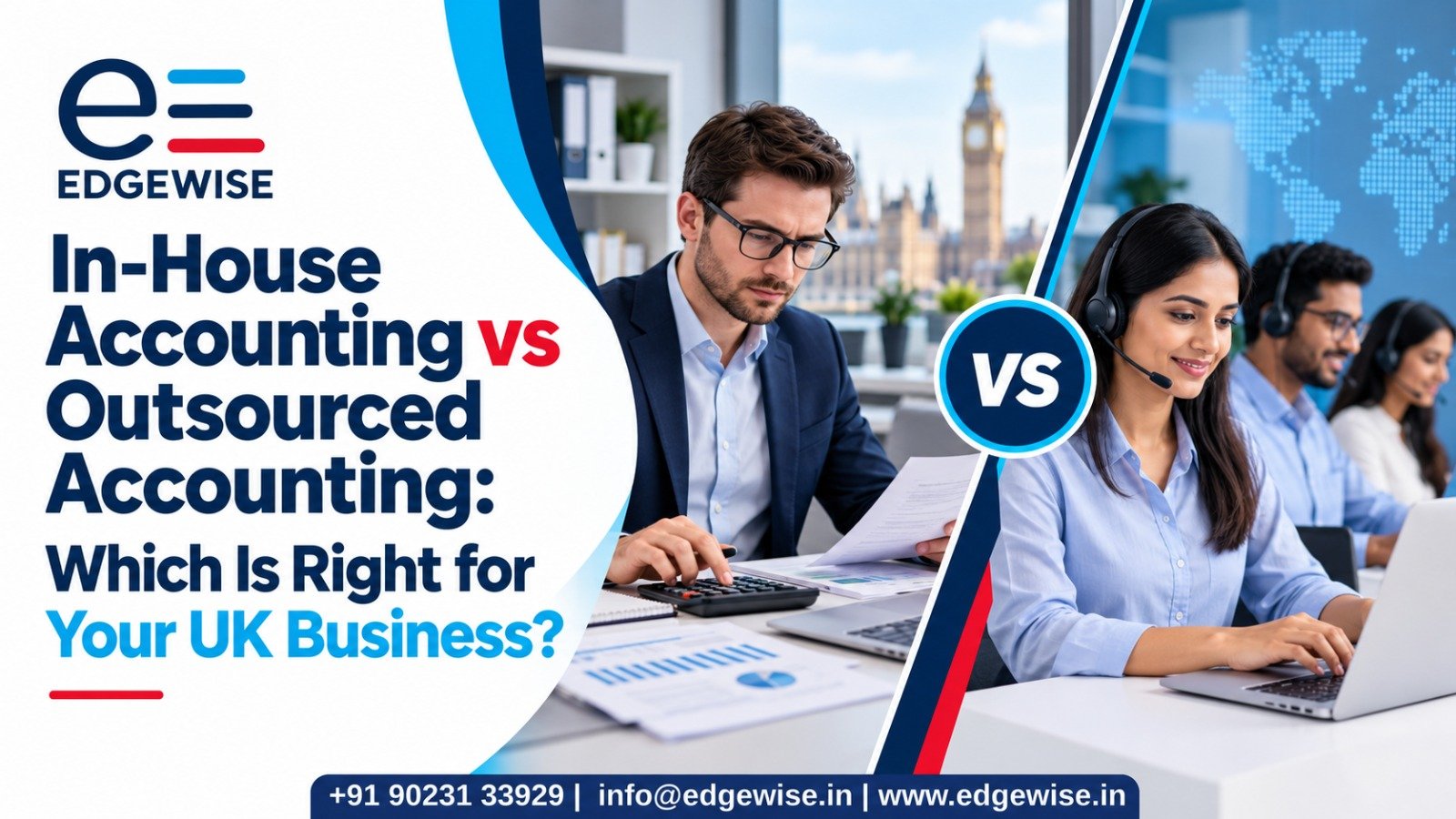
Should you build an in-house accounting team or outsource your accounting functions to an external service provider?
Both approaches offer distinct advantages. In-house accounting provides direct control and immediate access to financial information, while outsourced accounting can offer flexibility, access to wider expertise and potentially lower operating costs.
The right choice depends on several factors, including business size, transaction volume, financial complexity, budget and long-term growth plans.
For small and medium-sized businesses, understanding the differences between these two accounting models is particularly important.
This guide provides a comprehensive comparison of in-house accounting vs outsourced accounting in the UK, covering costs, operational efficiency, regulatory compliance, technology, scalability and the factors businesses should consider before making a decision.
1. What Is In-House Accounting?
In-house accounting refers to managing a company’s financial activities through employees directly recruited and employed by the business.
Depending on the organisation’s size and requirements, the internal finance function may consist of a single bookkeeper, an accountant or a complete finance team.
Common Responsibilities of an In-House Accounting Team
- Recording day-to-day financial transactions.
- Maintaining accounts payable and receivable.
- Preparing bank reconciliations.
- Managing payroll and employee expenses.
- Preparing VAT calculations and supporting records.
- Maintaining the general ledger.
- Preparing management accounts.
- Supporting budgeting and forecasting.
- Assisting with statutory accounts and tax compliance.
- Monitoring cash flow and financial performance.
Advantages of In-House Accounting
Direct Control: Business owners and management can communicate directly with accounting employees and supervise processes closely.
Immediate Accessibility: Internal staff may be available to respond to urgent financial queries and participate in day-to-day operational discussions.
Business Familiarity: Employees develop a detailed understanding of the organisation’s operations, internal policies and financial reporting requirements.
Closer Operational Integration: An internal finance team can coordinate directly with purchasing, sales, operations and management departments.
Limitations of In-House Accounting
Maintaining an internal accounting function involves ongoing employment and administrative costs.
Businesses must consider salaries, employer National Insurance contributions, pension obligations, recruitment, employee training, software subscriptions and workplace infrastructure.
Smaller organisations may also find it difficult to recruit individuals with sufficient expertise across bookkeeping, taxation, payroll and financial reporting.
Consequently, in-house accounting is often more suitable where the volume or complexity of financial activity justifies dedicated internal resources.
2. What Is Outsourced Accounting?
Outsourced accounting involves engaging an external accounting firm or service provider to perform selected accounting activities or manage an agreed portion of the finance function.
Depending on the engagement, businesses may outsource routine bookkeeping, payroll processing, VAT preparation, management reporting or year-end accounting support.
Some organisations outsource their entire finance function, while others retain an internal finance manager and delegate specific tasks to external specialists.
Common Outsourced Accounting Services
- Bookkeeping and general ledger maintenance.
- Bank and credit card reconciliations.
- Accounts payable and receivable processing.
- Payroll preparation and administration.
- VAT bookkeeping and return preparation support.
- Management accounts and financial reporting.
- Financial statement preparation support.
- Corporation Tax working papers and computations.
- Accounting data clean-up and reconciliations.
- Financial reporting and analysis support.
Advantages of Outsourced Accounting
Potential Cost Efficiency: Businesses may avoid some of the fixed employment costs associated with maintaining a full-time accounting team.
Flexible Resources: The level of outsourced support can be adjusted based on transaction volumes, reporting requirements and business growth.
Access to Wider Capabilities: A suitable provider may offer staff with experience across different accounting functions.
Operational Continuity: A provider with appropriate staffing and documented processes may reduce dependence on one individual.
Focus on Core Business Activities: Management can allocate more attention to business development, customers and operational strategy.
However, outsourcing does not eliminate the need for internal supervision or regulatory accountability.
A successful arrangement requires clear responsibilities, appropriate quality controls and effective communication.
3. In-House Accounting vs Outsourced Accounting: Key Differences
The main differences between the two accounting models can be evaluated across several important factors.
| Comparison Factor | In-House Accounting | Outsourced Accounting |
|---|---|---|
| Cost structure | Salary and ongoing employment overheads | Contractual service fees |
| Recruitment | Managed directly by the business | Provider manages its own staffing |
| Expertise | Depends on employees recruited | Depends on provider capabilities |
| Control | Direct daily supervision | Managed through agreed workflows |
| Scalability | Requires recruitment or redeployment | Can be adjusted contractually |
| Technology | Business usually manages systems | May use existing or provider-supported systems |
| Business continuity | Depends on internal staffing | Depends on provider’s backup arrangements |
| Communication | Direct access to employees | Agreed communication channels |
| Data security | Managed through internal controls | Requires contractual and technical safeguards |
| Compliance | Business remains accountable | Business remains accountable |
Neither model automatically guarantees better accuracy, security or compliance.
The quality of the accounting function depends on the competence of the people involved, the effectiveness of internal controls and the procedures used to review financial information.
4. Cost Comparison: In-House Accounting vs Outsourced Accounting
Cost is often one of the primary factors influencing the decision to outsource.
However, comparing an employee’s salary directly with an outsourcing fee can be misleading.
The full cost of in-house accounting includes additional employment and infrastructure expenses.
Cost Components of In-House Accounting
A business employing an accountant may incur:
- Gross salary.
- Employer National Insurance contributions.
- Employer pension contributions.
- Recruitment and onboarding costs.
- Training and professional development.
- Accounting software subscriptions.
- Computer equipment and IT support.
- Office infrastructure.
- Holiday and absence cover.
- Management and supervision costs.
For the 2026-27 tax year, the standard employer Class 1 National Insurance rate is 15% on earnings above the annual secondary threshold of £5,000, subject to applicable employee categories, reliefs and other rules.
Eligible employers may also benefit from Employment Allowance, which can reduce their employer National Insurance liability.
Illustrative In-House Accountant Cost
Assume a UK business employs an accountant earning £35,000 annually.
| Cost Component | Illustrative Annual Amount |
|---|---|
| Gross salary | £35,000 |
| Employer National Insurance, before reliefs | £4,500 |
| Employer pension contribution | £860 |
| Software, training and equipment | £2,000 |
| Total illustrative annual cost | £42,360 |
The pension estimate assumes a qualifying earnings basis and minimum employer contribution, with no qualifying earnings exclusions beyond the standard lower threshold. Actual costs depend on pension arrangements and individual circumstances.
This simplified example excludes recruitment costs, office space, holiday cover and other possible expenses. It also does not account for potential Employment Allowance.
Cost Components of Outsourced Accounting
An outsourced accounting arrangement may involve:
- A fixed monthly fee.
- Transaction-based charges.
- Charges linked to client volumes.
- Fees for additional reporting or compliance support.
- Accounting software and integration costs.
- Transition and onboarding costs.
Outsourcing does not automatically include all software, payroll, tax or advisory services.
Businesses should obtain a detailed quotation specifying the activities included and any additional charges.
Which Model Is More Cost-Effective?
For a smaller business with limited accounting transactions, outsourcing may be less expensive than employing a full-time accountant.
For a larger business requiring daily finance management, detailed internal reporting and frequent operational involvement, an in-house accountant may represent better value.
The correct comparison should consider the total cost of each model and the actual services delivered.
5. Expertise and Professional Capabilities
Accounting requires different technical capabilities depending on the nature of the business.
A single in-house accountant may be responsible for bookkeeping, payroll, VAT, management accounts and financial reporting.
Although an experienced professional can manage several functions, specialised areas may require additional support.
In-House Expertise
In-house employees can develop a strong understanding of company-specific procedures and financial reporting requirements.
However, recruiting separate specialists for every accounting function may be costly for smaller businesses.
Outsourced Expertise
A well-resourced accounting service provider may offer access to professionals with different areas of experience.
This can be particularly useful where businesses require occasional specialist support rather than a full-time employee.
Nevertheless, businesses should verify the qualifications, experience and professional supervision arrangements of their selected provider.
The key consideration is not simply whether accounting is performed internally or externally, but whether the people performing the work possess the appropriate knowledge and skills.
6. Control, Communication and Financial Visibility
One common concern about outsourcing is the potential reduction in direct control over accounting activities.
In-house accounting allows management to communicate directly with employees, request information and monitor ongoing activities.
Outsourced accounting requires a more structured communication arrangement.
How Businesses Can Maintain Control When Outsourcing
An effective arrangement should establish:
- Clearly documented responsibilities.
- Defined approval authorities.
- Agreed reporting deadlines.
- Regular review meetings.
- Secure access to accounting systems.
- A query-resolution process.
- Escalation procedures for urgent issues.
- Periodic performance reviews.
For example, a business may outsource transaction processing and bank reconciliations while retaining internal approval authority for vendor payments.
This approach can preserve management oversight while reducing administrative workload.
Cloud-based accounting software can also provide authorised management users with ongoing visibility of financial information.
7. Compliance Responsibilities in the UK
UK businesses must comply with various accounting, taxation and statutory reporting requirements.
Outsourcing accounting activities does not automatically transfer these legal responsibilities to the external provider.
HMRC Compliance
Businesses may need to comply with requirements relating to:
- Corporation Tax.
- VAT.
- PAYE and payroll reporting.
- National Insurance contributions.
- Making Tax Digital.
- Business recordkeeping.
An outsourced accounting provider may assist with preparation and compliance processes, but the business and its directors retain relevant statutory obligations.
Companies House Filing Requirements
UK private limited companies generally have the following reporting deadlines:
| Requirement | General Deadline |
|---|---|
| Annual accounts | Nine months after the financial year end |
| Corporation Tax payment | Nine months and one day after the accounting period ends |
| Company Tax Return (CT600) | Twelve months after the accounting period ends |
| Confirmation statement | At least once every twelve months |
First accounts and certain other circumstances may have different deadlines.
Corporation Tax Filing Changes in 2026
The joint HMRC and Companies House online accounts and tax return filing service closed on 31 March 2026.
From 1 April 2026, companies that previously relied on that service generally need appropriate commercial software to submit Company Tax Returns to HMRC.
This change makes accounting software selection and compliance workflows increasingly important for smaller businesses.
Companies House Identity Verification
Identity verification became a legal requirement for company directors and Persons with Significant Control under the phased implementation that began on 18 November 2025.
Existing directors and PSCs are subject to applicable transitional arrangements and individual due dates. Businesses should verify the relevant deadlines rather than assume that one universal deadline applies to everyone.
A reliable accounting function should help management identify filing requirements and coordinate with the appropriate authorised professionals.
8. Data Security and Confidentiality in Accounting Outsourcing
Accounting records often contain commercially sensitive and personal information.
These may include employee payroll details, bank account information, customer data and supplier records.
When outsourcing accounting activities, businesses should establish appropriate confidentiality and information security arrangements.
Important Data Protection Considerations
- Written confidentiality obligations.
- Appropriate data processing agreements.
- Controlled access to accounting systems.
- Multi-factor authentication.
- Secure file-sharing procedures.
- Restricted access to sensitive financial information.
- Clear document retention and deletion policies.
- Appropriate international data-transfer safeguards.
- Procedures for reporting and managing data security incidents.
Where UK personal data is transferred to a service provider outside the UK, the parties should assess applicable UK GDPR requirements.
The relevant contractual roles and responsibilities depend on the processing arrangement. A business does not automatically cease to have data protection obligations simply because processing has been outsourced.
A credible outsourcing provider should be able to explain its security procedures and contractual arrangements clearly.
9. Scalability and Business Growth
As a business grows, its accounting requirements often become more complex.
Increasing transaction volumes, additional employees, new customers and expanded business operations can place greater pressure on financial systems.
Scalability of In-House Accounting
An internal accounting function can expand through recruitment and training.
However, hiring additional employees may involve recruitment costs, onboarding time and increased fixed overheads.
Scalability of Outsourced Accounting
Outsourcing may provide greater flexibility where a business experiences seasonal fluctuations or rapidly changing transaction volumes.
For example, an e-commerce business experiencing increased sales activity during peak trading periods may require additional transaction processing and reconciliation support.
An outsourced provider may be able to increase processing capacity within agreed service terms.
However, scalability should not be assumed. Businesses should verify the provider’s actual capacity, turnaround commitments and fee structure.
10. Business Continuity and Operational Risk
Accounting operations must continue even when employees are unavailable.
An in-house finance function that depends heavily on one individual may face disruption during sickness, resignation or extended leave.
Outsourced providers may reduce this risk through documented procedures and alternative staffing arrangements.
However, the effectiveness of these arrangements depends on the provider.
Important Continuity Measures
Businesses should assess:
- Availability of replacement personnel.
- Documentation of accounting procedures.
- Backup and recovery arrangements.
- Ownership and accessibility of accounting records.
- Business continuity procedures.
- Handover arrangements when an engagement ends.
Regardless of the accounting model selected, businesses should avoid allowing important financial processes to depend entirely on one person.
11. Technology and Accounting Software
Modern accounting technology can improve financial reporting efficiency and collaboration.
Commonly used UK accounting platforms include:
- Xero.
- QuickBooks Online.
- Sage.
- FreeAgent.
- Other compatible accounting and reporting software.
Both in-house and outsourced accounting teams can work effectively with cloud-based software.
Potential benefits include automated bank feeds, digital document capture, accounting reconciliations and improved financial reporting.
However, software compatibility, user permissions, integration costs and data ownership should be agreed before selecting an outsourced accounting provider.
Technology improves efficiency only when supported by appropriate accounting procedures and review controls.
12. In-House Accounting vs Outsourced Bookkeeping: Understanding the Difference
Businesses sometimes use the terms accounting and bookkeeping interchangeably.
However, there is an important distinction.
Bookkeeping primarily involves recording, classifying and reconciling financial transactions.
Accounting involves a broader range of activities, including financial reporting, accounting adjustments, tax computations, budgeting and financial analysis.
Outsourced bookkeeping is therefore a narrower service than outsourcing an entire accounting function.
For example, a business may retain an internal finance manager while outsourcing routine bookkeeping and bank reconciliations.
This hybrid structure allows management to maintain direct financial oversight while obtaining external processing support.
The appropriate arrangement depends on the business’s requirements rather than the terminology used by service providers.
13. Which Accounting Model Is Right for Your UK Business?
Choosing between in-house and outsourced accounting requires an assessment of actual business needs.
When In-House Accounting May Be the Better Option
An internal accounting team may be more suitable where:
- The business has complex daily financial operations.
- Management requires frequent in-person finance support.
- Transaction volumes justify full-time employees.
- Finance professionals are closely involved in operational decisions.
- The business has the resources to maintain adequate staffing and training.
When Outsourced Accounting May Be the Better Option
Outsourcing may be appropriate where:
- Transaction volumes do not justify a full-time accounting team.
- The business wants to manage fixed employment overheads.
- Additional bookkeeping or accounting capacity is required.
- Workloads fluctuate throughout the year.
- The business needs support with specific accounting activities.
- Management wants to focus internal resources on core operations.
When a Hybrid Accounting Model May Be Suitable
A hybrid arrangement combines an internal finance function with outsourced accounting support.
For example, a growing SME may retain an internal finance controller responsible for cash flow, reporting and management decisions while outsourcing transaction processing, payroll preparation and routine reconciliations.
This approach can provide a balance between direct control and operational flexibility.
14. Practical Checklist Before Outsourcing Accounting
Before entering into an outsourcing arrangement, UK businesses should consider the following:
- Identify the accounting functions to be outsourced.
- Assess current accounting costs and workloads.
- Compare total in-house and outsourcing expenses.
- Define service deliverables and reporting timelines.
- Verify the provider’s relevant experience and capabilities.
- Confirm software compatibility.
- Establish confidentiality and data protection arrangements.
- Agree on accounting review and approval responsibilities.
- Define communication and escalation procedures.
- Establish performance monitoring arrangements.
- Confirm ownership and accessibility of financial records.
- Review contract termination and handover provisions.
A structured selection process reduces the risk of misunderstandings and helps establish a more effective working relationship.
15. Why Choose Edgewise Training Solutions Pvt Ltd?
At Edgewise Training Solutions Pvt Ltd, we understand that businesses and accounting practices require organised financial records, efficient processes and dependable operational support to manage their accounting responsibilities.
Whether an organisation maintains an internal accounting team or works with external professionals, consistent bookkeeping, accurate reconciliations and well-defined reporting procedures are essential for effective financial management.
Edgewise focuses on providing structured accounting and back-office support that complements existing finance functions and accounting practices.
How Edgewise Can Support Your Accounting Operations
1. Bookkeeping and General Ledger Support
Accurate bookkeeping is the foundation of reliable financial reporting. Edgewise can assist with systematic transaction recording, ledger maintenance and supporting accounting schedules within an agreed engagement scope.
2. Bank and Financial Reconciliations
Timely reconciliations help identify discrepancies and maintain consistency between accounting records and financial statements.
Our approach emphasises organised reconciliation procedures and supporting documentation.
3. Accounts Payable and Receivable Support
Maintaining reliable supplier and customer records is essential for cash flow visibility and financial control.
Edgewise can support routine accounts payable and receivable processing activities, depending on engagement requirements.
4. Management Reporting and Accounting Support
Organised financial records and consistent accounting schedules help internal finance teams and professional accountants prepare meaningful financial reports.
5. Structured Back-Office Accounting Processes
Documented workflows, standardised working papers and clear query-management procedures can improve consistency across recurring accounting assignments.
6. Flexible Accounting Assistance
Accounting workloads may change with transaction volumes, reporting periods and business expansion.
Edgewise aims to provide support arrangements aligned with mutually agreed accounting requirements and operational priorities.
Our Approach to Accounting Collaboration
We recognise that successful outsourcing requires more than transferring routine tasks.
It requires clearly defined responsibilities, confidentiality, communication and appropriate professional oversight.
Our approach focuses on:
- Maintaining organised financial information.
- Supporting systematic accounting processes.
- Following agreed documentation and reporting procedures.
- Coordinating effectively with accounting professionals.
- Identifying and communicating accounting queries.
- Respecting confidentiality and agreed information-handling requirements.
- Supporting the preparation of review-ready accounting records.
We believe that accounting outsourcing should strengthen existing financial processes rather than reduce management control.
Why Partner with Edgewise?
By supporting routine accounting and back-office activities, Edgewise seeks to help businesses and accounting practices allocate more time to financial analysis, professional reviews, strategic planning and client relationships.
Our objective is to support efficient accounting workflows through process consistency, reliable documentation and effective collaboration.
Looking to optimise your accounting operations?
Connect with Edgewise Training Solutions Pvt Ltd to explore how structured bookkeeping and outsourced accounting support can complement your existing finance function.
The precise scope of services, software capabilities, staffing arrangements and turnaround commitments will depend on the agreed engagement terms.
Disclaimer
The information contained in this blog is provided by Edgewise Training Solutions Pvt Ltd for general informational and educational purposes only and should not be considered professional accounting, taxation, legal, financial or business advisory advice.
Although reasonable efforts have been made to ensure the accuracy of the information presented, UK accounting standards, HM Revenue & Customs (HMRC) regulations, Companies House requirements, tax rates, employment obligations and data protection legislation may change over time.
Any cost comparisons, financial illustrations or examples included in this article are indicative only and may not reflect the circumstances of every organisation. Actual employment costs, outsourcing fees, financial benefits and operational outcomes depend on business size, service requirements, contractual terms and other relevant factors.
Readers should independently verify current legal and regulatory requirements and seek advice from suitably qualified UK accounting, tax or legal professionals before making business or financial decisions.
Edgewise Training Solutions Pvt Ltd does not guarantee specific cost savings, financial performance improvements, regulatory compliance outcomes or operational benefits arising from reliance on this article.
Any accounting, bookkeeping or back-office services provided by Edgewise are subject to mutually agreed engagement terms, applicable legislation, confidentiality arrangements and appropriate professional oversight.
Responsibility for statutory filings, financial reporting approvals, regulatory compliance and management decisions remains with the relevant business, directors and authorised professionals, as applicable.