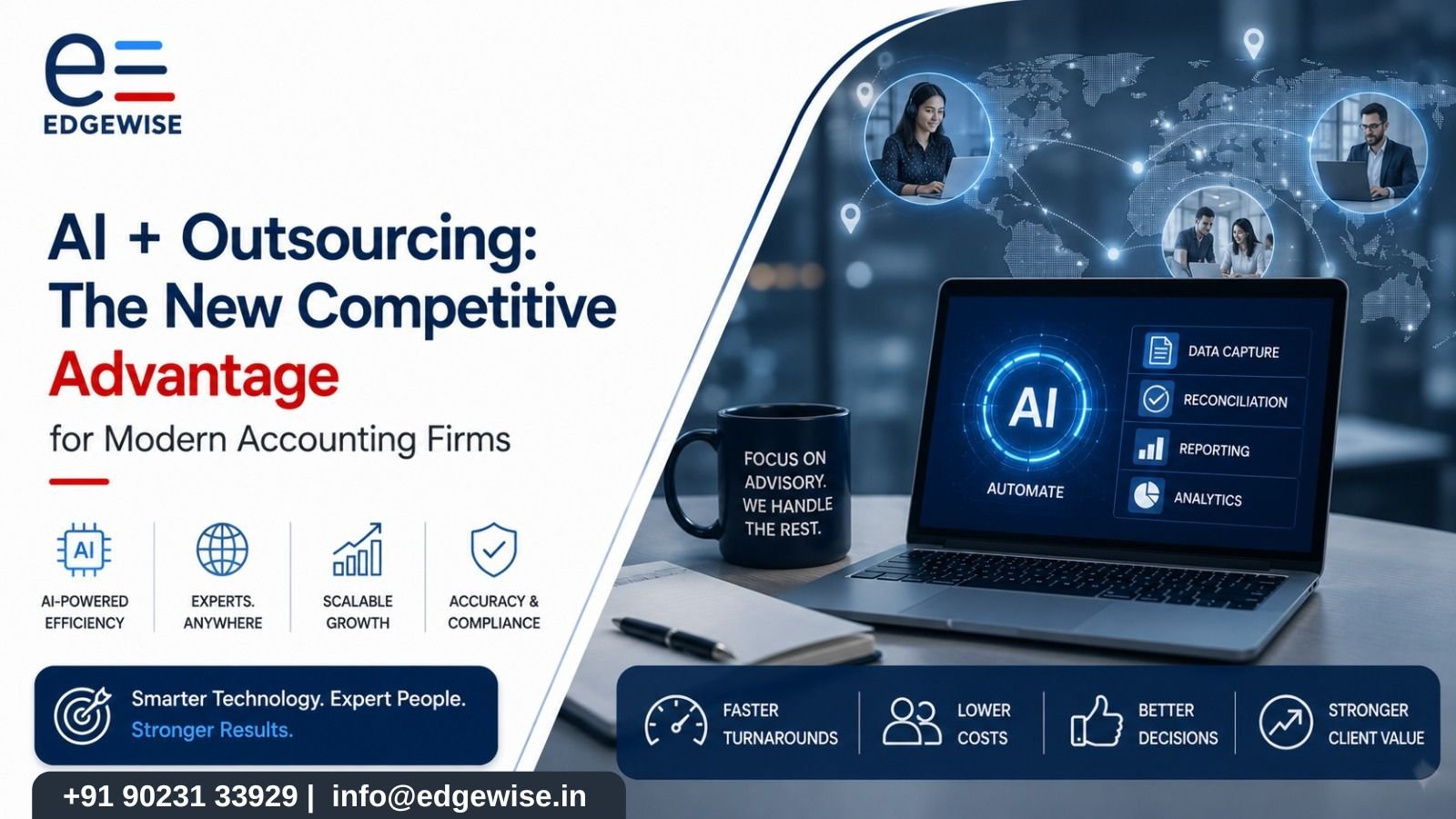
Artificial intelligence is changing how accounting outsourcing firms deliver bookkeeping, payroll, VAT, reconciliations, and reporting services.
AI helps automate repetitive and rule-based work, allowing accountants to process more transactions, reduce manual errors, and complete assignments faster. However, AI does not replace professional accountants. It supports them by handling routine work while experienced professionals review exceptions, apply judgement, and ensure compliance.
Why AI Matters in Accounting Outsourcing
Outsourcing firms often handle large volumes of:
- Supplier invoices;
- Bank statements;
- Payroll records;
- Expense receipts;
- VAT transactions; and
- Client accounting documents.
Processing this information manually takes significant time and increases the risk of data-entry errors.
AI allows outsourcing firms to manage larger workloads without increasing staff at the same rate. This results in:
- Faster turnaround times;
- Better accuracy;
- Improved scalability;
- Lower administrative effort; and
- More time for advisory work.
How Accounting Outsourcing Firms Use AI
1. Automated Data Extraction
AI tools use Optical Character Recognition to read invoices, receipts, bank statements, and other financial documents.
They can automatically extract:
- Supplier names;
- Invoice numbers;
- Dates;
- Amounts;
- VAT details; and
- Payment information.
This reduces manual data entry and speeds up bookkeeping.
2. Intelligent Transaction Coding
AI can review previous accounting entries and suggest suitable nominal codes for new transactions.
Instead of coding every transaction manually, accountants can focus on reviewing unusual or uncertain items.
3. Faster Bank Reconciliations
AI can match bank transactions with:
- Customer receipts;
- Supplier payments;
- Sales invoices;
- Purchase invoices; and
- Expense records.
Only unmatched or unusual items require manual investigation, making month-end reconciliations faster.
4. Invoice Processing
AI can capture invoice data, identify duplicate invoices, validate supplier information, and route documents through approval workflows.
This improves accounts payable efficiency and reduces delays caused by manual processing.
5. Payroll Validation
AI can help identify:
- Missing employee information;
- Duplicate employee records;
- Unusual salary changes;
- Tax-code inconsistencies;
- Pension anomalies; and
- Incorrect deductions.
Experienced payroll professionals still review and approve the final output before submission.
6. VAT Compliance Checks
AI can analyse transactions and flag:
- Incorrect VAT codes;
- Missing VAT information;
- Duplicate claims;
- Unusual adjustments; and
- Incomplete supporting documents.
This helps accountants focus on exceptions before the VAT return is finalised.
7. Fraud and Risk Detection
AI is effective at identifying unusual patterns across high transaction volumes.
It can highlight:
- Duplicate payments;
- Suspicious supplier activity;
- Unexpected changes in bank details;
- Unusual transaction amounts; and
- Potential fraud indicators.
AI therefore strengthens internal controls rather than replacing them.
8. Reporting and Forecasting
AI can analyse historical financial information and assist with:
- Cash-flow forecasting;
- Budget comparisons;
- Expense trends;
- Revenue projections; and
- Management reporting.
This enables accountants to provide more timely and proactive insights.
AI vs Human Accountants
| Activity | Role of AI | Role of Accountant |
|---|---|---|
| Data entry | Automates extraction | Reviews accuracy |
| Invoice processing | Captures and matches information | Resolves exceptions |
| Bank reconciliation | Matches routine transactions | Investigates differences |
| Payroll checking | Flags anomalies | Provides final approval |
| VAT review | Identifies potential errors | Confirms compliance |
| Tax planning | Provides data support | Applies professional judgement |
| Client advisory | Limited | Essential |
| Complex decisions | Limited | Requires human expertise |
The strongest accounting model combines AI with professional oversight.
AI handles speed and volume. Accountants provide judgement, accountability, regulatory interpretation, and client understanding.
What AI Cannot Replace
AI cannot fully replace areas that require professional reasoning and responsibility.
These include:
- Applying UK GAAP to complex transactions;
- Interpreting HMRC and Companies House requirements;
- Tax planning;
- Resolving unusual accounting issues;
- Ethical decision-making;
- Understanding client circumstances; and
- Building trusted client relationships.
The future of accounting is therefore human-led and AI-enabled.
Why Choose Edgewise Training Solutions Pvt Ltd?
Edgewise Training Solutions Pvt Ltd helps UK accounting practices improve capacity through trained offshore accounting support and technology-enabled workflows.
Edgewise can assist with:
- Bookkeeping;
- Invoice processing;
- Bank reconciliations;
- Payroll support;
- VAT working papers;
- Management accounts;
- Transaction reviews; and
- Accounting data organisation.
By combining structured processes, automation tools, and professional review, Edgewise helps practices reduce repetitive work while maintaining control over quality and compliance.
Key benefits include:
- Faster processing;
- Reduced manual errors;
- Scalable accounting support;
- Consistent review procedures;
- Lower recruitment pressure; and
- More time for advisory and client-facing work.
Edgewise works as an extension of the accounting practice, following its software, working papers, review procedures, and client requirements.
Conclusion
AI is helping accounting outsourcing firms deliver faster, more accurate, and more scalable services.
It can automate data extraction, transaction coding, bank reconciliations, invoice processing, payroll checks, VAT reviews, and reporting. However, final decisions must remain with experienced accounting professionals.
Edgewise Training Solutions Pvt Ltd combines trained accounting support with technology-enabled processes, helping UK practices manage routine work efficiently while their internal teams focus on compliance, advisory services, and business growth.