Winning new clients is a positive sign for any accounting firm. It reflects market trust, strong client relationships, and business growth.
However, growth also brings a serious operational challenge.
Many UK accounting practices are bringing in more clients, but the same internal team is expected to manage increased bookkeeping, payroll, VAT compliance, reporting, client communication, and deadline pressure.
At first, this may appear manageable. But over time, the signs become clear: staff begin working late, response times slow down, errors increase, deadlines become stressful, and team burnout becomes difficult to avoid.
The real challenge is not just winning clients. The real challenge is delivering consistent, accurate, and timely work without overloading the internal team.
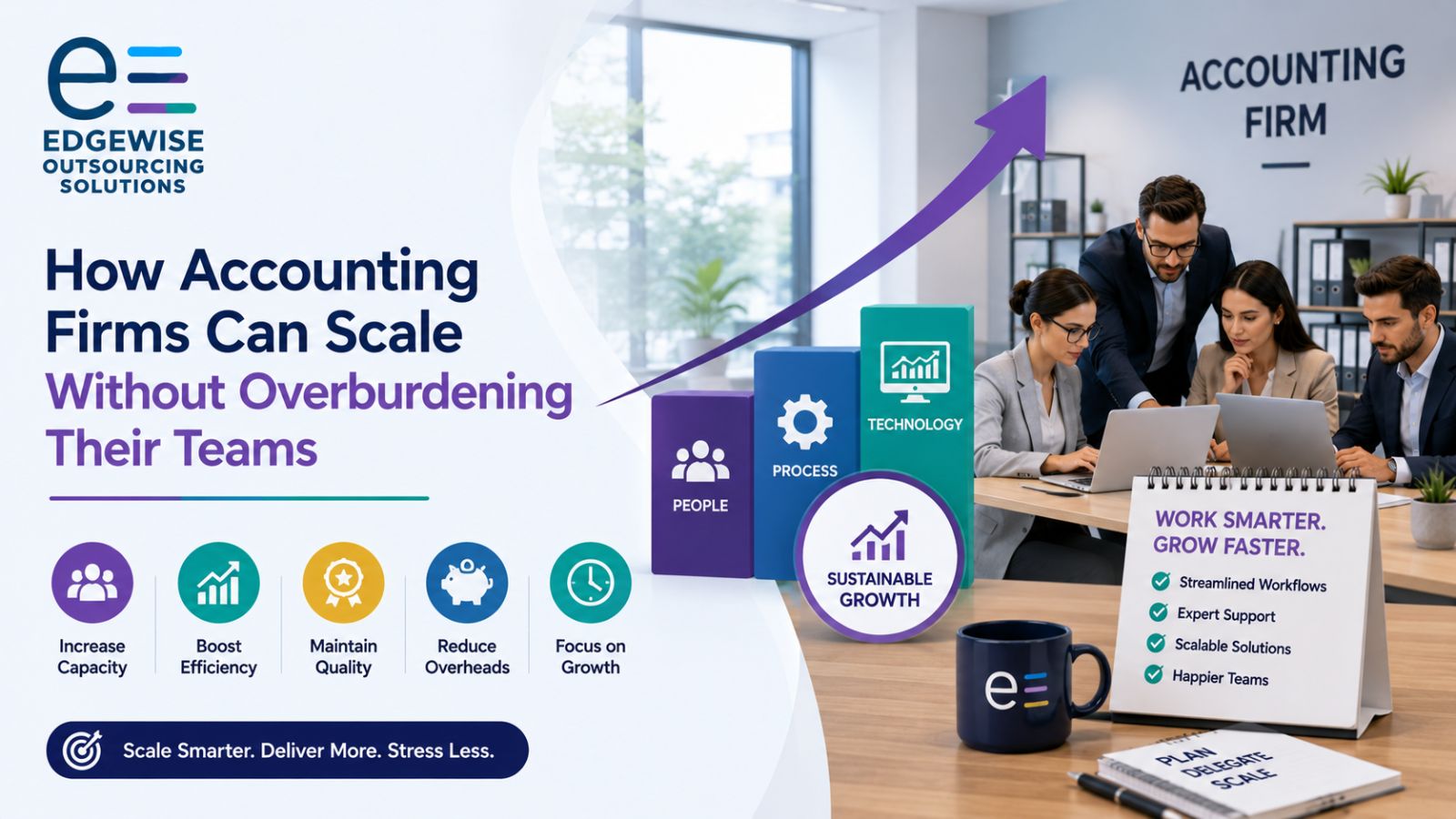
In 2026, successful accounting firms are not scaling by simply pushing people harder. They are scaling by building smarter systems, improving workflows, automating repetitive tasks, and outsourcing operational work strategically.
Why Accounting Teams Are Reaching a Breaking Point
The pressure on accounting firms has changed significantly over the last few years.
Accounting teams are now expected to handle a wide range of responsibilities, including:
- Bookkeeping
- Payroll support
- VAT compliance
- Making Tax Digital requirements
- Client communication
- Software management
- Management reporting
- Year-end accounts support
- Advisory services
At the same time, clients expect faster responses, real-time insights, accurate reports, lower turnaround times, and more strategic advice.
This creates pressure on internal teams, especially when the firm’s workflow was originally built for a smaller client base.
As the number of clients increases, manual processes, inconsistent workflows, and overdependence on internal staff can quickly create operational stress.
The Hidden Cost of Overloading Your Team
Overloading a team may seem manageable in the short term, but it can create long-term business risk.
When accounting teams are consistently under pressure, firms may experience:
- Staff burnout
- Reduced productivity
- Increased errors
- Delayed client communication
- Missed deadlines
- Poor client experience
- Higher employee turnover
- Lower profitability
- Increased compliance risk
For accounting firms, quality and trust are critical. If the team is overloaded, the quality of delivery may suffer.
This can directly affect client retention, team morale, and the firm’s ability to grow sustainably.
Why Hiring More Staff Is Not Always the Solution
Hiring additional employees may appear to be the obvious solution. However, it is not always practical or commercially efficient.
Recruitment in the accounting sector can be time-consuming. Firms may struggle to find experienced professionals in bookkeeping, payroll, VAT compliance, and accounts preparation.
Even when the right talent is available, hiring comes with additional costs such as:
- Salaries
- Employer contributions
- Pension obligations
- Software access
- Office infrastructure
- Training and onboarding
- Supervision and management time
For smaller and mid-sized accounting practices, these fixed costs can create financial pressure.
The problem becomes more complex during peak periods such as January tax season, VAT quarters, payroll cycles, and year-end reporting. Hiring permanent employees only to manage temporary workload spikes may not always make business sense.
This is why many firms are moving towards more flexible operating models.
How Smart Accounting Firms Are Scaling in 2026
Smart accounting firms are no longer relying only on headcount expansion. They are improving their systems, workflows, technology, outsourcing strategy, and operational discipline.
The objective is simple: increase capacity without increasing unnecessary pressure on the internal team.
1. Automating Repetitive Work
One of the biggest reasons accounting teams become overloaded is repetitive manual work.
This may include:
- Invoice processing
- Bank reconciliations
- Payroll data entry
- VAT calculations
- Document collection
- Receipt matching
- Basic reporting updates
Modern accounting tools can help reduce manual effort and improve workflow efficiency.
Platforms such as Xero, QuickBooks, Sage, and other cloud accounting tools can support automation in areas such as reconciliations, invoice capture, VAT workflows, and reporting.
Automation does not replace accountants. It helps accountants focus on higher-value work by reducing repetitive administrative tasks.
2. Standardising Internal Processes
Many accounting firms face delays because different team members follow different processes.
This can lead to inconsistent bookkeeping treatment, different documentation styles, varied reporting formats, and confusion during review.
Standardised workflows help improve:
- Consistency
- Speed
- Training efficiency
- Review quality
- Client service delivery
- Internal accountability
Examples of standardisation include:
- Fixed bookkeeping procedures
- Structured VAT workflows
- Defined approval processes
- Standard reporting templates
- Clear document collection checklists
- Common naming conventions
- Review-ready working papers
When processes become predictable, scaling becomes easier.
3. Outsourcing Overflow Work Strategically
Outsourcing is no longer only a cost-cutting option. For modern accounting firms, it has become a strategic capacity-building tool.
Outsourcing can help firms:
- Increase delivery capacity
- Reduce pressure on internal teams
- Maintain turnaround times
- Access trained accounting support
- Manage peak-season workload
- Improve scalability
- Reduce fixed hiring pressure
Commonly outsourced work may include:
- Bookkeeping
- Bank reconciliation
- VAT support
- Payroll support
- Accounts payable and receivable
- Year-end accounts support
- Management reporting support
- Back-office accounting tasks
By outsourcing routine and overflow work, internal teams can focus on client relationships, advisory services, review, and business development.
4. Using a Hybrid Team Model
A hybrid team model combines the strengths of internal teams, outsourced specialists, and automation tools.
This model allows accounting firms to maintain control while improving capacity.
In a hybrid model:
- Internal teams manage client relationships and review
- Outsourced teams handle routine operational workload
- Automation tools reduce repetitive tasks
- Partners and managers focus on advisory and growth
This creates flexibility without compromising quality.
For growing firms, the hybrid model can be more sustainable than relying only on internal employees.
5. Focusing on Higher-Value Services
Many accounting firms want to move beyond compliance-led work and offer higher-value services such as:
- Advisory services
- Tax planning
- Cash flow forecasting
- Budgeting
- Strategic consulting
- Virtual CFO support
- Business performance analysis
These services can improve profitability and strengthen client relationships.
However, advisory work requires time and attention. If the internal team is fully occupied with routine bookkeeping and compliance tasks, it becomes difficult to develop advisory services.
This is why reducing operational overload is essential.
Only when repetitive tasks are streamlined, automated, or outsourced can firms focus on strategic services that support long-term growth.
The Role of Technology in Sustainable Firm Growth
Technology plays an important role in helping accounting firms scale efficiently.
Key technology areas include:
- Cloud accounting
- Workflow automation
- Digital document management
- AI-supported reporting
- Client portals
- Secure data-sharing systems
- Task management platforms
These tools help improve visibility, collaboration, reporting, compliance tracking, and delivery control.
However, technology alone is not enough. It must be supported by trained people and standardised processes.
The best results are achieved when firms combine internal expertise, outsourcing support, and technology-enabled workflows.
Signs Your Firm May Be Growing Faster Than Its Team Can Handle
Growth pressure often builds gradually. That is why firms should regularly review whether their current operating model is still suitable.
Common warning signs include:
- Constant overtime
- Delayed client responses
- Recurring backlog
- Rising error rates
- Staff frustration
- Missed internal review deadlines
- Difficulty onboarding new clients
- Heavy pressure during peak seasons
- Limited time for advisory work
If these issues are becoming normal, the firm may not need harder work. It may need operational restructuring.
How Edgewise Training Solutions Pvt Ltd Can Support Accounting Firms
At Edgewise Training Solutions Pvt Ltd, we support accounting firms with structured bookkeeping and back-office accounting assistance designed to reduce workload pressure and improve delivery efficiency.
Our services are built to help firms scale without overloading their internal teams.
We can assist with:
- Day-to-day bookkeeping
- Bank reconciliation
- Invoice processing
- Sales and purchase ledger support
- VAT support
- Payroll data support
- Management accounts support
- Accounts payable and receivable support
- Back-office accounting assistance
- Peak-season workload support
- Reporting and review support
Our objective is to work as an extended support team for accounting practices, helping them improve turnaround time, reduce bottlenecks, and focus on higher-value client work.
Why This Matters for Growing Firms
For accounting firms, sustainable growth requires more than new clients.
It requires:
- Efficient systems
- Flexible capacity
- Reliable delivery
- Strong review mechanisms
- Consistent workflows
- Team protection
- Operational control
A firm that grows without strengthening its delivery model may face quality issues, staff burnout, and client dissatisfaction.
But a firm that adopts modern operational practices can scale with confidence.
Conclusion
The future of accounting firm growth is not about pushing teams harder. It is about working smarter.
The accounting firms that scale successfully in 2026 will be those that:
- Automate repetitive work
- Standardise internal workflows
- Outsource strategically
- Use hybrid team models
- Protect internal team capacity
- Focus more on advisory and client relationships
Sustainable growth requires efficiency, flexibility, scalability, and operational control.
At Edgewise Training Solutions Pvt Ltd, we help accounting firms reduce routine workload, improve delivery capacity, and grow without overloading their teams.
If your firm is winning clients but struggling to manage workload, now may be the right time to rethink your operating model.
With the right support, your accounting practice can scale confidently, serve clients better, and protect the people who make growth possible.