
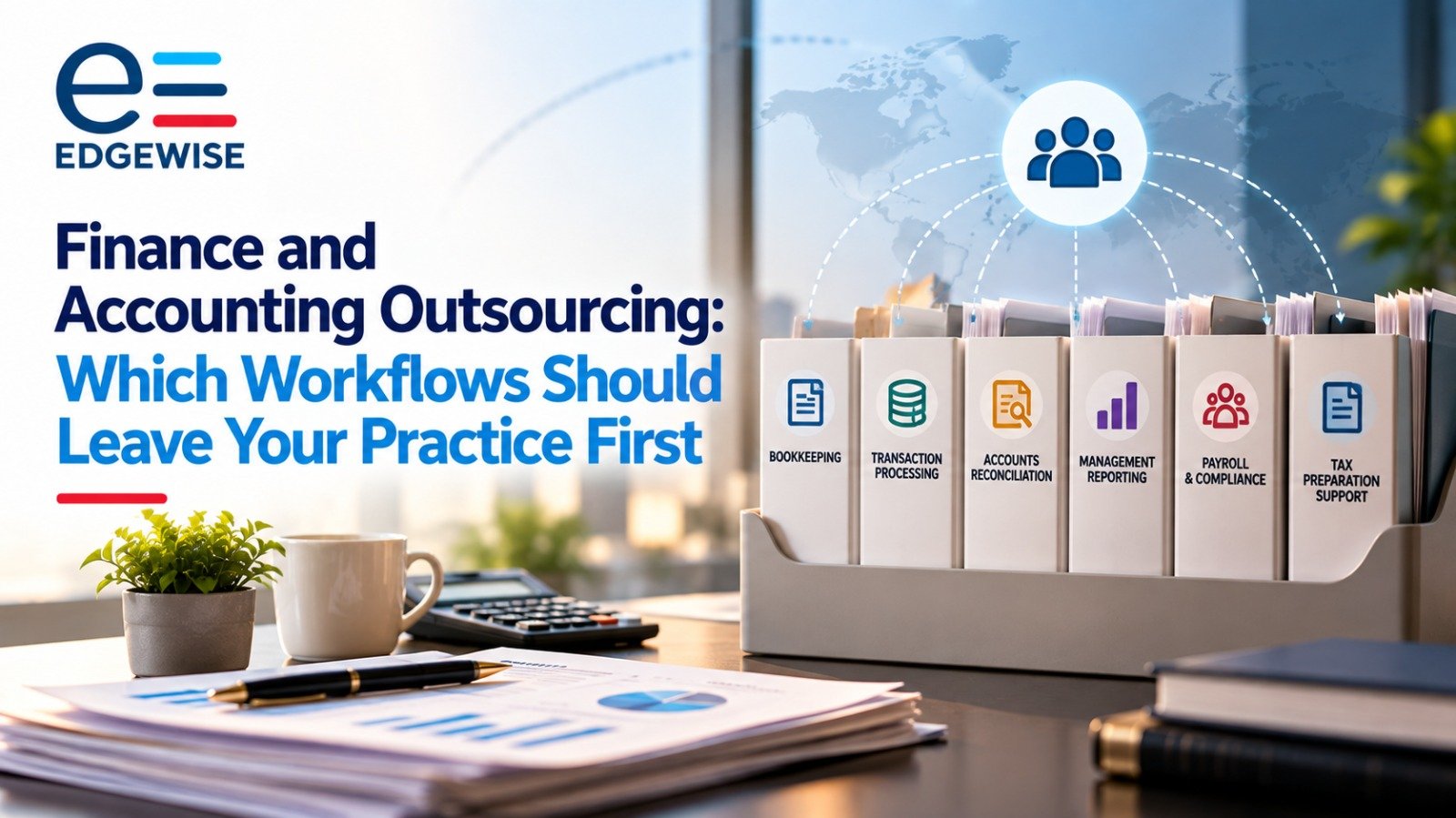
Outsourcing has become an increasingly important strategy for accounting practices looking to improve capacity, control costs and allow senior professionals to focus on higher-value work.
But one of the most important decisions is not simply whether to outsource.
It is deciding what to outsource first.
Many accounting practices make the mistake of moving the most time-consuming or frustrating work immediately. However, outsourcing works best when workflows are transferred in the right sequence.
The ideal starting point is usually work that is:
- Highly repetitive;
- Process-driven;
- Easy to document;
- Low in professional judgement;
- Relatively invisible to the client; and
- Capable of being reviewed before the final output reaches the client.
Starting with these workflows allows a practice to test the outsourcing arrangement, establish quality standards and build confidence before transferring more complex responsibilities.
Why the Order of Outsourcing Matters
Accounting outsourcing should not be treated simply as a list of services that can be transferred to an external team.
The sequence matters.
The first workflow outsourced becomes the testing ground for:
- Communication;
- Turnaround times;
- Documentation standards;
- Review procedures;
- Quality control;
- Data transfer;
- Escalation processes; and
- Responsibility between internal and external teams.
A well-structured first handover can create a model that can later be applied across several functions.
A poorly structured first handover can create additional review work, delays and frustration for both teams.
For this reason, practices should normally begin with processes that can be standardised and reviewed internally before moving into areas requiring significant judgement or direct client interaction.
Four Factors to Consider Before Outsourcing a Workflow
Before deciding which workflow should leave the practice, it is useful to assess each process against four key factors.
1. Time Consumed Compared With Fees Earned
Some accounting activities consume substantial staff time but contribute relatively little to the overall fee.
Examples may include:
- Bank reconciliations;
- Bookkeeping clean-up;
- Transaction classification;
- Chasing supporting documents;
- Data entry; and
- Routine ledger maintenance.
Where significant staff hours are being spent on highly administrative work, outsourcing may release valuable internal capacity.
Senior employees can then spend more time on review, advisory work, client communication and business development.
2. Repeatability
The more standardised a process is, the easier it generally becomes to outsource.
For example, bank reconciliations normally follow a defined process:
- Obtain bank data.
- Match transactions with accounting records.
- Investigate unmatched items.
- Post authorised adjustments.
- Prepare reconciliation.
- Escalate exceptions.
The same broad process can be repeated across different clients.
Highly customised activities are more difficult to outsource because every engagement may require a different approach.
As a general rule:
High repeatability = stronger outsourcing potential.
3. Professional Judgement Required
Not all accounting work requires the same level of professional judgement.
Routine processing can often be performed according to predefined rules.
However, areas involving significant tax interpretation, commercial decisions, restructuring, valuation or strategic advice may require senior-level involvement.
A useful outsourcing model separates:
Preparation from judgement and approval.
For example, an outsourced team may prepare:
- Working papers;
- Reconciliations;
- Draft accounts;
- Tax computation schedules; and
- Supporting calculations.
The firm’s senior team can then review the work and make the final professional decisions.
This allows the practice to obtain capacity benefits without transferring responsibility for critical judgement.
4. Client Visibility
Another important consideration is whether the client directly sees the activity being performed.
Some activities happen entirely in the background.
Examples include:
- Bank reconciliation;
- Ledger review;
- Bookkeeping clean-up;
- Working paper preparation; and
- Draft financial statement preparation.
The client normally sees only the final reviewed result.
Other activities are highly visible.
Examples include:
- Advisory meetings;
- Tax planning discussions;
- Client review meetings;
- Commercial negotiations; and
- Final sign-off discussions.
Practices beginning an outsourcing arrangement may therefore prefer to start with low-visibility, back-office work before moving towards activities involving direct client contact.
Which Workflows Should Usually Be Outsourced First?
Using the factors above, accounting practices can divide their workflows into different stages.
A practical outsourcing sequence could look as follows.
| Workflow | Repeatability | Judgement Required | Client Visibility | Suggested Stage |
|---|---|---|---|---|
| Bookkeeping clean-up | High | Low | Low | Stage 1 |
| Bank reconciliation | High | Low | Low | Stage 1 |
| Transaction processing | High | Low | Low | Stage 1 |
| Self Assessment draft preparation | High | Low-Medium | Low | Stage 1 |
| VAT return preparation | High | Low-Medium | Low | Stage 2 |
| Payroll processing | High | Low-Medium | Medium | Stage 2 |
| Management accounts preparation | Medium-High | Medium | Low | Stage 2 |
| Year-end accounts preparation | Medium | Medium | Low | Stage 3 |
| Corporation Tax preparation | Medium | Medium-High | Low | Stage 3 |
| Tax planning | Low | High | High | Retain senior oversight |
| Advisory work | Low | High | High | Retain senior oversight |
| Client review and final sign-off | Low | High | High | Retain internally |
The underlying principle is straightforward:
High-volume + repeatable + low judgement + low client visibility generally makes a strong candidate for early outsourcing.
Bookkeeping, bank reconciliation and draft Self Assessment preparation are therefore typical first-wave workflows, while advisory and client review remain more appropriate for internal senior teams.
Stage 1: Bookkeeping and Bank Reconciliation
For many practices, bookkeeping is the most natural place to begin.
Bookkeeping can consume significant internal resources, particularly where client records require substantial clean-up before accounts or tax work can begin.
Tasks suitable for outsourcing may include:
- Transaction posting;
- Bank reconciliation;
- Credit card reconciliation;
- Supplier ledger reconciliation;
- Customer ledger reconciliation;
- Expense classification;
- Ledger clean-up;
- Suspense account review;
- Routine journal posting; and
- Preparation of bookkeeping reports.
These tasks are generally process-oriented and can be supported by detailed checklists.
Any unusual transactions can be referred back to the practice rather than being decided independently by the outsourced team.
This creates an important distinction:
Routine processing is outsourced; exceptions are escalated.
Stage 1: Self Assessment Preparation
Self Assessment work can also create considerable seasonal pressure for UK accounting practices.
The period leading up to the January filing deadline can result in:
- Large volumes of client records;
- Repetitive data processing;
- Missing document follow-ups;
- Tax computation preparation; and
- Significant pressure on internal staff.
Draft preparation can therefore be suitable for outsourcing.
An outsourced team may prepare:
- Income summaries;
- Expense schedules;
- Rental income calculations;
- Investment income schedules;
- Supporting tax computation workings;
- Draft return information; and
- Query lists for missing information.
The UK practice should continue to perform the appropriate technical review and final sign-off before submission.
Draft Self Assessment preparation works particularly well because the workload is predictable and can be supported through standardised checklists, while final review remains with the practice.
Stage 2: VAT Return Preparation
Once bookkeeping processes are operating effectively through an outsourced model, VAT preparation may be a logical next step.
The workflow may include:
- Reviewing accounting records;
- Checking VAT classifications;
- Reconciling VAT control accounts;
- Preparing VAT workings;
- Identifying unusual transactions;
- Preparing draft VAT returns; and
- Raising queries for review.
For standard clients, VAT work can be highly process-driven.
More complex areas, such as partial exemption, international transactions or unusual VAT treatments, can be escalated to experienced members of the practice.
This allows routine preparation to be outsourced while technical decisions remain appropriately controlled.
Stage 2: Payroll Processing
Payroll is another highly repetitive process that can benefit from outsourcing.
Possible outsourced activities include:
- Processing payroll data;
- Preparing payroll calculations;
- Generating payslips;
- Preparing payroll reports;
- Processing starters and leavers;
- Pension calculations;
- Payroll reconciliations; and
- Preparing information required for statutory submissions.
However, payroll requires particularly strong controls.
Errors can immediately affect employees and therefore become visible much faster than many bookkeeping errors.
Clear deadlines, approval procedures and quality checks are therefore essential.
Stage 2: Management Accounts Preparation
Practices can also consider outsourcing the preparation element of management accounts.
An external accounting team may prepare:
- Monthly bookkeeping;
- Balance sheet reconciliations;
- Accrual and prepayment schedules;
- Fixed asset schedules;
- Management accounts packs;
- Variance schedules; and
- Supporting working papers.
The practice can then use this information for higher-value discussions with clients.
This structure allows the technical preparation to be performed efficiently while the client relationship and business interpretation remain with the practice.
Stage 3: Year-End Accounts
Year-end accounts normally involve more complexity and judgement than routine bookkeeping.
They may nevertheless be suitable for outsourcing once the practice has established a reliable workflow.
An outsourced accounts team may prepare:
- Lead schedules;
- Balance sheet reconciliations;
- Fixed asset schedules;
- Accruals and prepayments;
- Control account reconciliations;
- Draft accounts;
- Working papers; and
- Query schedules.
The firm’s internal team can then focus on:
- Reviewing accounting treatment;
- Resolving complex matters;
- Assessing disclosures;
- Discussing adjustments;
- Reviewing tax implications; and
- Completing final client sign-off.
Year-end accounts and Corporation Tax work are therefore later-stage outsourcing areas, because they involve greater variation and professional judgement.
Stage 3: Corporation Tax Preparation
Corporation Tax preparation can also be structured using a preparation-and-review model.
Routine outsourced activities might include:
- Draft tax computations;
- Capital allowance schedules;
- Tax reconciliation workings;
- Supporting schedules;
- Draft CT600 information;
- Preparing client queries; and
- Cross-checking accounts with tax workings.
However, technical tax decisions should remain appropriately reviewed by experienced professionals.
Areas such as:
- Research and development claims;
- Loss relief;
- Group arrangements;
- Corporate restructuring;
- Transfer pricing;
- International tax; and
- Complex capital allowance claims
may require more specialised review.
What Should Usually Remain Within the Practice?
Outsourcing does not mean transferring every activity.
The highest-value areas of an accounting practice are often those requiring professional judgement, commercial understanding and strong client relationships.
These may include:
- Final accounts review;
- Final tax review;
- Strategic tax planning;
- Business advisory;
- Corporate structuring;
- Transaction advisory;
- Financial forecasting discussions;
- Complex technical accounting;
- Client relationship management; and
- Final sign-off.
An outsourcing model can actually increase the amount of time available for these activities.
Instead of partners and senior managers spending hours reconciling ledgers or preparing basic schedules, they can concentrate on the matters where their expertise creates greater value.
Preparation vs Review: A Better Outsourcing Model
One of the most effective ways to structure outsourcing is to divide accounting workflows into three stages:
Preparation
The outsourced team performs routine processing and prepares the working papers.
Review
The practice reviews the work, investigates exceptions and resolves technical matters.
Approval and Client Communication
The practice retains responsibility for final approval and communication with the client.
This creates a controlled structure:
- Outsourced Team → Preparation
- Practice Team → Technical Review
- Partner/Senior → Approval and Client Interaction
The objective is therefore not simply to replace internal staff.
It is to create a workflow in which each level of work is performed by the appropriate resource.
Start Small Before Scaling
A practice considering outsourcing should normally avoid moving a large portfolio immediately.
Instead, begin with a controlled group of clients or transactions.
For example:
Phase 1: 10 to 20 bookkeeping clients.
Phase 2: Review quality, turnaround times and communication.
Phase 3: Improve the checklist and escalation process.
Phase 4: Increase client volume.
Phase 5: Add another service such as VAT preparation.
This gradual approach allows weaknesses to be identified before they affect a larger part of the practice.
Build a Clear Handover Process
The success of outsourcing depends heavily on the quality of the handover process.
Every outsourced workflow should ideally have:
- A documented procedure;
- Standard checklist;
- Defined source documents;
- Expected output format;
- Turnaround time;
- Review procedure;
- Escalation rules;
- Responsibility matrix; and
- Quality-control standards.
The outsourced team should know exactly what it is authorised to complete and what must be referred to the practice.
For example:
Instruction: Reconcile all bank transactions.
Escalation rule: Any transaction above a defined threshold without supporting documentation must be included in the query list.
Clear instructions significantly reduce unnecessary communication and allow the outsourced team to operate more independently.
An effective handover therefore means documented processes, predetermined escalation rules, manageable initial batches, quality review and a structured communication rhythm.
Quality Control Should Be Built Into the Process
The goal of outsourcing should not simply be lower processing costs.
Quality and consistency remain critical.
A strong outsourcing model can include several review layers:
Processor → Senior Reviewer → Practice Reviewer → Final Approval
Quality procedures may include:
- Standard working papers;
- Review checklists;
- Reconciliation requirements;
- Documented query logs;
- Exception reports;
- Sample reviews;
- Performance tracking; and
- Periodic process reviews.
Quality should therefore be designed into the outsourcing workflow rather than checked only after something goes wrong.
Data Security and Confidentiality
Accounting outsourcing involves access to confidential financial and personal information.
Practices should therefore conduct appropriate due diligence before transferring client data.
Areas to consider include:
- Data protection arrangements;
- Confidentiality agreements;
- Access controls;
- Secure file transfer;
- Password and authentication policies;
- Employee access restrictions;
- Data storage locations;
- Business continuity;
- Cybersecurity measures; and
- Applicable UK GDPR and professional obligations.
Engagement terms and client communication should also be reviewed where outsourcing arrangements require appropriate disclosure or consent.
The Real Objective: Creating Capacity
The most valuable result of outsourcing is not simply reducing processing costs.
It is creating capacity inside the practice.
If routine accounting activities can be completed by a dedicated outsourced team, internal professionals can spend more time on:
- Client relationships;
- Advisory services;
- Tax planning;
- Business development;
- Complex technical matters;
- Financial analysis; and
- Practice growth.
Outsourcing therefore works best when viewed as an operating model rather than merely a cost-saving exercise.
A Practical Outsourcing Roadmap
For many accounting practices, a sensible progression may look like this:
Stage 1 - Transaction processing
- Bookkeeping
- Bank reconciliation
- Ledger clean-up
Stage 2 - Routine compliance preparation
- Self Assessment draft preparation
- VAT preparation
- Payroll
- Management accounts preparation
Stage 3 - Advanced compliance preparation
- Year-end accounts
- Corporation Tax preparation
- Supporting tax schedules
Retained within the practice
- Technical review
- Tax planning
- Advisory
- Client meetings
- Final approval and sign-off
The right sequence will differ between practices, but the underlying principle remains the same:
Outsource the process before outsourcing the judgement.
How Edgewise Training Solutions Pvt Ltd Can Help
Successful finance and accounting outsourcing requires much more than transferring work from one team to another.
It requires the right people, clearly documented processes, reliable communication and an effective review structure.
Edgewise Training Solutions Pvt Ltd can support accounting practices, finance teams and professional firms in building structured outsourcing models that improve efficiency without compromising control.
Our support can include:
Bookkeeping and Accounting Support
We can assist with:
- Transaction processing;
- Bank reconciliations;
- Credit card reconciliations;
- Accounts payable support;
- Accounts receivable support;
- Ledger scrutiny;
- Bookkeeping clean-up;
- Month-end accounting;
- Accrual and prepayment workings; and
- Balance sheet reconciliations.
Tax and Compliance Preparation
Our team can support the preparation of:
- Self Assessment workings;
- VAT return workings;
- Corporation Tax schedules;
- Tax computation support;
- Supporting reconciliations; and
- Compliance working papers.
Year-End Accounts Support
We can assist practices with:
- Trial balance review;
- Lead schedules;
- Fixed asset schedules;
- Reconciliations;
- Draft financial statements;
- Supporting working papers; and
- Query preparation.
Management Accounting Support
Edgewise can also support:
- Monthly management accounts;
- Variance analysis;
- Financial reporting packs;
- Cash-flow reporting;
- Budget-versus-actual reporting; and
- Management information preparation.
Structured Outsourcing Implementation
Where a practice is outsourcing for the first time, we can help create a structured handover process covering:
- Workflow documentation;
- Standard operating procedures;
- Preparation checklists;
- Responsibility allocation;
- Query management;
- Review processes;
- Turnaround expectations; and
- Quality-control procedures.
Our objective is to help practices create an outsourcing model where routine accounting work is completed efficiently while partners and senior professionals retain control over technical judgement, client relationships and final approvals.
With the right structure, outsourcing can become more than a solution to short-term capacity pressure. It can become a scalable part of the practice’s operating model.
Disclaimer
This article is provided by Edgewise Training Solutions Pvt Ltd for general information and educational purposes only.
The information contained in this article does not constitute accounting, tax, legal, regulatory, data protection or other professional advice and should not be relied upon as a substitute for advice based on the specific circumstances of an individual, business or accounting practice.
The suitability of outsourcing particular accounting, tax or finance activities depends on several factors, including the nature of the work, professional responsibilities, applicable regulations, contractual arrangements, client consent requirements, data protection obligations and the internal review processes of the relevant practice.
Accounting practices should conduct appropriate due diligence before appointing any outsourcing service provider and should ensure that appropriate confidentiality, information security, quality-control and regulatory arrangements are in place.
Relevant legislation, professional standards, HMRC requirements and regulatory guidance may change over time. Readers should therefore review the latest requirements applicable to their circumstances and obtain appropriate professional advice where necessary.