
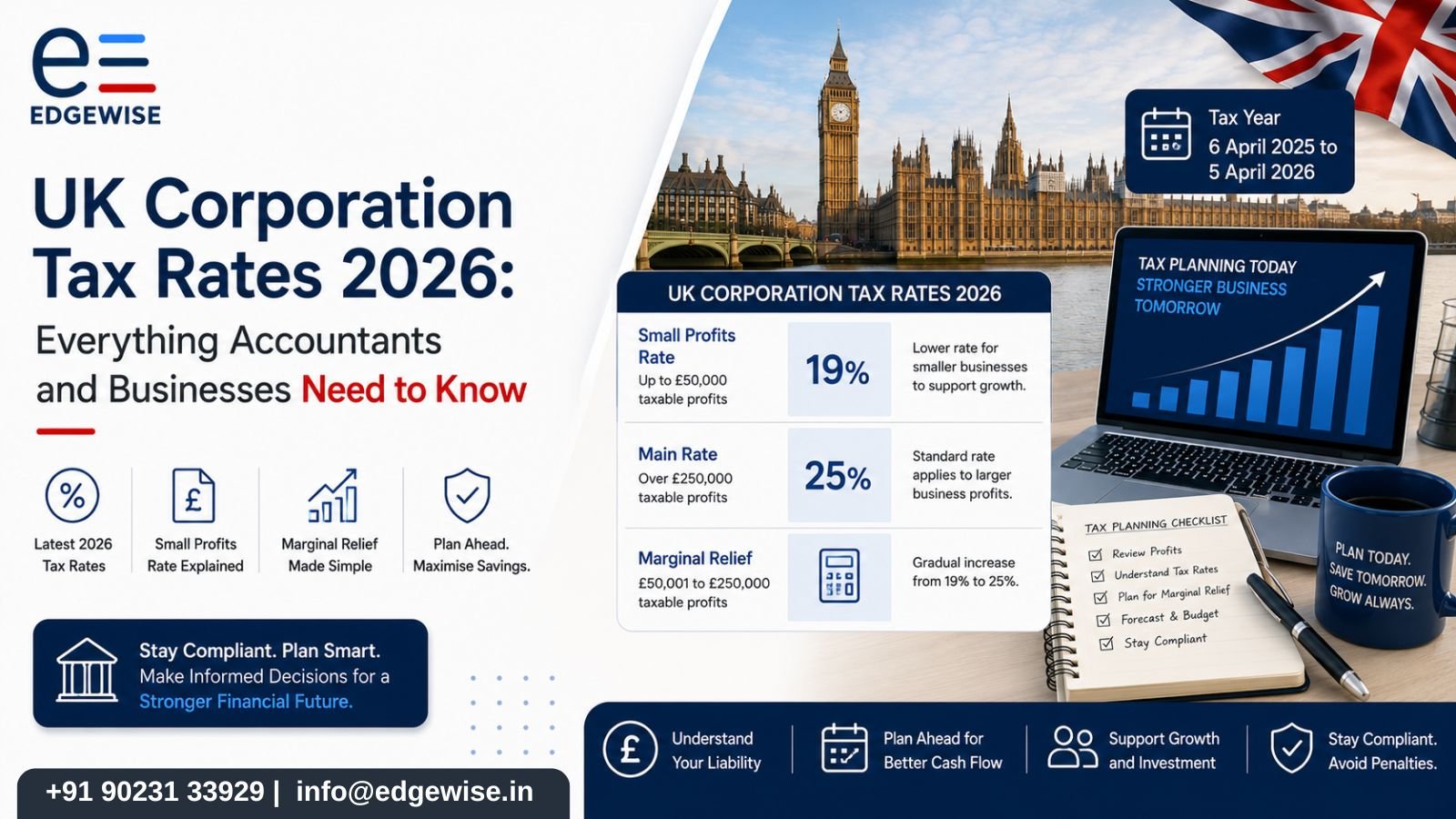
Corporation Tax is no longer calculated by applying one rate to every UK company. The applicable rate depends on taxable profits, the availability of Marginal Relief, the length of the accounting period, and the number of associated companies.
For accountants, this creates both a compliance responsibility and an advisory opportunity. Accurate forecasting and early planning can help clients avoid unexpected liabilities, improve cash flow, and make better business decisions.
UK Corporation Tax Rates for 2026
For the financial year beginning 1 April 2026, the main Corporation Tax rates for non-ring-fence profits remain:
| Taxable profits | Corporation Tax treatment |
|---|---|
| £50,000 or less | 19% Small Profits Rate |
| Between £50,000 and £250,000 | 25% less Marginal Relief |
| Above £250,000 | 25% Main Rate |
These limits generally apply to a company with no associated companies and a 12-month accounting period. Companies with profits between £50,000 and £250,000 pay Corporation Tax at the main rate, reduced by Marginal Relief, producing a gradual increase in the effective rate.
How Marginal Relief Works
Marginal Relief applies where a company’s profits fall between the lower and upper limits.
The relief is calculated using:
Marginal Relief = (F × (U − A)) × (N ÷ A)
Where:
- F is the standard fraction of 3/200;
- U is the upper profit limit;
- A is augmented profits; and
- N is taxable total profits.
Accountants should not simply apply 19% or 25% when profits fall within the Marginal Relief band. Exempt distributions and other amounts included in augmented profits may also affect the final calculation.
Associated Companies Can Reduce the Thresholds
Associated companies are one of the most important areas to review when calculating Corporation Tax.
Companies are generally associated where one controls another or where both are under common control. The £50,000 and £250,000 thresholds are divided by the total number of associated companies, including the company being assessed.
For example, where two companies are under common control, the limits may be reduced to:
- £25,000 lower limit; and
- £125,000 upper limit.
As a result, a company may enter the Marginal Relief band or become subject to the 25% main rate much sooner than expected. The thresholds are also proportionately reduced for accounting periods shorter than 12 months.
Important Corporation Tax Deadlines
For most small and medium-sized companies:
| Requirement | General deadline |
|---|---|
| Pay Corporation Tax | 9 months and 1 day after the accounting period ends |
| File the Company Tax Return | 12 months after the accounting period ends |
For example, where an accounting period ends on 31 March 2026:
- Corporation Tax is generally payable by 1 January 2027; and
- The Company Tax Return is generally due by 31 March 2027.
Large and very large companies may be required to pay Corporation Tax through quarterly instalments instead of using the standard payment deadline.
Common Corporation Tax Mistakes
Missing Associated Companies
Accountants may calculate tax using the full thresholds without reviewing the company’s wider ownership structure. This can result in understated liabilities and inaccurate forecasts.
Ignoring Marginal Relief
Applying only the headline rates of 19% or 25% may produce an incorrect tax calculation where profits fall between the relevant limits.
Waiting Until Year-End
By the time the year-end accounts are prepared, opportunities involving capital expenditure, employer pension contributions, losses, bonuses, or other planning decisions may already have passed.
Missing Available Reliefs
Tax calculations should consider relevant capital allowances, qualifying business expenses, loss relief, pension contributions, and applicable research and development reliefs.
Confusing the Payment and Filing Deadlines
Corporation Tax is normally payable before the Company Tax Return is due. Waiting until the filing deadline to arrange payment may result in interest and penalties.
How Accountants Can Add Greater Value
Corporation Tax should be treated as an ongoing advisory matter rather than a once-a-year compliance exercise.
Accounting practices can support clients through:
- Regular profit forecasting;
- Reviewing associated-company relationships;
- Estimating Marginal Relief;
- Planning capital expenditure;
- Reviewing employer pension contributions;
- Identifying available allowances and reliefs;
- Monitoring payment and filing deadlines; and
- Preparing cash-flow forecasts for upcoming tax liabilities.
These services help clients understand not only how much tax is payable, but also how business decisions may affect future liabilities.
Why Edgewise Training Solutions Pvt Ltd?
Corporation Tax work requires technical attention, accurate records, reliable working papers, and sufficient capacity during busy filing periods.
Edgewise Training Solutions Pvt Ltd can help UK accounting practices manage routine accounting and compliance workloads through structured offshore support.
Edgewise can support practices with:
- Bookkeeping and ledger maintenance;
- Bank and balance-sheet reconciliations;
- Corporation Tax working-paper preparation;
- Year-end accounts support;
- Collection and organisation of client records;
- Tax-computation support schedules;
- Deadline monitoring; and
- Review-ready accounting information.
By delegating process-driven work to a trained support team, UK accountants can spend more time reviewing tax positions, advising clients, and identifying planning opportunities.
Edgewise works as an extension of the accounting practice, following its software, working-paper formats, internal procedures, and review requirements. This helps firms increase capacity without continuously expanding their permanent workforce.
Conclusion
The 2026 Corporation Tax regime requires accountants to look beyond the headline rates.
Marginal Relief, associated companies, augmented profits, accounting-period length, and available reliefs can all affect the final liability. Practices that review these matters throughout the year can provide more accurate forecasts and more valuable tax-planning support.
Where routine compliance work limits advisory capacity, Edgewise Training Solutions Pvt Ltd can provide structured offshore support, helping accounting practices manage deadlines, maintain quality, and focus on higher-value client services.