Managing tax compliance in the UK has become more digital, more structured, and more time-sensitive. Businesses are expected to monitor VAT, PAYE, Corporation Tax, Self Assessment, and other tax obligations through online systems.
For many business owners, this can feel confusing. For accounting practices managing multiple clients, it can become even more challenging.
This is where the HMRC Business Tax Account becomes important.
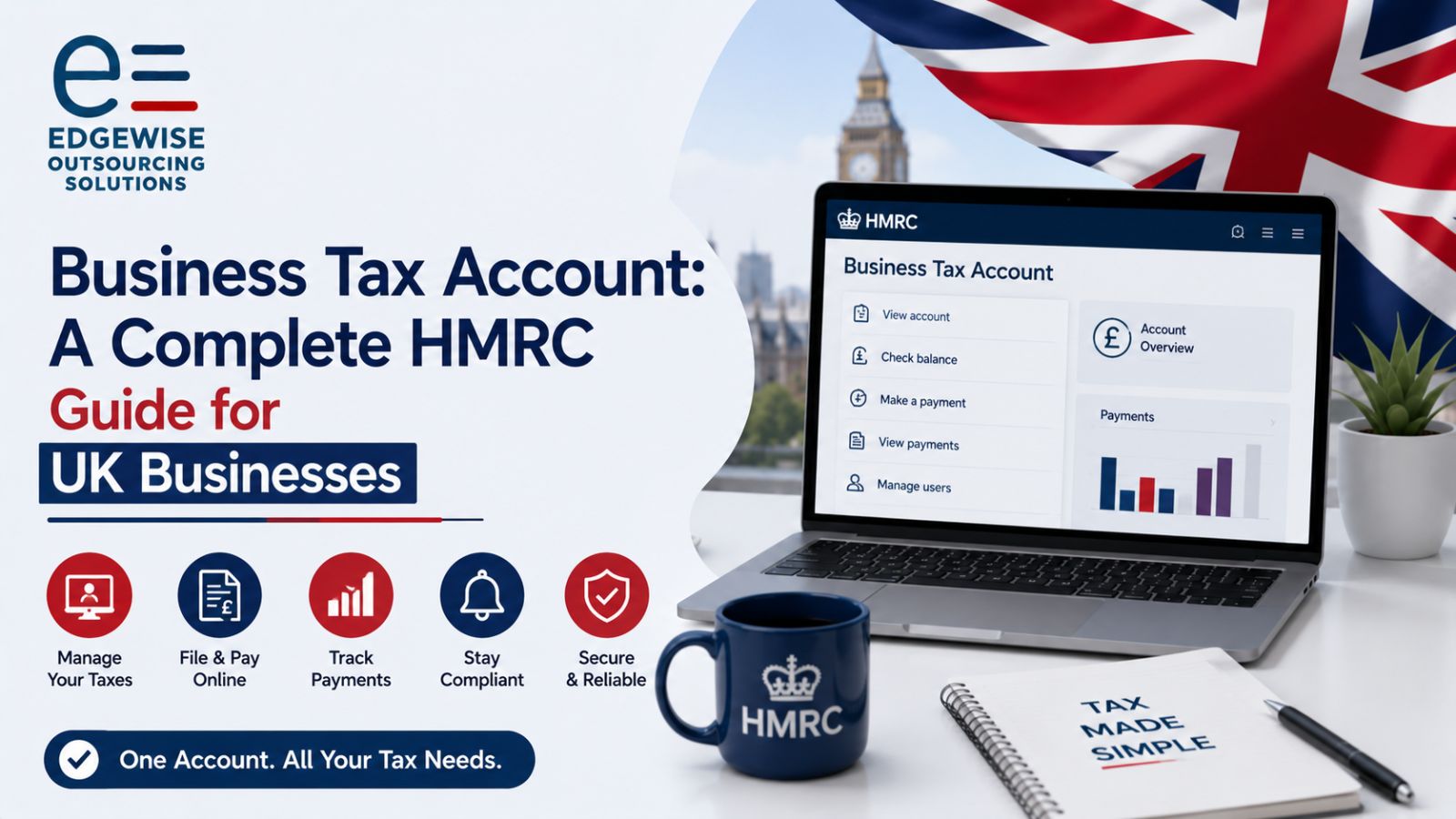
A Business Tax Account acts as a central online account where businesses can access and manage different tax services. It helps business owners and their accountants keep track of tax registrations, liabilities, payments, deadlines, and online services in one place.
At Edgewise Training Solutions Private Limited, we believe that businesses should not wait for tax issues to become urgent. A properly managed Business Tax Account can help reduce confusion, improve compliance, and make tax administration more organised.
What Is an HMRC Business Tax Account?
An HMRC Business Tax Account is an online account used by businesses to manage their tax affairs with HMRC.
It can be used by sole traders, partnerships, limited companies, and employers to access different business tax services. These may include VAT, PAYE for employers, Corporation Tax, Self Assessment, and other HMRC services depending on the business structure.
In simple words, it is a digital dashboard for business tax management.
Through a Business Tax Account, a business can generally:
- View tax services linked to the business
- Add or manage tax services
- Check tax liabilities
- Review payments and balances
- Access VAT services
- Manage PAYE for employers
- View Corporation Tax-related information
- Track certain HMRC notices and communications
- Authorise an accountant or tax agent where applicable
The exact services visible in the account depend on what the business is registered for and what services have been added.
Why a Business Tax Account Is Important
Many businesses face tax problems not because they are intentionally non-compliant, but because they do not have a clear system to monitor their obligations.
For example, a business may be registered for VAT but may not know where to check VAT return deadlines. Another business may have employees but may not regularly review PAYE liabilities. A company may also miss Corporation Tax payment planning because responsibilities are spread across different systems and emails.
A Business Tax Account helps bring these areas together.
It supports better compliance by allowing businesses to:
- Track obligations more clearly
- Access online tax services from one place
- Reduce dependency on scattered communication
- Maintain better visibility over tax payments
- Respond to HMRC requirements more efficiently
- Prepare for digital tax reporting
For accounting practices, it also helps in guiding clients more effectively.
What Can Be Managed Through a Business Tax Account?
A Business Tax Account can connect to different HMRC services depending on the business type and tax registrations.
1. VAT
VAT-registered businesses can use HMRC online services to manage VAT-related responsibilities.
This may include:
- Accessing VAT services
- Viewing VAT obligations
- Checking payment history
- Managing VAT registration details
- Working with Making Tax Digital-compatible software
- Tracking VAT return-related information
For most VAT-registered businesses, digital record-keeping and software-based submissions are now part of normal compliance. Therefore, keeping the VAT service properly linked and monitored is important.
2. PAYE for Employers
Businesses that employ staff need to manage payroll reporting and PAYE obligations.
Through the relevant employer services, businesses can monitor PAYE and National Insurance liabilities, access employer-related notices, and manage employer tax obligations.
Payroll submissions are generally made through payroll software, but the Business Tax Account remains important for reviewing the employer tax position and keeping track of PAYE-related matters.
3. Corporation Tax
Limited companies can add Corporation Tax services to their Business Tax Account.
This helps companies access Corporation Tax-related information, manage online services, and monitor tax responsibilities linked to the company.
Corporation Tax compliance is important because companies need to calculate taxable profits, pay Corporation Tax on time, and file Company Tax Returns within the required deadline.
4. Self Assessment
Some businesses and individuals may also need Self Assessment services.
This is especially relevant for sole traders, partners in partnerships, landlords, and individuals with income not fully taxed through PAYE.
Where applicable, Self Assessment services can be accessed through HMRC online accounts, helping taxpayers view returns, payments, and liabilities.
5. Construction Industry Scheme
Businesses operating in the construction sector may need to manage Construction Industry Scheme responsibilities.
This can involve contractor registration, subcontractor verification, deduction reporting, and related compliance matters.
For construction businesses, CIS compliance must be managed carefully because errors or delays can create penalties and unnecessary administrative pressure.
Business Tax Account vs Personal Tax Account
Many taxpayers get confused between a Business Tax Account and a Personal Tax Account.
Both are HMRC online accounts, but they are used for different purposes.
- Particulars
- Business Tax Account
- Personal Tax Account
- Used by
- Businesses, employers, sole traders, companies and partnerships
- Individuals
- Main purpose
- Managing business taxes and online tax services
- Managing personal tax affairs
- Common services
- VAT, PAYE, Corporation Tax, CIS, business Self Assessment
- Income Tax, PAYE, tax code, personal Self Assessment
- Login
- Government Gateway
- Government Gateway
- Best used for
- Business tax compliance
- Personal tax management
A business owner may need both accounts depending on their personal and business circumstances.
How to Set Up an HMRC Business Tax Account
Setting up a Business Tax Account is usually straightforward, but the correct details must be available before starting.
- Step 1: Keep business information ready
Before setting up or adding services, keep the following details ready where applicable:
- Government Gateway user ID and password
- Business name
- Business address
- Unique Taxpayer Reference
- Company registration number for limited companies
- VAT registration number, if applicable
- PAYE reference, if applicable
- National Insurance number for sole traders
- Contact email and phone number
Having the correct information avoids delays during registration.
Step 2: Create or use a Government Gateway account
The business needs Government Gateway sign-in details to access HMRC online services.
If the business does not already have sign-in details, they can be created during the setup process.
It is important that these login details are kept secure. Businesses should not share passwords casually, even with external advisers. Where an accountant or tax agent needs access, proper authorisation should be used.
Step 3: Add relevant tax services
Once signed in, the business can add the relevant HMRC services such as VAT, PAYE for employers, Corporation Tax, or other applicable taxes.
Each service may require separate enrolment or activation.
This step is important because many businesses assume that all services will appear automatically. In practice, services may need to be added manually.
Step 4: Complete activation, where required
Some services may require an activation process. HMRC may send an activation code or ask for further verification depending on the service.
The service will only become fully available once the activation is completed.
Step 5: Authorise an accountant or tax agent
If the business uses an accountant or tax adviser, the agent should be authorised properly through HMRC’s agent authorisation process.
This allows the adviser to act on behalf of the business for relevant tax services.
Businesses should avoid sharing Government Gateway passwords directly. Proper agent authorisation gives controlled access and protects both the business and the adviser.
Common Login and Access Problems
Businesses and accounting practices often face practical access issues. These may seem small, but they can delay filings and create unnecessary pressure near deadlines.
Forgotten Government Gateway details
If login details are lost, they may need to be recovered through HMRC’s online process. Businesses should maintain secure records of account access information.
Wrong password or locked account
Repeated incorrect attempts can create delays. Password recovery should be completed early instead of waiting until a filing deadline.
Missing tax services
Sometimes VAT, PAYE, or Corporation Tax services do not appear in the account. This may happen if the service was never added or activation was not completed.
Agent authorisation not completed
Accountants may not be able to access client data unless the client has completed the authorisation process correctly.
Old or incorrect business details
Changes in address, contact details, directors, or business status should be updated where required. Outdated information can create communication gaps with HMRC.
Business Tax Account and Making Tax Digital
The Business Tax Account is closely connected with the wider move towards digital tax administration.
Making Tax Digital requires eligible businesses and taxpayers to maintain digital records and use compatible software for submissions.
MTD already applies to VAT-registered businesses. From April 2026, MTD for Income Tax applies to certain sole traders and landlords based on qualifying income thresholds.
This makes proper digital tax management even more important.
Businesses should review:
- Whether they fall under MTD requirements
- Whether their software is compatible
- Whether bookkeeping is updated regularly
- Whether digital records are complete
- Whether their accountant or agent is authorised
- Whether quarterly reporting requirements apply
Digital compliance is not only about filing returns. It also requires disciplined record-keeping throughout the year.
What Happens When a Business Closes?
Closing a business does not automatically close all tax obligations.
If a business stops trading, it may still need to:
- Inform HMRC
- Submit final VAT returns, if VAT-registered
- Deregister for VAT, where applicable
- Complete final payroll submissions, if it had employees
- Settle outstanding PAYE or VAT liabilities
- File final accounts and Corporation Tax returns, where applicable
- Close or update relevant HMRC services
- Maintain records for the required period
A business should not ignore its Business Tax Account after closure. Outstanding filings or liabilities may still remain visible and need to be dealt with properly.
Why Accounting Practices Should Guide Clients on Business Tax Accounts
Many clients expect their accountant to handle everything tax-related. However, if the Business Tax Account is not correctly set up, linked, or authorised, even a technically strong accountant may face delays.
Accounting practices should guide clients on:
- Setting up HMRC online access
- Adding the correct tax services
- Completing agent authorisation
- Maintaining secure login practices
- Tracking VAT, PAYE and Corporation Tax obligations
- Preparing for Making Tax Digital
- Keeping digital records updated
- Responding to HMRC notices on time
This creates a better client experience and reduces last-minute compliance problems.
Role of Outsourcing in Managing Tax Compliance
As compliance becomes more digital, accounting practices are handling higher volumes of bookkeeping, VAT, payroll, tax filing support, reconciliations, and reporting.
For many firms, the challenge is not only technical knowledge. The real challenge is capacity, turnaround time, and process management.
Outsourcing can support accounting practices by helping with:
- Bookkeeping
- VAT working preparation
- Payroll support
- PAYE reconciliation
- Corporation Tax working papers
- Self Assessment support
- Client data cleanup
- Digital record maintenance
- Management accounts
- Compliance trackers
This allows internal teams to focus more on review, client advisory, tax planning, and relationship management.
However, outsourcing should be managed with proper controls, data security, review systems, and clear communication.
How Edgewise Training Solutions Private Limited Can Help
Edgewise Training Solutions Private Limited supports businesses, professionals, and accounting practices with structured accounting, tax support, bookkeeping, payroll support, compliance tracking, and outsourced finance processes.
Our approach is practical and process-driven. We help businesses and accounting practices manage financial data in a more organised manner so that compliance becomes smoother and decision-making becomes clearer.
We can assist with:
- Business tax account support
- HMRC online services guidance
- Bookkeeping and reconciliation
- VAT return working support
- PAYE and payroll support
- Corporation Tax working support
- Self Assessment support
- Making Tax Digital readiness
- Management accounts
- Outsourced accounting support
- Client-wise compliance tracking
A well-managed Business Tax Account helps reduce confusion, improve visibility, and keep tax compliance under control.
Conclusion
The HMRC Business Tax Account is now an important part of UK tax administration.
It helps businesses manage tax services, monitor obligations, review payments, and stay connected with HMRC’s digital systems. For accounting practices, it is also a useful tool for guiding clients and improving compliance workflows.
As Making Tax Digital expands and tax administration becomes more software-driven, businesses can no longer rely on scattered records, manual follow-ups, or last-minute filing habits.
The right approach is to set up the account properly, link all relevant services, authorise advisers correctly, monitor obligations regularly, and maintain clean digital records.
At Edgewise Training Solutions Private Limited, we help businesses and accounting practices build better accounting and compliance processes so that tax management becomes more organised, accurate, and stress-free.