
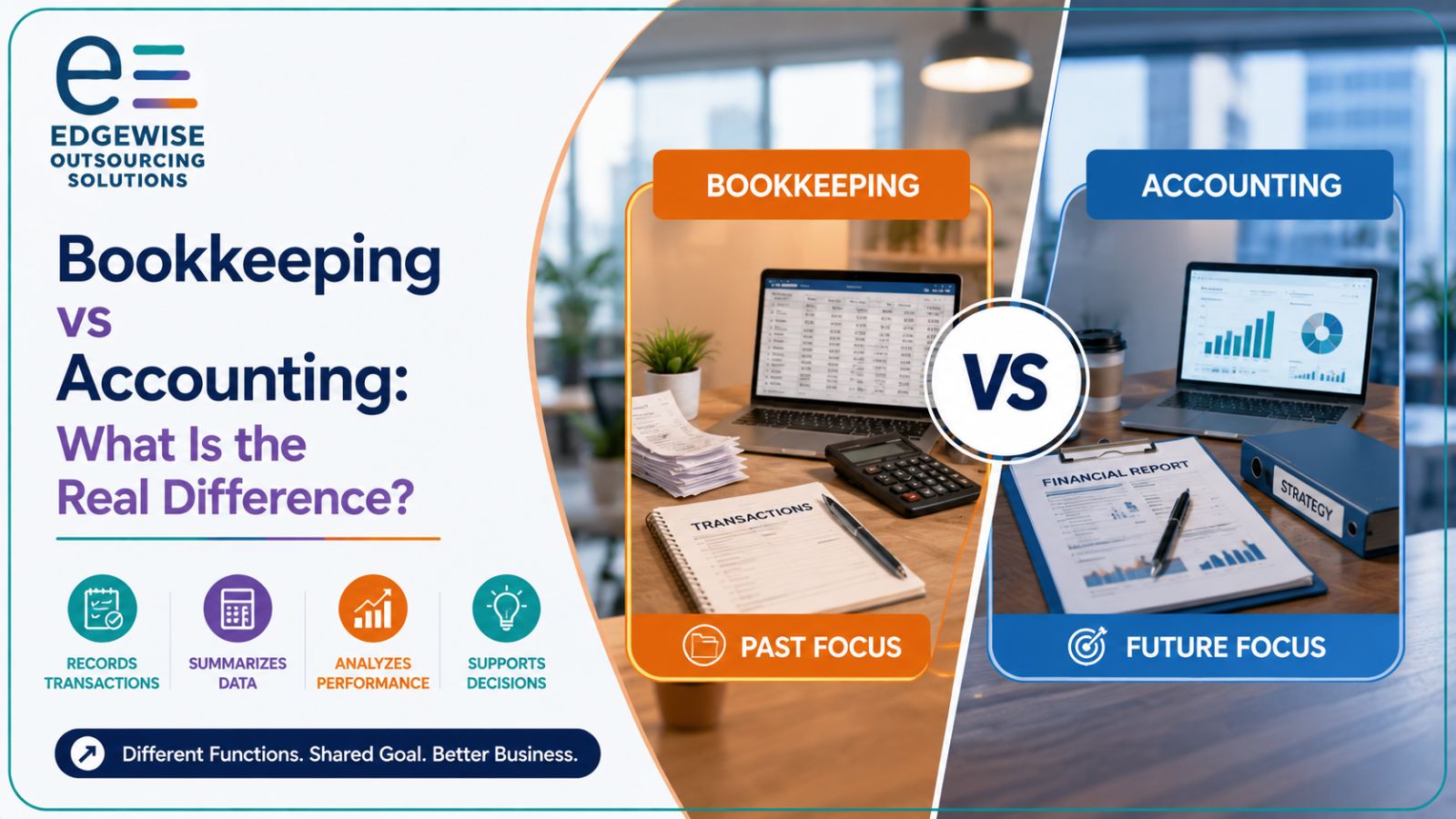
For many business owners, the words bookkeeping and accounting sound almost the same. In day-to-day conversations, people often use them interchangeably.
But in reality, both are different — and both are equally important for running a business properly.
Bookkeeping keeps your financial records organised. Accounting helps you understand what those records actually mean. One gives you clean data, and the other helps you use that data for tax planning, compliance, business decisions, and future growth.
At Edgewise Training Solutions Private Limited, we often see businesses struggling not because they do not have data, but because the data is either not properly recorded or not properly analysed. That is why understanding the difference between bookkeeping and accounting is important.
What Is Bookkeeping?
Bookkeeping is the process of recording the financial transactions of a business on a regular basis.
In simple words, bookkeeping answers the question:
- “What happened with the money?”
A bookkeeper records sales, purchases, receipts, payments, expenses, payroll, bank transactions, and other day-to-day entries. The objective is to maintain accurate and updated financial records.
Common bookkeeping activities include:
- Recording sales invoices
- Recording purchase invoices
- Posting receipts and payments
- Bank reconciliation
- Maintaining accounts payable and receivable
- Payroll processing
- VAT/GST return data preparation
- Maintaining the ledger
- Organising bills, receipts, and supporting documents
Bookkeeping may look simple from the outside, but it requires accuracy, consistency, and attention to detail. If bookkeeping is not done properly, the entire financial reporting system becomes weak.
What Is Accounting?
Accounting starts where bookkeeping ends.
Once the financial transactions are properly recorded, accounting uses that information to prepare reports, analyse performance, calculate taxes, and support business decisions.
Accounting answers the question:
- “What do these numbers mean for the business?”
An accountant reviews the books, prepares financial statements, analyses profit and cash flow, ensures compliance, and gives guidance on tax and business planning.
Common accounting activities include:
- Preparation of financial statements
- Preparation of statutory accounts
- Tax planning and tax return filing
- Management accounts
- Cash flow forecasting
- Budgeting and variance analysis
- Business advisory
- Financial analysis
- Compliance review
- Support for funding, loans, and investor reporting
Accounting is more analytical in nature. It helps business owners understand whether the business is profitable, whether costs are under control, whether cash flow is healthy, and what steps should be taken next.
- Key Difference Between Bookkeeping and Accounting
The simplest way to understand the difference is this:
Bookkeeping records the transactions. Accounting interprets those transactions.
- Particulars
- Bookkeeping
- Accounting
- Main Purpose
- Recording financial transactions
- Analysing financial information
- Focus
- Accuracy and organisation
- Interpretation and decision-making
- Frequency
- Daily, weekly, or monthly
- Monthly, quarterly, or annually
- Output
- Ledgers, reconciliations, transaction records
- Financial statements, tax returns, reports, advice
- Nature of Work
- Transaction-based
- Analysis-based
- Business Use
- Keeps records clean and updated
- Helps in planning, compliance, and strategy
Both are connected. Without bookkeeping, accounting cannot be done properly. Without accounting, bookkeeping remains only data entry without deeper business meaning.
Why Businesses Need Both
Many businesses make the mistake of thinking they need only one of the two. But bookkeeping and accounting work best when they work together.
Good bookkeeping ensures that every transaction is recorded correctly. Good accounting ensures that those records are reviewed, understood, and used for better decisions.
For example, if your sales are increasing but cash flow is still weak, bookkeeping will show the transactions, but accounting will help identify the reason — maybe customers are delaying payments, margins are falling, or expenses are increasing.
Similarly, if expenses are rising every month, bookkeeping will record the expense, but accounting will help analyse whether the increase is justified or whether cost control is required.
- Common Mistakes Businesses Make
1. Treating bookkeeping as a year-end activity
Bookkeeping should not be done only at the end of the year. When records are updated regularly, business owners get a better understanding of their financial position throughout the year.
Delayed bookkeeping often leads to errors, missing invoices, incorrect tax calculations, and unnecessary stress during compliance deadlines.
2. Mixing personal and business expenses
This is one of the most common mistakes in small businesses. When personal and business expenses are mixed, it becomes difficult to understand the true profitability of the business.
Separate records help maintain transparency and make tax and accounting work much easier.
3. Paying accounting-level cost for bookkeeping work
If basic bookkeeping is not maintained properly, accountants may have to spend extra time cleaning the records before preparing accounts or tax returns. This can increase the overall cost.
It is always better to keep bookkeeping updated from the beginning.
4. Ignoring financial analysis
Some businesses maintain proper books but never review them. This means they have data, but they are not using it.
Regular accounting review helps identify trends, risks, opportunities, and tax-saving possibilities.
5. Not using proper accounting software
Modern businesses should use accounting software to maintain accurate and real-time financial data. Software like Xero, QuickBooks, Zoho Books, Tally, Sage, or similar platforms can help automate many routine tasks and reduce manual errors.
How Technology Has Changed Bookkeeping and Accounting
Technology has changed the way financial work is done.
Earlier, bookkeeping involved manual entries and physical records. Today, bank feeds, cloud accounting software, automated invoice processing, digital receipts, and reporting dashboards have made the process faster and more accurate.
However, technology cannot replace professional judgement.
Software can record and organise data, but a professional is still required to review, interpret, and advise. A system may show that expenses have increased, but a finance professional will explain why it happened and what should be done.
That is where the combination of technology and human expertise becomes valuable.
When Should a Business Outsource Bookkeeping or Accounting?
Outsourcing can be a practical option when the business does not have enough internal time, expertise, or staff to manage financial work properly.
A business may consider outsourcing when:
- Bookkeeping is regularly delayed
- Internal staff is overloaded
- Financial reports are not prepared on time
- Tax and compliance deadlines are becoming stressful
- Management wants better reporting and analysis
- The business wants to reduce fixed employee cost
- The company is growing and needs structured financial systems
Outsourcing allows business owners to focus on operations while professionals handle financial records, reporting, and compliance support.
How Edgewise Training Solutions Private Limited Can Help
Edgewise Training Solutions Private Limited supports businesses with practical accounting, bookkeeping, reporting, and financial support services.
Our approach is simple: financial data should not remain only for compliance. It should help business owners make better decisions.
We can assist with:
- Bookkeeping support
- Accounting support
- Bank reconciliation
- Accounts payable and receivable tracking
- Payroll support
- Monthly financial reporting
- Management accounts
- Budget vs actual analysis
- Cash flow reporting
- KPI tracking
- Outsourced accounting support
With proper bookkeeping and accounting systems, businesses can improve financial control, reduce compliance pressure, and make decisions with more confidence.
Conclusion
Bookkeeping and accounting are not the same, but they are closely connected.
Bookkeeping keeps the financial records accurate and organised. Accounting uses those records to prepare reports, manage compliance, analyse performance, and guide business decisions.
A business that maintains both properly will always have better financial visibility.
Whether done in-house or outsourced, bookkeeping and accounting should be treated as an important part of business management — not just a compliance formality.
At Edgewise Training Solutions Private Limited, we help businesses maintain structured financial processes so that accounting data becomes useful, reliable, and decision-oriented.