
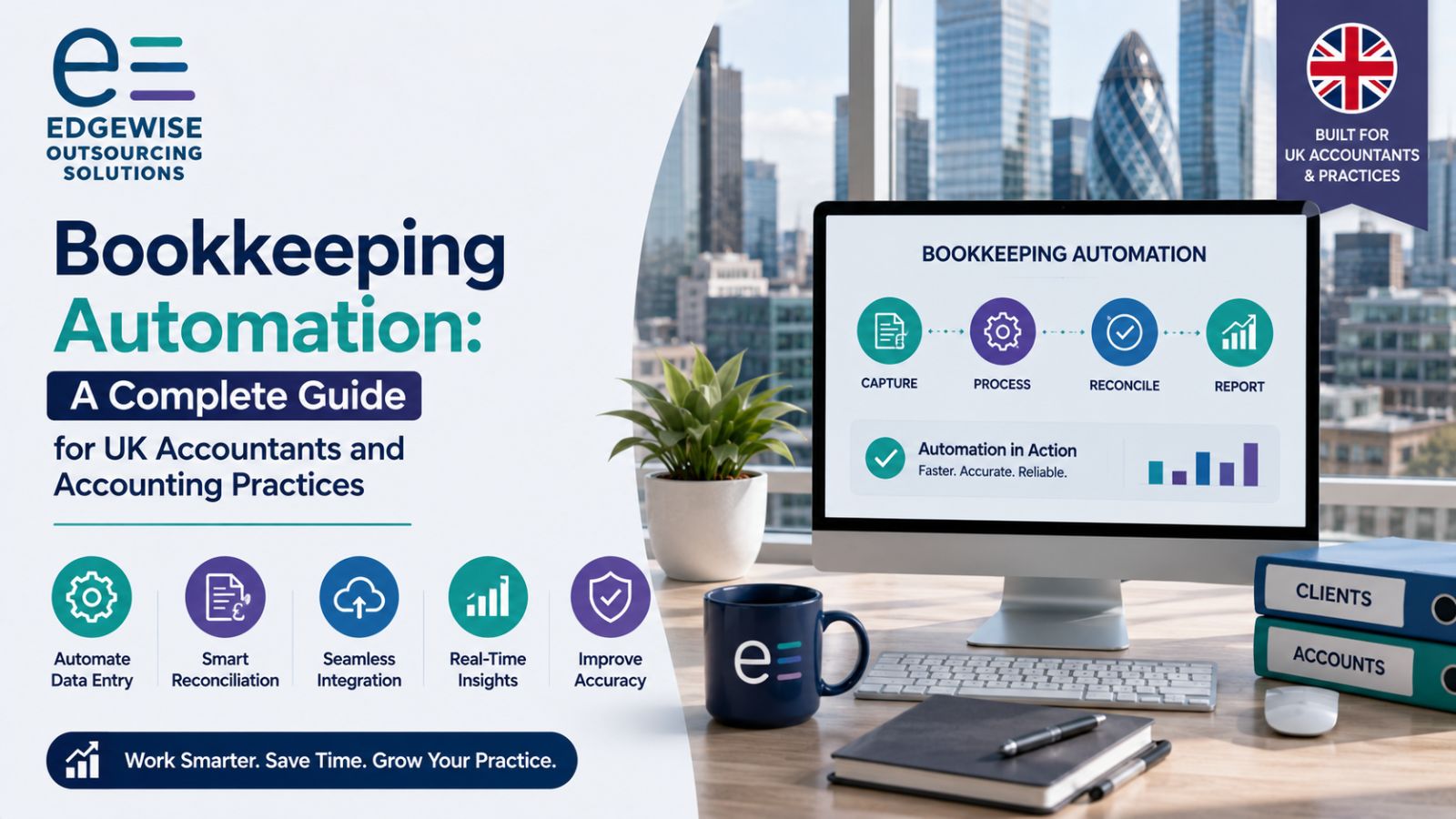
For any accounting practice, bookkeeping may appear simple from the outside. In reality, it is one of the most time-consuming and operationally demanding parts of accounting work.
Receipt chasing, invoice processing, bank reconciliations, expense categorisation, VAT preparation, payroll-related data, and client reporting can consume a significant amount of staff time. During peak periods such as Self Assessment season, VAT quarters, payroll deadlines, and year-end reporting, this workload can quickly become overwhelming.
Many UK accounting practices are facing the same challenge: clients expect faster updates, real-time financial information, and accurate reporting, while internal teams are already stretched.
This is where bookkeeping automation becomes important.
Bookkeeping automation is no longer a future concept. It is becoming a practical requirement for accounting firms that want to improve accuracy, save time, scale operations, and focus more on advisory services.
What Is Bookkeeping Automation?
Bookkeeping automation means using digital tools, artificial intelligence, cloud accounting software, and workflow systems to reduce repetitive manual bookkeeping work.
It can help automate tasks such as:
- Data entry
- Bank reconciliation
- Receipt capture
- Invoice processing
- Expense categorisation
- VAT reporting support
- Financial reporting
- Document collection
- Ledger updates
Instead of manually entering every transaction, automation tools can capture data from bank feeds, invoices, receipts, and documents. The system can then categorise transactions, match entries, and prepare records for review.
For example, a client uploads a receipt. The software extracts the data, identifies the supplier, categorises the expense, and pushes the entry into the accounting system for review.
This helps reduce manual work and allows accountants to focus on accuracy, review, advisory, and client communication.
Why UK Accounting Firms Need Automation Now
The UK accounting industry is changing rapidly. Firms that continue to rely only on manual bookkeeping may find it difficult to keep pace with client expectations and regulatory requirements.
Key reasons automation is becoming essential include:
1. Making Tax Digital Requirements
Making Tax Digital has already changed the way businesses maintain records and submit tax information. As digital compliance expands further, accounting firms will need stronger systems, cleaner records, and MTD-compliant software.
Manual spreadsheets and disconnected processes may become increasingly inefficient.
Automation helps firms maintain digital records, process transactions faster, and support more compliant reporting workflows.
2. Rising Transaction Volumes
Businesses are using more digital payments, online platforms, card transactions, payment gateways, subscriptions, and automated billing systems.
This means accounting firms are handling larger volumes of financial data than before.
Processing these transactions manually is time-consuming and increases the risk of error.
Automation helps manage high transaction volumes more efficiently.
3. Talent Shortage in Accounting
Many UK accounting firms are finding it difficult to recruit and retain skilled bookkeeping and accounting staff.
When talent is limited, firms must use their existing team more effectively.
Automation reduces repetitive manual work and allows accountants to focus on higher-value responsibilities such as review, reporting, client communication, and advisory services.
4. Demand for Real-Time Financial Insights
Clients no longer want to wait until year-end to understand their financial position.
They expect regular updates, management reports, cash flow visibility, and business insights.
Bookkeeping automation helps firms maintain more updated records and generate timely reports, enabling better client conversations and faster decision-making.
- 5 Key Benefits of Bookkeeping Automation for UK Accounting Practices
1. Improved Accuracy and Reduced Human Error
Manual bookkeeping is prone to mistakes. Errors in data entry, VAT coding, expense classification, or bank reconciliation can affect financial reports and compliance.
Automation tools reduce the need for repetitive manual entry. They can extract data from invoices, receipts, and bank feeds, reducing the risk of clerical mistakes.
This improves the quality of bookkeeping records and reduces the time spent on corrections.
2. Time Saving for Internal Teams
In accounting, time is one of the most valuable resources.
Automation can save significant staff time by reducing manual work in areas such as:
- Bank reconciliation
- Invoice processing
- Receipt matching
- Payroll data preparation
- Report generation
- VAT working preparation
This allows internal teams to focus on client service, review, tax planning, advisory, and practice growth.
3. Scalability Without Immediate Hiring
As an accounting practice grows, the number of clients and transactions also increases.
If the firm relies only on manual processes, growth can quickly create operational pressure.
Automation helps firms handle more work without immediately hiring additional staff. This creates a more scalable delivery model and improves operational efficiency.
4. Real-Time Financial Insights
Automation allows accounting firms to maintain more updated books and generate reports faster.
This helps clients understand their financial position more clearly and make informed decisions.
Real-time insights can support:
- Cash flow monitoring
- Expense control
- Profitability review
- Budgeting
- Management reporting
- Business planning
For accounting firms, this creates an opportunity to deliver more value beyond basic compliance.
5. Better Compliance Support
Compliance requirements continue to evolve. Accounting firms need accurate digital records, reliable workflows, and timely reporting.
Automation tools can help support compliance by:
- Maintaining digital records
- Reducing manual errors
- Supporting VAT reporting workflows
- Integrating with MTD-compliant software
- Improving documentation and audit trails
- Ensuring timely bookkeeping updates
This helps reduce compliance risk and improves confidence in client records.
- How to Automate Bookkeeping: Step-by-Step Guide for UK Practices
- Step 1: Assess Your Current Bookkeeping Process
The first step is to review your existing bookkeeping workflow.
Identify tasks that are repetitive, time-consuming, or prone to errors. These may include:
- Manual data entry
- Invoice processing
- Receipt collection
- Bank reconciliation
- Expense coding
- VAT workings
- Report preparation
These tasks are usually the best starting points for automation.
Step 2: Select Cloud Accounting Software
Bookkeeping automation works best when supported by cloud accounting software.
Popular options for UK accounting practices include:
- Xero
- QuickBooks Online
- Sage Business Cloud
These platforms help firms manage bookkeeping, reconciliation, reporting, and compliance workflows more efficiently.
Step 3: Implement Data Capture Tools
Data capture tools help convert invoices, receipts, and financial documents into structured digital data.
Common tools include:
- Dext
- AutoEntry
- Hubdoc
These tools reduce manual data entry and help feed accurate information into accounting software.
Step 4: Automate Bank Feeds and Reconciliation
Bank feeds automatically import transactions from bank accounts into accounting software.
Automation tools can then help match bank transactions with invoices, receipts, and ledger entries.
This reduces reconciliation time and improves record accuracy.
Step 5: Automate Financial Reporting
Once bookkeeping data is updated regularly, firms can automate or streamline reporting.
Reports may include:
- Management accounts
- VAT summaries
- Expense analysis
- Cash flow reports
- Aged receivables
- Aged payables
- Profitability reports
This helps firms provide clients with more timely and useful financial information.
Best Bookkeeping Automation Tools for UK Accountants
Several tools are commonly used by UK accounting practices to automate bookkeeping workflows.
Xero
Xero is widely used by UK accountants and small businesses. It supports bank feeds, automated reconciliation, invoicing, reporting dashboards, and integrations with many third-party tools.
QuickBooks Online
QuickBooks Online offers features such as expense categorisation, invoice tracking, bank reconciliation, and real-time reporting. It is suitable for firms supporting small and mid-sized businesses.
Sage Business Cloud
Sage is a well-established accounting solution used by many UK businesses and accountants. It supports cloud accounting, bookkeeping, VAT workflows, and reporting.
Dext
Dext helps capture data from receipts, invoices, and bills. It reduces manual entry and integrates with accounting platforms such as Xero and QuickBooks.
AutoEntry
AutoEntry extracts data from invoices, receipts, statements, and other financial documents. It helps reduce manual processing time and supports efficient bookkeeping workflows.
Hubdoc
Hubdoc helps collect and process bills, receipts, and financial documents. It converts uploaded documents into usable accounting data and supports digital record-keeping.
Automation Plus Outsourcing: A Stronger Model
Technology alone does not solve every bookkeeping challenge.
Automation tools still need proper setup, review, monitoring, and accounting judgement. This is where a combination of automation and outsourcing can create stronger results.
When automation is supported by trained bookkeeping professionals, accounting firms can achieve:
- Faster processing
- Better accuracy
- Reduced internal workload
- Cleaner records
- Scalable support
- Improved client reporting
- More time for advisory services
Outsourcing can help firms implement automation more effectively by providing trained resources who understand accounting workflows and cloud-based tools.
How Edgewise Training Solutions Pvt Ltd Can Support Accounting Firms
At Edgewise Training Solutions Pvt Ltd, we support accounting firms with bookkeeping and back-office accounting assistance designed to improve efficiency and reduce routine workload.
Our support can include:
- Day-to-day bookkeeping
- Bank reconciliation
- Invoice processing
- Sales and purchase ledger support
- Expense categorisation
- VAT support
- Management accounts support
- Cloud accounting updates
- Data clean-up assistance
- Reporting support
- Back-office accounting support during peak workload periods
We aim to work as an extended support team for accounting practices, helping them combine structured processes, technology-enabled workflows, and reliable bookkeeping assistance.
Our objective is to help accounting firms save time, improve accuracy, reduce operational pressure, and focus on higher-value client services.
Conclusion
Bookkeeping automation is changing the way UK accounting practices operate.
With rising compliance requirements, higher transaction volumes, staff shortages, and increasing client expectations, manual bookkeeping is becoming harder to sustain.
Automation helps firms save time, improve accuracy, scale operations, and deliver faster insights to clients.
When automation is combined with reliable outsourcing support, accounting firms can reduce routine workload, improve efficiency, and free up senior teams for advisory and growth-focused work.
At Edgewise Training Solutions Pvt Ltd, we help accounting firms build smarter bookkeeping support systems so they can serve clients better, work more efficiently, and grow with confidence.
If your accounting practice is spending too much time on repetitive bookkeeping tasks, now may be the right time to explore automation-supported bookkeeping assistance.