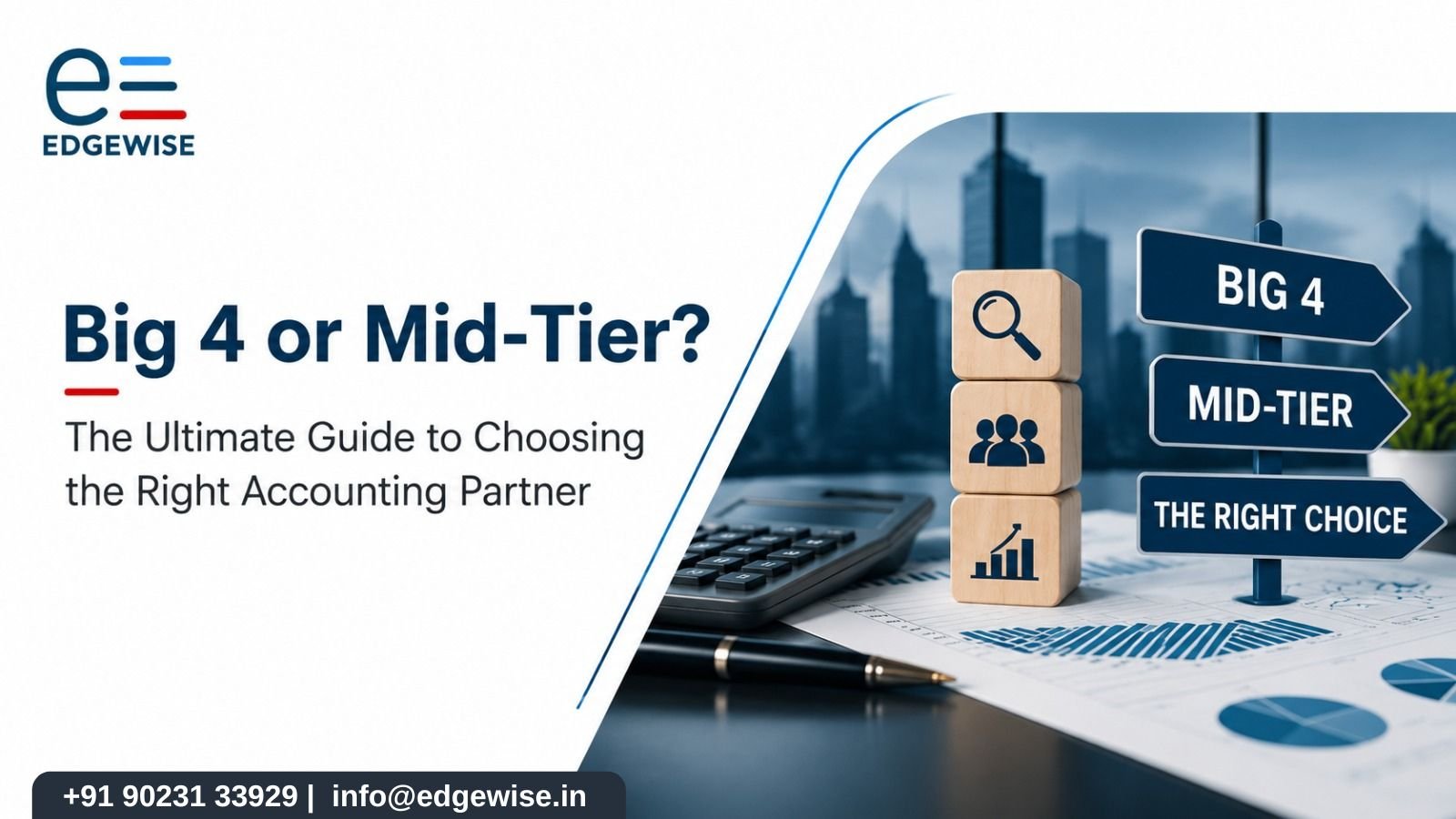
Choosing an accounting firm should not be based on reputation alone. The right choice depends on your company’s size, regulatory requirements, international presence, growth plans, and budget.
Big 4 firms offer extensive global resources and institutional credibility, while mid-tier firms generally provide stronger partner access, greater flexibility, and lower fees. Smaller and growing businesses may also consider outsourced accounting as a cost-effective alternative.
Key Takeaways
- Big 4 firms are generally best suited to listed companies, multinational groups, IPO-bound businesses, and highly regulated organisations.
- Mid-tier firms are often more suitable for SMEs, startups, private companies, and growing businesses.
- Big 4 firms provide broader global infrastructure, while mid-tier firms usually offer more direct senior involvement.
- Outsourced accounting may be more economical for businesses that do not require a large in-house finance department.
- The best firm is the one that matches your operational complexity and future growth plans.
Big 4 vs Mid-Tier Firms at a Glance
| Factor | Big 4 Firms | Mid-Tier Firms |
|---|---|---|
| Examples | Deloitte, PwC, EY and KPMG | BDO, RSM, Grant Thornton, Forvis Mazars and Crowe |
| Typical clients | Listed companies and multinationals | SMEs, startups and mid-market companies |
| International reach | Extensive global network | Strong but more selective network |
| Partner accessibility | Generally lower | Generally higher |
| Service model | Standardised and process-driven | Flexible and customised |
| Fees | Premium | Moderate |
| Best suited for | Complex and regulated engagements | Growth businesses and private companies |
What Are the Big 4 Firms?
The Big 4 are the world’s largest professional-services networks:
- Deloitte
- PwC
- EY
- KPMG
They operate across more than 140 countries and provide audit, tax, consulting, risk, transaction, and financial-advisory services.
Big 4 firms are particularly valuable when a business:
- Operates in several countries;
- Is publicly listed or preparing for an IPO;
- Requires SEC, SOX, IFRS, ESG, or complex regulatory reporting;
- Is completing a major merger or acquisition;
- Needs international tax and transfer-pricing support; or
- Requires a recognised firm for investors, lenders, or regulators.
Their main strengths are global coordination, technical specialisation, institutional credibility, and the ability to manage large and complex engagements.
However, these capabilities come with premium fees and more formal service structures.
What Are Mid-Tier Firms?
Mid-tier firms operate between the Big 4 and smaller regional practices. Major examples include BDO, RSM, Grant Thornton, Forvis Mazars, and Crowe.
Many mid-tier firms have offices in more than 100 countries and provide audit, tax, advisory, outsourcing, and transaction services.
They are commonly selected by businesses seeking:
- Strong technical expertise;
- More direct partner involvement;
- Faster response times;
- Greater service flexibility;
- Better team continuity; and
- More proportionate pricing.
For many privately held and mid-market businesses, a mid-tier firm can provide the necessary expertise without the cost and administrative structure associated with a Big 4 engagement.
Key Differences Between Big 4 and Mid-Tier Firms
1. Cost
Big 4 firms charge higher fees because clients are also paying for global infrastructure, proprietary technology, brand recognition, specialist departments, and multiple levels of internal review.
Mid-tier firms generally have lower overheads and can offer more competitive pricing.
The Big 4 premium may be justified where the auditor’s brand directly affects an IPO, institutional fundraising, regulatory approval, or large financing arrangement. For less complex businesses, a mid-tier firm may provide better value.
2. Partner Involvement
Big 4 engagements are usually delivered through larger teams. Routine communication may be handled by managers or senior associates, with partners becoming involved in major technical or commercial matters.
Mid-tier engagements are more likely to be partner-led. Clients often receive direct access to senior professionals throughout the engagement.
This can be particularly valuable for owner-managed companies, startups, and rapidly growing businesses that frequently require practical and timely guidance.
3. International Capabilities
Big 4 firms are best equipped for businesses with numerous entities operating across many jurisdictions.
They can coordinate tax, audit, transfer pricing, regulatory reporting, and compliance requirements across multiple countries.
Mid-tier firms also have extensive international networks and are usually capable of supporting businesses operating in a limited number of countries. However, extremely complex multinational groups may require the deeper resources of a Big 4 network.
4. Flexibility and Response Time
Big 4 firms generally use standardised global methodologies and formal approval processes. These systems provide consistency but may reduce flexibility.
Mid-tier firms often have shorter decision-making channels and can adapt more quickly to changes in scope, deadlines, or business requirements.
This flexibility is useful during fundraising, acquisitions, restructuring, system implementation, and rapid business expansion.
5. Industry Expertise
Both Big 4 and mid-tier firms maintain sector specialists.
Big 4 firms generally offer broader expertise in highly regulated industries such as banking, insurance, capital markets, and listed infrastructure.
Mid-tier firms often have strong capabilities in sectors such as:
- Technology and SaaS;
- Manufacturing;
- Healthcare;
- Real estate;
- E-commerce;
- Family-owned businesses; and
- Private-equity portfolio companies.
The quality of the specific engagement team should be evaluated rather than relying only on the firm’s overall brand.
Indicative Cost Comparison
Actual fees vary depending on the organisation’s size, locations, transaction volume, reporting requirements, systems, deadlines, and risk profile.
| Service | Big 4 Firms | Mid-Tier Firms |
|---|---|---|
| Annual mid-market audit | $500,000 to $5 million+ | $60,000 to $200,000 |
| Annual tax advisory | $200,000 to $1 million+ | $30,000 to $150,000 |
| Finance or CFO advisory | $300,000 to $800,000 | $50,000 to $200,000 |
| Outsourced accounting | Not usually a core service | Approximately $2,000 to $10,000 per month |
These figures are broad market indicators and should not be treated as fixed quotations.
Which Firm Should You Choose?
Choose a Big 4 Firm If:
- Your company is publicly listed or preparing for an IPO;
- You operate across several countries;
- Your business is highly regulated;
- You need complex cross-border tax, valuation, or transaction advice;
- An investor, lender, or regulator requires Big 4 involvement; or
- Your organisation has numerous entities and complex reporting obligations.
Choose a Mid-Tier Firm If:
- You are an SME, startup, or privately held company;
- You require strong technical support at a reasonable cost;
- Direct partner access is important;
- Your business is raising capital or expanding;
- You want continuity in the engagement team; or
- Your requirements are complex but do not involve extensive multinational coordination.
When Outsourced Accounting May Be Better
Outsourced accounting allows a business to delegate part or all of its finance function to a specialist provider.
Services may include:
- Bookkeeping and reconciliations;
- Payroll;
- Accounts payable and receivable;
- VAT and tax compliance;
- Monthly management accounts;
- Cash-flow forecasting;
- Audit preparation; and
- Outsourced or fractional CFO support.
It may be suitable where:
- The business cannot justify a full in-house finance team;
- Management is spending too much time supervising accounting work;
- The company requires CFO-level support on a part-time basis;
- Finance workloads fluctuate during the year;
- The internal team is not keeping pace with growth; or
- The company is preparing for its first statutory audit.
Outsourced accounting does not replace a statutory audit. The audit may need to be conducted by an independent firm.
Revenue-Based Decision Framework
| Annual Revenue | Suggested Approach |
|---|---|
| Under $2 million | Outsourced accounting with a boutique compliance firm |
| $2 million to $25 million | Outsourced finance support with a mid-tier audit or advisory firm |
| $25 million to $250 million | Mid-tier accounting firm with specialist or CFO support |
| Above $250 million | Big 4 or a large mid-tier firm, depending on complexity |
| IPO-bound or listed | Big 4 or another auditor accepted by the relevant market |
Revenue should not be considered in isolation. Companies should also assess their number of entities, countries of operation, regulatory exposure, investor profile, transaction volume, and expected growth.
Conclusion
The right accounting solution depends on the size, complexity, and growth stage of your business. While Big 4 firms are suitable for large, listed, and highly regulated organisations, mid-tier firms provide greater flexibility and partner involvement. For businesses seeking scalable finance support without the expense of expanding an in-house team, outsourcing can offer a practical alternative.
How Edgewise Training Solutions Pvt Ltd Can Help
Edgewise Training Solutions Pvt Ltd supports accounting firms and businesses with structured bookkeeping and back-office accounting services. Its support includes bank reconciliations, invoice processing, accounts payable and receivable, VAT assistance, management accounts, cloud accounting, and peak-season workload management. Edgewise works as an extension of the client’s internal team, helping reduce routine workloads while allowing senior professionals to focus on advisory services, client relationships, and business growth.
By combining skilled accounting support, flexible engagement models, and cost-efficient delivery, Edgewise enables firms to improve operational efficiency, meet reporting deadlines, and scale their services with confidence.
For organisations that need reliable accounting support without Big 4-level overheads, get in touch with Edgewise Training Solutions Pvt Ltd today.