
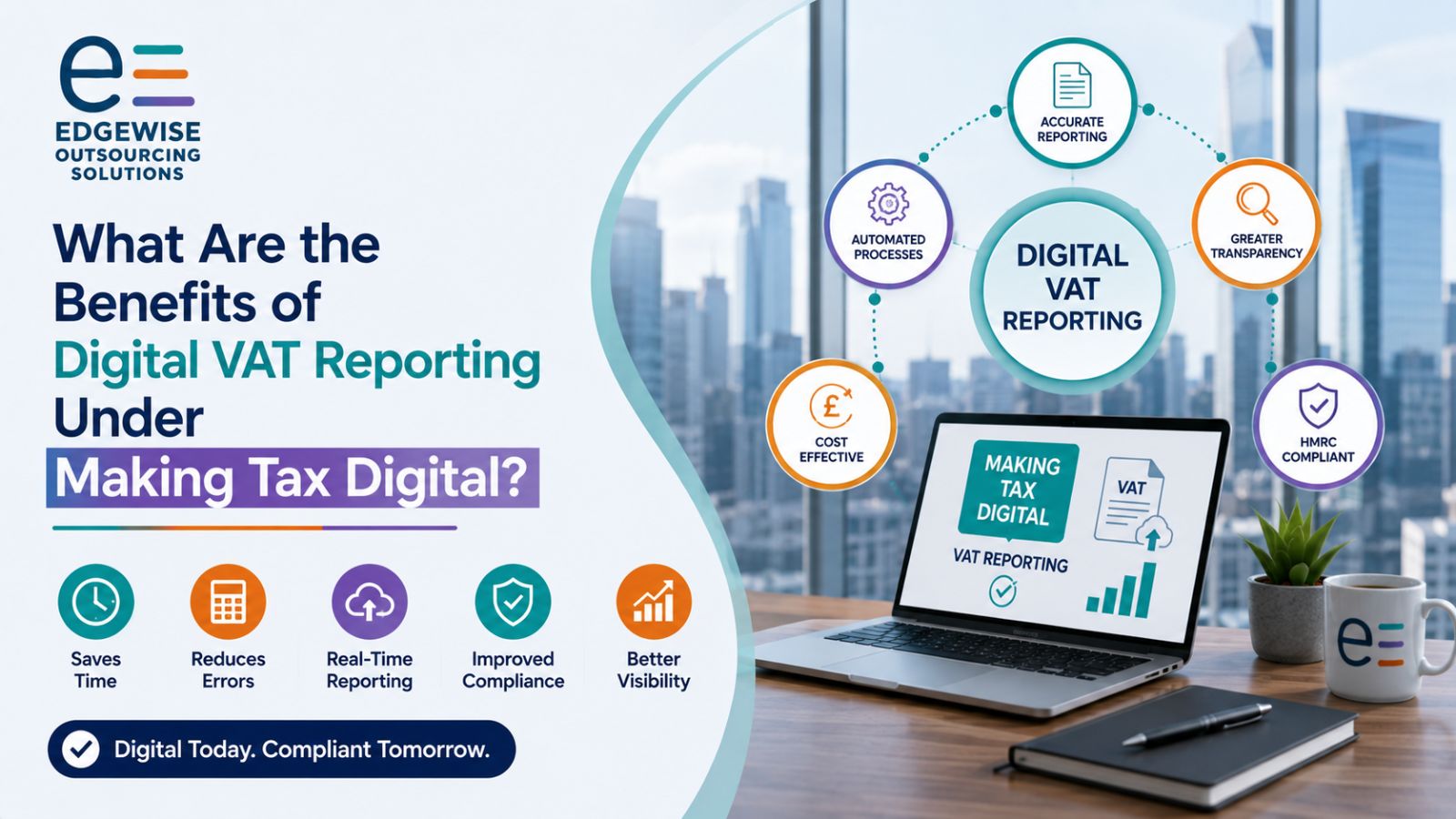
VAT reporting has become a more digital, structured, and time-sensitive process in the UK. For businesses and accounting practices, the move from manual records to digital VAT reporting is no longer just about compliance. It is about accuracy, efficiency, better visibility, and stronger financial control.
Many businesses still remember the old way of preparing VAT returns: collecting invoices, checking spreadsheets, reconciling bank entries, adjusting VAT codes, and submitting figures close to the deadline. This approach may have worked earlier, but it is no longer suitable for a digital tax environment.
Under Making Tax Digital for VAT, businesses are expected to maintain digital records and submit VAT returns using compatible software. This has changed the way businesses and accountants manage VAT.
At Edgewise Training Solutions Private Limited, we believe digital VAT reporting should not be seen as a burden. If implemented properly, it can become a strong tool for improving compliance, reducing errors, and making financial processes more efficient.
What Is Digital VAT Reporting?
Digital VAT reporting means maintaining VAT-related records in a digital format and submitting VAT returns to HMRC through compatible software.
It is part of the UK Government’s Making Tax Digital initiative, which aims to modernise the tax system and reduce avoidable errors in tax reporting.
In simple terms, digital VAT reporting means that businesses should not rely on disconnected manual records, last-minute calculations, or unsupported spreadsheet workings. VAT data should be maintained in a digital system, reviewed properly, and submitted through software that is compatible with HMRC requirements.
This usually involves accounting software such as Xero, QuickBooks, Sage, FreeAgent, or other MTD-compatible systems. Some businesses may also use spreadsheets with bridging software, but the process still needs to maintain proper digital links and comply with MTD rules.
Why Digital VAT Reporting Matters
VAT is not just a quarterly compliance task. It directly affects cash flow, pricing, working capital, and financial reporting.
When VAT records are maintained manually, businesses often face issues such as:
- Missing purchase invoices
- Incorrect VAT treatment
- Duplicate entries
- Wrong VAT codes
- Formula errors in spreadsheets
- Delayed reconciliations
- Last-minute filing pressure
- Difficulty tracking VAT liabilities in advance
Digital VAT reporting helps reduce these problems by creating a more organised and traceable process.
For accounting practices, the benefit is even greater. A firm managing VAT returns for multiple clients cannot depend only on manual follow-ups and spreadsheet-based working. As the client base grows, manual systems create more risk, more pressure, and more rework.
- Key Benefits of Digital VAT Reporting
1. Fewer Errors
Manual VAT preparation increases the risk of mistakes. A wrong formula, missed invoice, duplicated transaction, or incorrect VAT rate can affect the final return.
Digital VAT reporting reduces these risks because the data is captured and processed within the accounting system. VAT codes can be applied consistently, calculations can be automated, and unusual entries can be reviewed before filing.
This does not mean software removes the need for professional review. Human judgement is still important. However, digital systems reduce avoidable manual errors and help accountants focus more on review and advisory work.
2. Faster VAT Return Preparation
Under a manual process, VAT preparation can involve several steps: collecting data, checking invoices, updating spreadsheets, reconciling figures, reviewing calculations, and then submitting the return.
Digital VAT reporting simplifies this process.
When bookkeeping is updated regularly, VAT returns can be generated much faster. The accountant can review the report, check exceptions, confirm reconciliations, and submit the return through compatible software.
This saves time and reduces deadline pressure.
For accounting practices, faster VAT preparation means better turnaround time, improved team productivity, and more capacity during peak filing periods.
3. Real-Time Financial Visibility
One of the biggest weaknesses of manual VAT reporting is that the business may not know its VAT position until the end of the quarter.
Digital VAT reporting gives businesses better visibility throughout the period.
A business can monitor:
- Output VAT on sales
- Input VAT on purchases
- Estimated VAT payable
- VAT reclaim position
- Cash flow impact
- Unreconciled transactions
- Pending invoices
This helps business owners plan better. Instead of being surprised by a large VAT bill near the due date, they can prepare in advance.
4. Better Compliance
Making Tax Digital has increased the importance of proper digital records and software-based reporting.
Digital VAT reporting helps businesses stay aligned with HMRC’s expectations by maintaining records in a structured format and submitting returns through approved digital channels.
It also creates a better audit trail. If there is a query later, the business and accountant can trace the relevant transactions more easily.
Better compliance does not come only from software. It also requires proper bookkeeping discipline, correct VAT treatment, timely reconciliations, and review before submission.
5. Improved Client Experience
For accounting practices, digital VAT reporting can significantly improve client service.
When the data is organised and available in real time, accountants can answer client queries faster and provide clearer updates.
Clients benefit from:
- Faster VAT return completion
- Better visibility of tax payable
- Fewer last-minute document requests
- More structured reporting
- Reduced risk of penalties
- Clearer communication from the accountant
This improves trust and strengthens the relationship between the practice and the client.
How Digital VAT Reporting Improves Accounting Practice Performance
Digital VAT reporting is not only a compliance upgrade. It can also improve the way an accounting practice operates.
Increased Efficiency
Manual VAT work is repetitive and time-consuming. It often requires staff to collect data from multiple sources, check spreadsheets, correct formulas, and identify missing entries.
With digital VAT reporting, much of the routine processing can be streamlined. Bank feeds, invoice capture tools, VAT reports, and software integrations can reduce manual work.
This allows the team to focus on review, exception handling, client communication, and value-added services.
Higher Capacity
Many accounting practices struggle during VAT deadlines because several clients need attention at the same time.
If each return depends on manual working, staff capacity becomes a major limitation.
Digital VAT reporting helps practices handle more clients with better workflow discipline. Standardised processes, digital records, and software-based reporting make the VAT cycle more scalable.
This does not mean the practice should rush through filings. It means the practice can manage workload more efficiently without overloading the team.
Better Profitability
Profitability in an accounting practice depends heavily on time management.
If a simple VAT return takes too many hours because records are messy or processes are manual, the job becomes less profitable.
Digital VAT reporting can reduce time spent on basic preparation, correction, and rework. This improves margins and allows the practice to use its skilled team for higher-value work such as management reporting, tax planning, and business advisory.
Common Challenges in Moving to Digital VAT Reporting
Although digital VAT reporting offers many benefits, the transition is not always easy.
1. Resistance to Change
Some clients and staff members are comfortable with older systems. They may feel that spreadsheets are easier or that new software is unnecessary.
The solution is education. Businesses need to understand that digital VAT reporting is not only about software. It is about reducing risk, improving visibility, and staying compliant.
2. Data Migration Problems
Moving from manual records or old software to a digital system can reveal several issues, such as missing data, duplicate entries, incorrect opening balances, or inconsistent VAT codes.
Before going live, data should be cleaned, reviewed, and reconciled.
3. Software Selection Confusion
There are many MTD-compatible software options available. The right choice depends on the size of the business, transaction volume, sector, reporting needs, and internal capability.
Businesses should not choose software only because it is popular. They should choose software that fits their process.
4. Lack of Standardised Workflows
Software alone does not solve the problem.
If every client is handled differently, errors and delays can still occur. Accounting practices need standard workflows for document collection, bookkeeping, reconciliation, VAT review, client approval, and final submission.
Standardisation is what makes digital reporting efficient.
- How to Get Started with Digital VAT Reporting
- Step 1: Choose Suitable MTD-Compatible Software
The first step is selecting software that is compatible with HMRC requirements and practical for the business.
The software should ideally support:
- VAT reporting
- Bank feeds
- Invoice processing
- VAT code management
- Digital records
- Reporting dashboards
- Accountant access
- HMRC submission through compatible channels
The best software is not always the most expensive one. It is the one that fits the business process and can be used consistently.
Step 2: Keep VAT Records Digitally
Businesses should ensure that sales, purchases, expenses, credit notes, and VAT adjustments are recorded properly in a digital system.
Digital records should be updated regularly, not only at the quarter-end.
This helps avoid missing invoices, incorrect claims, and last-minute pressure.
Step 3: Reconcile Regularly
Bank reconciliation, supplier reconciliation, customer reconciliation, and VAT control reconciliation should be done regularly.
If records are not reconciled, the VAT return may be incorrect even if the software is being used.
Digital reporting works best when bookkeeping is disciplined.
Step 4: Standardise VAT Review
Before submitting any VAT return, there should be a clear review process.
This may include checking:
- Sales VAT codes
- Purchase VAT codes
- Zero-rated and exempt supplies
- Reverse charge entries
- Import VAT
- Unusual transactions
- Large input VAT claims
- Manual journals
- VAT control account balance
A proper review can prevent errors before submission.
Step 5: Train the Team
The team should understand both the software and the VAT process.
Training should cover:
- MTD requirements
- VAT coding
- Digital record-keeping
- Software usage
- Review procedures
- Client communication
- Error correction
Even the best software can fail if the people using it do not understand the process.
Step 6: Test Before Full Implementation
Before fully shifting to a new digital VAT process, it is useful to test the workflow.
Run a sample VAT return, check the data, verify the calculations, and ensure the submission process works properly.
This helps identify issues before an actual deadline.
The Role of Outsourcing in Digital VAT Reporting
Many businesses and accounting practices want to improve VAT reporting but struggle with time, staff capacity, training, or process implementation.
Outsourcing can help by providing structured support for bookkeeping, reconciliations, VAT working preparation, review assistance, and reporting.
For accounting practices, outsourcing can be useful when:
- VAT workload is increasing
- Internal staff is overloaded
- Clients submit data late
- Bookkeeping cleanup is required
- Digital migration support is needed
- The practice wants to improve turnaround time
- The team wants to focus on advisory work
However, outsourcing should be supported by proper quality controls, secure data handling, clear communication, and final review by the responsible accountant.
How Edgewise Training Solutions Private Limited Can Help
Edgewise Training Solutions Private Limited supports businesses, professionals, and accounting practices with structured accounting, bookkeeping, VAT support, management reporting, and outsourced finance processes.
Our focus is to make financial data more organised, reliable, and useful for decision-making.
We can assist with:
- Digital VAT reporting support
- Bookkeeping and reconciliation
- VAT return working preparation
- MTD readiness support
- Accounting software process support
- Client-wise compliance tracking
- Management accounts
- MIS reporting
- Outsourced accounting support
- Finance process improvement
With the right systems and support, digital VAT reporting can become more than a compliance task. It can become a practical tool for better control and better business decisions.
Conclusion
Digital VAT reporting is now an important part of UK tax compliance.
It helps businesses reduce errors, prepare VAT returns faster, improve financial visibility, maintain better records, and stay aligned with Making Tax Digital requirements.
For accounting practices, it creates an opportunity to improve efficiency, increase capacity, reduce deadline pressure, and deliver better service to clients.
The move to digital VAT reporting should not be treated as a one-time software change. It requires proper records, clear workflows, trained staff, regular reconciliations, and professional review.
At Edgewise Training Solutions Private Limited, we help businesses and accounting practices build practical accounting and VAT processes so that compliance becomes smoother, faster, and more reliable.