Accounting practices are under increasing pressure to process higher transaction volumes, meet tighter deadlines, and provide faster financial information to clients. At the same time, recruiting and retaining skilled accounting professionals remains challenging.
Accounts payable is often one of the most time-consuming areas of client accounting. Teams must collect supplier invoices, enter data, verify amounts, obtain approvals, process payments, resolve discrepancies, and answer supplier queries.
Artificial intelligence can simplify many of these activities. By automating invoice capture, validation, matching, approvals, and exception detection, AI allows accounting practices to manage larger client workloads without proportionately increasing their workforce.
What Is AI in Accounts Payable?
AI in accounts payable refers to the use of artificial intelligence, machine learning, optical character recognition and workflow automation to manage invoice-processing activities.
Under a traditional accounts payable process, team members manually:
- Receive and organise supplier invoices;
- Enter invoice information into accounting software;
- Match invoices with purchase orders or contracts;
- Send invoices for approval;
- Identify errors and duplicate payments;
- Process payments; and
- Respond to supplier queries.
AI reduces the amount of manual intervention required at each stage.
An AI-enabled accounts payable system can read an invoice, extract the relevant information, validate supplier details, identify unusual transactions, match the invoice with supporting records, and route it to the correct approver.
This creates a faster, more accurate and more scalable accounts payable process.
How AI Improves Accounts Payable Efficiency
1. Automated Invoice Capture
AI-powered systems can collect and process invoices received through email, scanned documents, PDFs, portals and other digital formats.
The system can automatically extract information such as:
- Supplier name;
- Invoice number;
- Invoice date;
- Due date;
- Purchase-order reference;
- Tax or VAT details;
- Invoice amount; and
- Payment terms.
This reduces repetitive data entry and allows accounting professionals to spend more time reviewing transactions rather than manually recording them.
2. Intelligent Invoice Matching
AI can compare invoices with purchase orders, contracts, goods-received records and previous transactions.
The system can identify whether:
- The supplier is authorised;
- The price agrees with the purchase order;
- The goods or services were received;
- The invoice has already been processed;
- The quantity or amount is incorrect; or
- Supporting documentation is missing.
Only invoices containing discrepancies need to be reviewed manually.
3. Automated Approval Workflows
Invoices often remain unpaid because they are sitting in an email inbox waiting for approval.
AI-powered workflows can automatically send invoices to the relevant manager based on predefined conditions such as:
- Department;
- Client;
- Supplier;
- Invoice amount;
- Expense category; or
- Approval authority.
The system can also issue reminders and escalate overdue approvals, reducing unnecessary payment delays.
4. Error and Exception Detection
AI can identify unusual or incomplete transactions before payments are processed.
This may include:
- Duplicate invoices;
- Incorrect supplier details;
- Unusual payment amounts;
- Missing tax information;
- Changes in bank details;
- Incorrect accounting codes; and
- Transactions outside normal approval limits.
The accounting team can then focus on investigating exceptions instead of manually reviewing every invoice.
5. Better Cash-Flow Information
AI-enabled accounts payable systems provide real-time visibility over upcoming payments and outstanding liabilities.
This helps practices and their clients:
- Prepare more accurate cash-flow forecasts;
- Prioritise payments;
- Avoid late-payment penalties;
- Capture early-payment discounts;
- Monitor supplier exposure; and
- Make better working-capital decisions.
Benefits for Accounting Practices
Faster Invoice Processing
Automation reduces the time required to capture, verify, approve and record supplier invoices. This improves turnaround times across multiple client accounts.
Improved Accuracy
Reducing manual data entry helps minimise transcription errors, incorrect coding and duplicate entries.
Lower Processing Costs
When routine activities are automated, practices can process more invoices using the same team. This reduces the cost per transaction and limits the need for continuous recruitment.
Stronger Fraud Detection
AI can identify unusual payment patterns, duplicate invoices and unexpected changes in supplier information. Human reviewers can investigate these issues before payment is released.
Greater Visibility
Real-time dashboards allow teams to monitor invoice status, pending approvals, payment deadlines and exceptions across different clients.
More Time for Advisory Work
By reducing repetitive administrative tasks, accountants can dedicate more time to:
- Cash-flow planning;
- Management reporting;
- Financial forecasting;
- Tax planning;
- Process improvement; and
- Client advisory services.
Common Problems With Manual Accounts Payable
Practices relying entirely on manual processes may experience several difficulties as their client base grows.
High Processing Costs
The time required to enter, review and approve each invoice increases operating costs. Hiring additional employees may also become necessary as invoice volumes rise.
Slow Turnaround Times
Manual approval processes depend on emails, reminders and follow-up calls. This can delay supplier payments and affect client relationships.
Limited Visibility
When invoices are processed through email and spreadsheets, it becomes difficult to determine whether an invoice has been received, approved, recorded or paid.
Greater Compliance Risk
Incorrect coding, incomplete records and missing supporting documents can create problems during VAT reviews, audits and other compliance procedures.
Staff Burnout
Repetitive invoice-processing work can reduce employee engagement and leave less time for technically challenging or commercially valuable work.
Practical Uses of AI in Accounting Practices
Multi-Client Invoice Processing
AI can classify invoices and allocate them to the correct client, entity, department or accounting ledger.
This is particularly valuable for practices managing accounts payable for several businesses.
Supplier Query Management
AI-enabled systems can provide routine information about invoice receipt, approval status and expected payment dates.
Complex supplier disputes can then be referred to an experienced team member.
VAT Validation
AI can assist with checking VAT numbers, tax amounts and invoice requirements. Transactions containing inconsistencies can be flagged for manual review.
Duplicate-Payment Detection
The system can compare supplier names, invoice numbers, dates and amounts to identify invoices that may have already been recorded or paid.
Approval Escalation
Invoices exceeding defined limits can automatically be escalated to senior managers or designated client approvers.
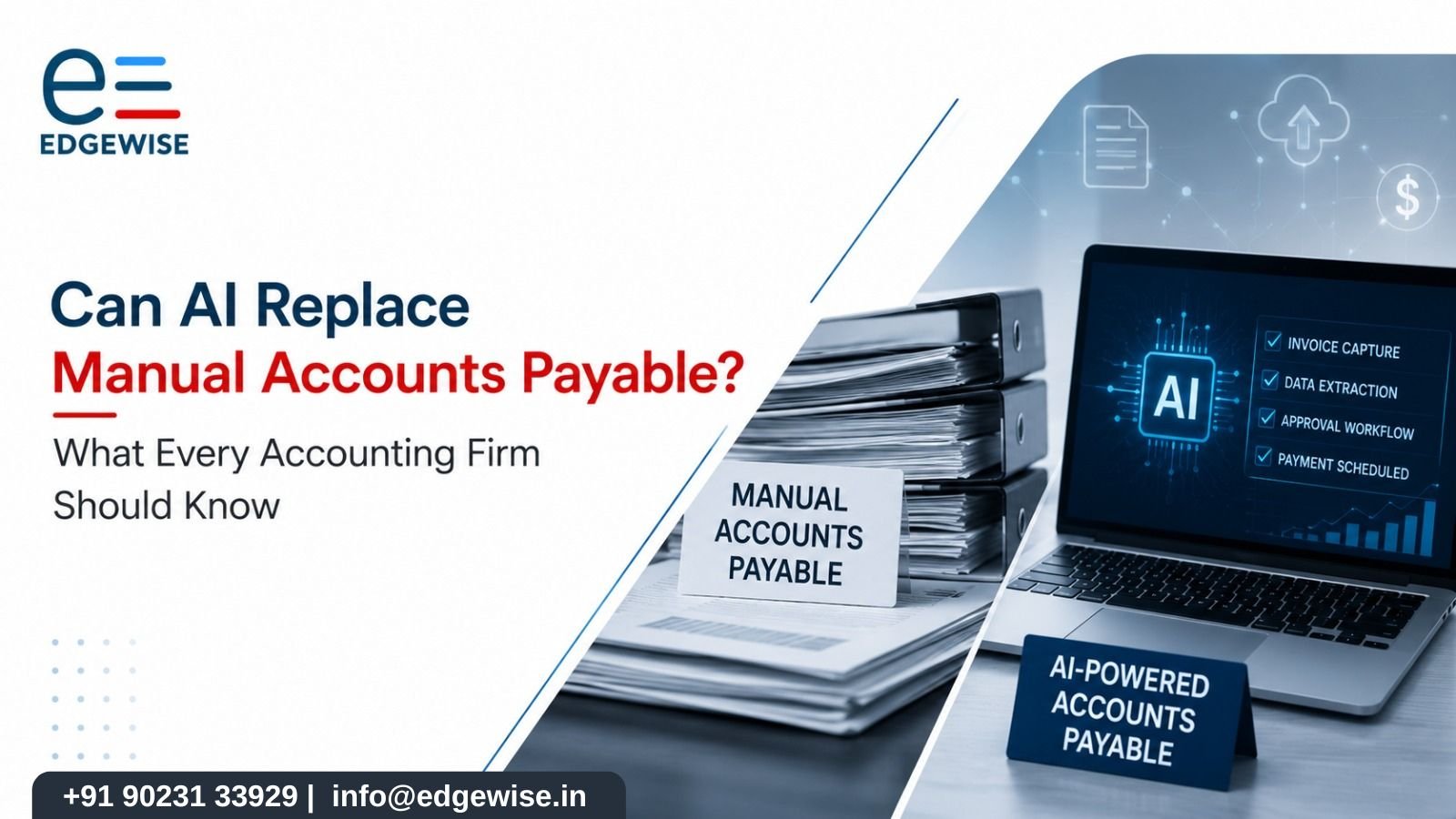
Manual vs AI-Powered Accounts Payable
| Area | Manual Processing | AI-Powered Processing |
|---|---|---|
| Invoice data entry | Manually entered | Automatically extracted |
| Processing speed | Slower | Faster |
| Error detection | Dependent on manual review | Automated exception alerts |
| Approval process | Email and follow-up based | Automatically routed |
| Duplicate detection | Often reactive | Proactively identified |
| Reporting | Prepared periodically | Available in real time |
| Scalability | Dependent on additional staff | Scales with transaction volume |
| Cost per transaction | Generally increases with volume | Can reduce as volume increases |
Manual processes may remain workable for businesses handling a small number of invoices. However, their limitations become increasingly visible as the number of clients, entities and transactions increases.
AI Does Not Eliminate the Need for Accountants
AI can automate repetitive processes, but it cannot independently manage every accounts payable situation.
Human professionals are still required to:
- Review exceptions;
- Resolve supplier disputes;
- Assess unusual transactions;
- Apply accounting judgement;
- Verify regulatory compliance;
- Review changes in supplier bank details;
- Communicate with clients; and
- Approve high-risk payments.
The most effective model combines automation with professional oversight.
AI processes routine invoices, while trained accounting professionals investigate exceptions and make decisions requiring judgement.
How Accounting Practices Can Implement AI in Accounts Payable
Accounting practices should introduce AI through a structured process rather than automating an inefficient workflow.
Step 1: Review the Existing Process
Document how invoices are received, entered, approved, recorded and paid. Identify repetitive tasks, approval delays and common errors.
Step 2: Standardise Client Workflows
Create consistent procedures for invoice naming, approval limits, supplier verification, coding and record retention.
Step 3: Select Appropriate Technology
Choose a system that integrates with the accounting software and document-management platforms already used by the practice and its clients.
Step 4: Establish Human Review Controls
Define which transactions can be processed automatically and which require manual review.
High-value payments, changes in supplier bank details and unusual transactions should continue to receive additional scrutiny.
Step 5: Train the Accounting Team
Employees must understand how the technology works, how exceptions should be reviewed and when professional judgement is required.
Step 6: Begin With a Controlled Pilot
Start with a limited number of clients or invoice categories. Measure processing time, accuracy, exceptions and user feedback before expanding the system.
Step 7: Monitor Performance
Practices should regularly review:
- Processing time;
- Error rates;
- Number of exceptions;
- Approval delays;
- Cost per invoice;
- Duplicate-payment alerts; and
- Client satisfaction.
Why AI Is Becoming Essential for Accounting Practices
Clients increasingly expect faster reporting, real-time information, improved accuracy and more strategic advice.
Manual accounts payable processes make it difficult to meet these expectations consistently, particularly when a practice is adding new clients or processing higher invoice volumes.
AI provides accounting practices with a way to increase capacity without increasing staffing at the same rate.
It also allows employees to move away from repetitive administration and contribute more effectively to client service, financial analysis and advisory work.
Why Edgewise Training Solutions Pvt Ltd?
Adopting AI is not only a technology project. Accounting teams must also understand how to use the technology effectively, review exceptions, maintain internal controls and apply professional judgement.
Edgewise Training Solutions Pvt Ltd can help accounting practices prepare their teams for technology-enabled accounts payable processes through structured learning and practical skill development.
Training can help employees understand:
- AI-enabled invoice processing;
- OCR and automated data extraction;
- Invoice matching and approval workflows;
- Exception handling;
- Supplier verification;
- Fraud and duplicate-payment risks;
- VAT and compliance checks;
- Internal controls; and
- Human review responsibilities.
By strengthening both technical knowledge and practical process skills, Edgewise Training Solutions Pvt Ltd can help accounting practices improve efficiency, maintain quality and manage larger client portfolios with confidence.
The future of accounts payable is not AI replacing accountants. It is trained accounting professionals using AI to process routine work more efficiently and deliver greater value to clients.