Artificial intelligence is increasingly being used across finance and accounting to automate routine work, speed up processes and improve efficiency.
However, AI is not error-free.
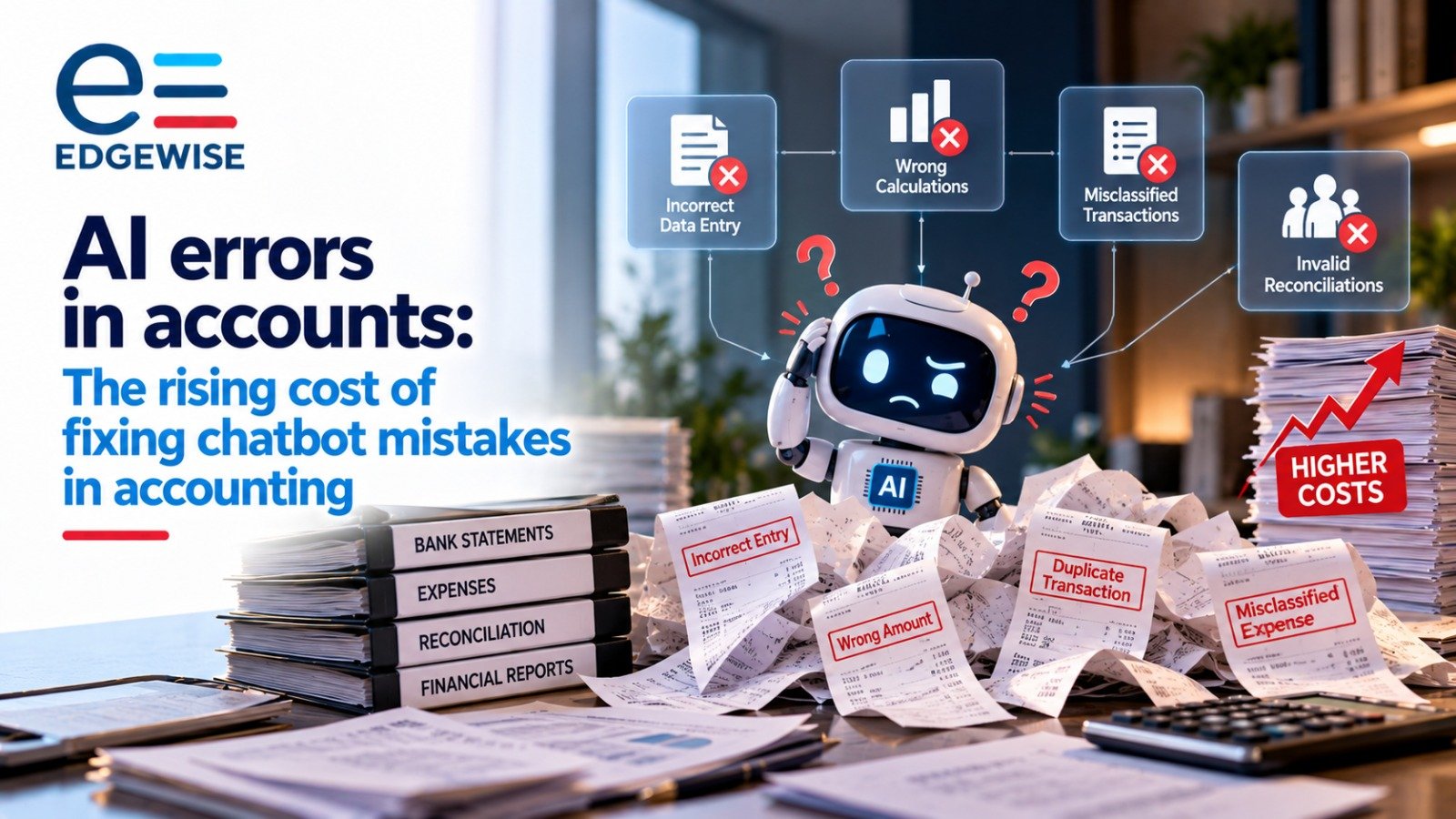
When general-purpose AI tools or chatbots are used for accounting, tax or financial decision-making without proper professional review, mistakes can create significant costs for both businesses and accountants.
These errors may include incorrect tax advice, VAT miscalculations, misclassified expenses, inaccurate payroll guidance or even fabricated information presented with confidence.
What Is “AI Slop” in accounting?
“AI slop” is not a technical accounting term, but it is increasingly used to describe low-quality, inaccurate or misleading content generated by AI systems.
In accounting, this may include:
- Incorrect tax interpretations;
- Inaccurate VAT treatment;
- Misclassification of expenses;
- Incorrect calculations;
- Fabricated or unsupported financial information;
- Misleading compliance guidance; and
- Advice that does not reflect the specific facts of the business.
The key risk is that AI-generated responses often sound authoritative, even when the information is incomplete or wrong.
Recent research cited by Dext indicates that many UK accountants have already encountered businesses suffering financial consequences after relying on inaccurate AI-generated tax or financial advice.
The Real Cost of AI Mistakes
The impact of an AI error can extend well beyond correcting a single number.
1. Financial Losses
Incorrect accounting or tax guidance may result in:
- Overpaid tax;
- Underpaid tax;
- Missed deductions or allowances;
- Incorrect VAT treatment;
- Payroll errors; and
- Potential penalties or interest.
Even a small error can become expensive if it affects multiple reporting periods or remains undetected for a long time.
2. Additional Review and Correction Time
One of the hidden costs of AI is the time required to verify and correct its output.
Instead of saving time, accountants may find themselves:
- Rechecking calculations;
- Rebuilding working papers;
- Correcting tax treatment;
- Reviewing unsupported assumptions; and
- Explaining errors to clients.
This can reduce the time available for higher-value activities such as advisory work, planning and client support.
3. Loss of Client Trust
Clients may assume that information produced by AI is accurate because it is presented clearly and confidently.
Problems arise when a professional accountant later has to explain that the AI-generated answer was wrong.
This can create confusion and make it harder to maintain confidence in professional advice.
For accounting firms, maintaining trust means being clear that AI-generated information should not be treated as a substitute for qualified professional judgement.
4. Compliance and Regulatory Risk
AI mistakes can also create compliance problems.
Incorrect information may lead to:
- Wrong tax filings;
- Incorrect VAT returns;
- Misstated accounts;
- Inappropriate tax claims;
- Missed statutory requirements; or
- Poorly supported accounting decisions.
Where incorrect information is used in a formal filing, the consequences may include additional enquiries, penalties or the need to amend submissions.
Why Do AI Errors Happen?
AI systems are highly capable, but they do not operate in the same way as qualified accounting professionals.
Several factors can create errors.
Hallucinations
AI may generate information that appears credible but has no factual basis.
This is particularly dangerous when the response includes invented legislation, incorrect tax rates or unsupported interpretations.
Lack of Business Context
A chatbot may not know important facts such as:
- The entity type;
- Relevant accounting framework;
- Tax residency;
- VAT scheme;
- Previous accounting treatment;
- Contract terms; or
- The specific financial period being considered.
Without this context, even technically correct general information may lead to the wrong conclusion.
Poor Input Data
AI output is only as reliable as the information provided.
Incomplete, outdated or inaccurate data can produce equally unreliable conclusions.
This is the familiar principle of:
Garbage in, garbage out.
Complex Rules Require Judgement
Accounting and tax rules are not always mechanical.
Areas such as revenue recognition, tax reliefs, VAT, deferred tax, financial instruments and accounting estimates may require professional interpretation.
General-purpose AI tools may not properly identify when judgement is required.
AI Should Assist, Not Replace Professional Judgement
The appropriate use of AI in accounting is not to eliminate human involvement.
It is to improve efficiency while retaining proper review and accountability.
A more reliable approach is:
AI-assisted preparation → Professional review → Final approval
AI may be useful for:
- Data extraction;
- Drafting;
- Reconciliation assistance;
- Identifying unusual transactions;
- Preparing initial schedules;
- Summarising financial information; and
- Supporting research.
However, important accounting, tax and compliance conclusions should still be validated by a suitably qualified professional.
Use Accounting-Specific Technology Where Possible
There is an important difference between a general-purpose chatbot and technology designed specifically for accounting workflows.
Dedicated accounting platforms may provide:
- Structured data validation;
- Controlled integrations;
- Audit trails;
- User permissions;
- Defined accounting rules;
- Reconciliation controls; and
- Review workflows.
These controls can make them more appropriate for financial processes than relying on a public chatbot for important accounting decisions.
Educating Clients About AI Risk
Accounting professionals also have an important role in helping clients understand the limitations of AI.
Clients should be encouraged not to rely blindly on chatbot answers for matters such as:
- Tax planning;
- VAT treatment;
- Payroll;
- Business restructuring;
- Tax reliefs;
- Financial reporting; and
- Regulatory compliance.
AI can provide useful background information, but professional advice should be based on the client’s actual facts and current legislation.
Building a Human Review Process
Businesses and accounting firms using AI should create clear review controls.
A practical process may include:
- Defining which tasks AI can assist with;
- Prohibiting unsupervised use for high-risk decisions;
- Requiring human verification of key calculations;
- Reviewing tax and compliance conclusions;
- Maintaining supporting documentation;
- Restricting the use of confidential client data; and
- Escalating complex matters to qualified professionals.
The objective is not to avoid AI.
It is to use it in a controlled manner.
The Future of AI in Accounting
AI will continue to become more important across accounting, bookkeeping and finance.
It can improve productivity, automate repetitive tasks and help professionals analyse information faster.
But increased use also increases the importance of:
- Governance;
- Professional review;
- Data protection;
- Quality control;
- Staff training; and
- Clear accountability.
The firms that benefit most from AI are likely to be those that combine automation with strong professional oversight.
Why Choose Edgewise Training Solutions Pvt Ltd?
At Edgewise Training Solutions Pvt Ltd, we believe technology should support accounting professionals, not replace professional judgement.
Our approach combines structured accounting processes with human review to help businesses and accounting practices improve efficiency while maintaining accuracy and control.
Edgewise can support clients with:
- Bookkeeping and accounting support;
- Bank and ledger reconciliations;
- Accounts payable and receivable;
- Management accounts;
- Financial reporting;
- Tax and compliance working papers;
- Review-ready schedules;
- Process documentation; and
- Accounting workflow support.
We focus on:
- Accuracy - ensuring outputs are properly reviewed;
- Human oversight - important accounting decisions are not left solely to automated tools;
- Process discipline - structured workflows and review checkpoints;
- Confidentiality - responsible handling of financial information; and
- Practical use of technology - using automation where it improves efficiency without compromising quality.
For businesses and accounting firms adopting AI, Edgewise can help create a balanced approach where technology improves productivity while professional review protects accuracy and compliance.
Disclaimer
This article is provided by Edgewise Training Solutions Pvt Ltd for general information and educational purposes only.
It does not constitute accounting, tax, legal, financial, regulatory or technology advice and should not be relied upon as a substitute for professional advice based on specific circumstances.
AI-generated information may be incomplete, inaccurate or outdated. Businesses should not rely solely on public AI tools for accounting, tax, compliance or financial decisions without appropriate professional review.
The impact of AI tools will vary depending on the software used, the quality of the data provided, applicable legislation and the nature of the accounting task.
Readers should verify important information from authoritative sources and obtain advice from appropriately qualified professionals where necessary.