
For most UK accountants, bookkeeping begins as a core service. It forms the foundation of accurate reporting, tax compliance, VAT support, management accounts, and advisory work.
However, as the client base grows, routine bookkeeping tasks can quickly become a major operational burden. Receipt chasing, bank reconciliations, invoice matching, expense coding, data entry, and month-end updates begin to consume valuable time.
What once felt manageable can start stretching internal resources. Teams may find themselves working longer hours, delaying higher-value services, and struggling to maintain turnaround times during busy periods such as VAT quarters, payroll deadlines, Self Assessment season, and year-end closures.
This is why many UK accountancy firms are now rethinking the way they manage bookkeeping.
Outsourced bookkeeping is no longer viewed only as a cost-saving measure. It has become a strategic way to regain control of time, improve margins, reduce internal pressure, and allow firms to focus on services that drive real growth.
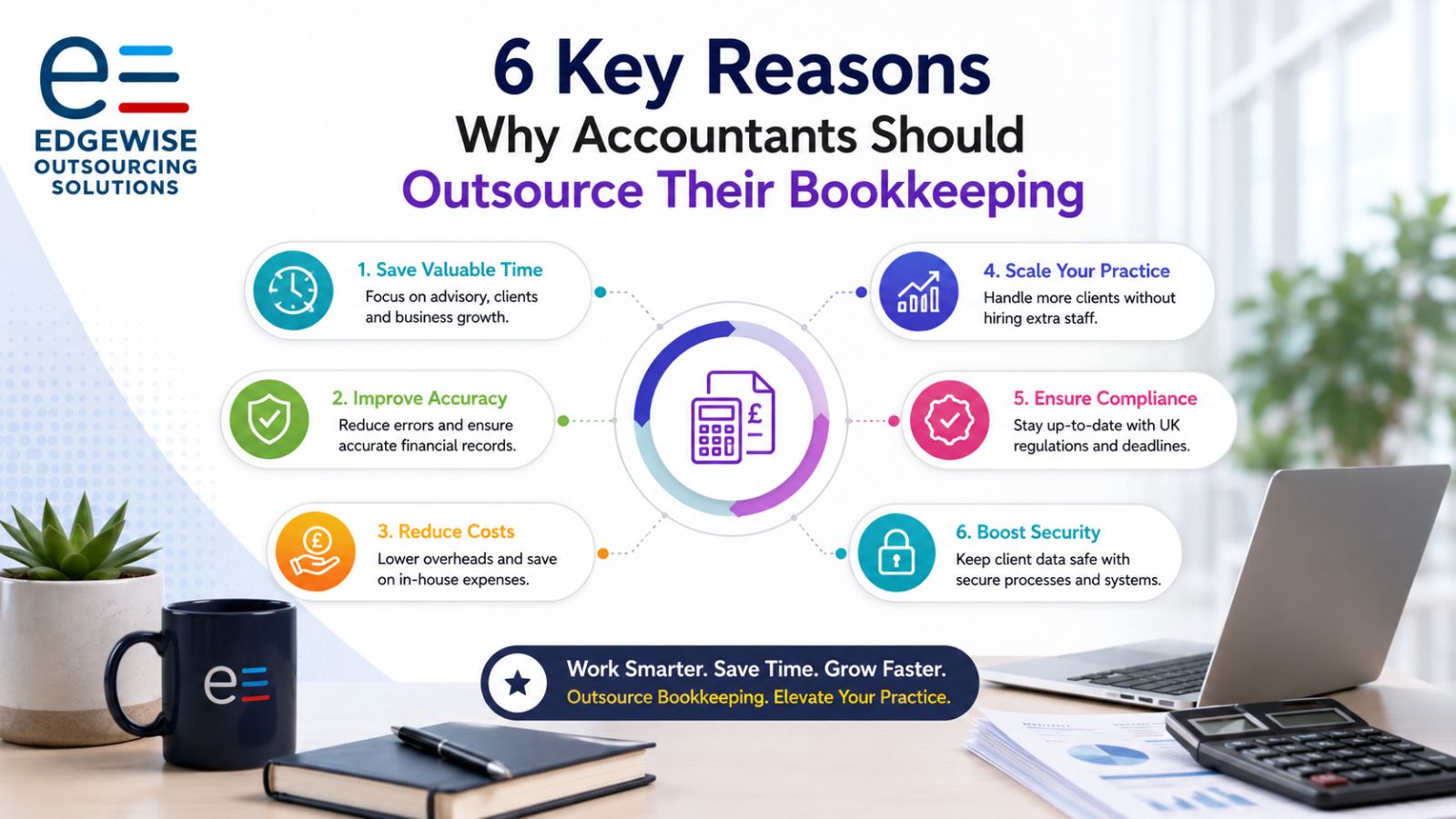
In this article, we discuss six smart reasons why UK accountants are making the switch to outsourced bookkeeping.
1. Reclaim Time for High-Value Advisory Work
Modern clients expect more than basic transaction recording. They want meaningful insights, timely reports, budgeting support, tax planning, cash flow guidance, and business advisory.
However, when an accounting team is occupied with routine bookkeeping tasks, it becomes difficult to dedicate sufficient time to advisory services.
Outsourcing bookkeeping allows firms to shift repetitive work to a trained external team. This gives partners, managers, and senior staff more time to focus on:
- Tax planning
- Business advisory
- Cash flow forecasting
- Budgeting
- Management reporting
- Virtual CFO services
- Client relationship management
- Business performance review
This helps accountants move from being only compliance service providers to becoming trusted financial advisors.
2. Scale Without the Cost of Hiring In-House
Hiring, training, and retaining bookkeepers can be expensive. Apart from salaries, firms also need to consider recruitment costs, onboarding time, supervision, employee benefits, software access, infrastructure, and management effort.
For firms with growing client portfolios or seasonal workload pressure, hiring permanent staff may not always be the most efficient solution.
Outsourced bookkeeping gives accounting firms access to flexible support that can scale with workload.
During peak periods, firms can increase support. During slower months, they can reduce dependency without carrying unnecessary fixed costs.
This makes outsourcing a practical solution for firms that want to grow without immediately increasing permanent overheads.
3. Gain Access to Trained Bookkeepers and Modern Technology
A good outsourcing partner brings access to trained bookkeeping professionals who are familiar with commonly used accounting platforms and cloud-based tools.
This may include:
- Xero
- QuickBooks
- Sage
- FreeAgent
- Dext
- Hubdoc
- AutoEntry
- Microsoft Excel
- Cloud-based workflow systems
For small and mid-sized accounting firms, building this level of capability internally may require time, cost, and continuous training.
Outsourcing allows firms to access skilled professionals and efficient processes without heavy upfront investment.
The right outsourcing partner works within the firm’s existing systems and supports the internal team with structured workflows and timely delivery.
4. Improve Accuracy and Reduce Errors
Bookkeeping errors can create serious issues for accounting firms and their clients. Incorrect expense classification, unreconciled bank entries, missing invoices, or inaccurate VAT coding can affect financial reporting, tax compliance, and management decisions.
Outsourced bookkeeping teams generally follow defined processes, checklists, and review mechanisms. This helps reduce avoidable errors and improves consistency in bookkeeping output.
A structured outsourcing model can help with:
- Proper ledger maintenance
- Timely bank reconciliation
- Accurate transaction coding
- Cleaner client records
- Better month-end reporting
- Reduced rework
- Improved review readiness
For accounting firms, this means less time spent fixing mistakes and more confidence in the quality of financial records.
5. Achieve Faster Turnaround and Better Deadline Management
UK accounting firms often face intense deadline pressure during VAT quarters, payroll cycles, Self Assessment season, and year-end finalisation.
When internal teams are already stretched, routine bookkeeping can easily create backlogs. This delays reporting, review, filing, and client communication.
Outsourced bookkeeping support can help firms improve turnaround time by ensuring that routine tasks are completed on schedule.
In many cases, offshore or remote support models also allow firms to benefit from extended working hours and overnight processing. This can be especially useful during peak workload periods.
Faster turnaround improves client satisfaction and gives the internal team more time for review and advisory discussions.
6. Strengthen Data Security and Compliance Discipline
Data security is a major concern for any accounting firm. Client financial information must be handled with confidentiality, proper access control, and secure systems.
Professional outsourcing partners generally follow structured security protocols, restricted access practices, confidentiality procedures, and secure data-sharing processes.
In addition to security, outsourced teams can also support compliance discipline by maintaining organised records, timely reconciliations, and properly documented workflows.
This helps accounting firms maintain better control over client data, reporting timelines, and compliance-related bookkeeping requirements.
Why Outsourcing Is a Strategic Move
The decision to outsource bookkeeping is ultimately about working smarter.
It allows accounting firms to remove repetitive tasks from their internal team, reduce operational pressure, and build a more scalable service delivery model.
Outsourcing does not mean giving up control. A well-managed outsourcing arrangement allows the firm to retain control over client relationships, review, finalisation, advisory, and strategic decision-making.
The outsourced team simply becomes an extension of the firm’s delivery function.
How Edgewise Training Solutions Pvt Ltd Can Support UK Accounting Firms
At Edgewise Training Solutions Pvt Ltd, we support accounting firms with reliable, structured, and process-driven bookkeeping and back-office accounting assistance.
Our services are designed to help UK accounting firms reduce routine workload, improve turnaround time, and create more capacity for advisory and client-facing work.
Our support can include:
- Day-to-day bookkeeping
- Bank reconciliation
- Invoice processing
- Sales and purchase ledger maintenance
- Expense coding
- VAT support
- Payroll data support
- Management accounts support
- Accounts payable and receivable assistance
- Cloud accounting support
- Back-office accounting assistance during peak workload periods
We aim to work as an extended support team for accounting practices, helping them improve delivery efficiency while allowing their internal teams to focus on higher-value services.
Conclusion
For UK accounting firms, bookkeeping will always remain an important function. However, it does not have to become a bottleneck.
As firms grow, outsourcing bookkeeping can help them save time, reduce cost pressure, improve accuracy, scale operations, and focus more on advisory-led services.
In 2026, accounting firms that adopt a smarter outsourcing model are likely to gain a clear competitive advantage.
At Edgewise Training Solutions Pvt Ltd, we help accounting firms build stronger and more efficient bookkeeping support systems so they can serve clients better and grow with confidence.
If your firm is spending too much time on routine bookkeeping, now may be the right time to explore a more scalable and strategic outsourcing model.